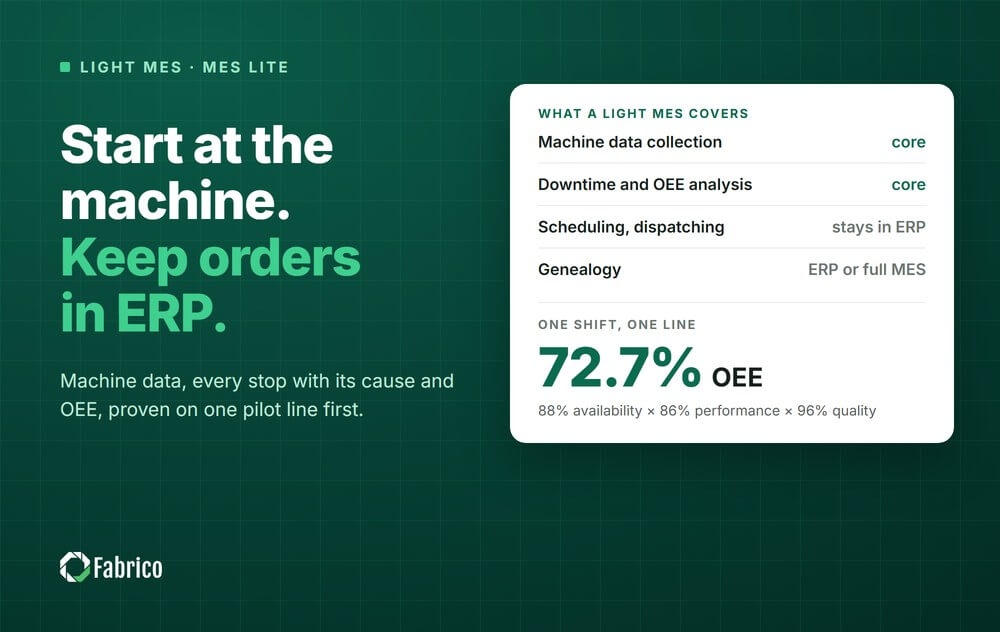

Manufacturers invest heavily in MES and OEE software to understand where time and capacity are lost on the shop floor. Yet for many plants, quality holds, rework and release decisions still sit in spreadsheets, emails or a separate quality system. The result is a fragmented view of performance, where OEE looks solid on paper but yield and customer complaints tell a different story.
When quality holds are managed in the same platform that tracks production and OEE, you see the complete picture: how much good product you actually ship, how long inventory is tied up in quarantine and how often quality events trigger rework, line stops or maintenance. For buyers of MES and OEE software, this integration is becoming essential to getting real value from their data.
OEE is meant to expose availability, performance and quality losses in real time. In practice, many quality losses live outside the OEE platform.
The result: you may know machine uptime and speed, but you do not see how often that output ends up on hold, how long it stays there or how much extra time and material are consumed in rework. To understand why OEE metrics can mislead without quality context, see this discussion of OEE and quality integration.
When quality holds, rework and release decisions are handled in the same cloud-based MES and OEE platform that collects machine data, you unlock several advantages.
Everyone sees the same reality. The line may be running, but if 30 percent of its last shift output is under review, the OEE dashboard reflects that in the quality component, not just in separate quality reports. Production, quality and maintenance teams work from the same live picture.
Built-in tracking of held lots within the OEE and production views shows:
This makes it far easier for plant managers and operations directors to understand exposure to scrap, write-offs and late shipments, and to prioritise where quality resources should focus.
Rework jobs are often treated as separate production orders. In a unified MES and OEE environment, each rework action is tied back to the originating batch, machine and reason code. That allows you to see the true cost of quality events:
For sectors such as consumer packaged goods, where changeovers, packaging material variation and regulatory expectations complicate quality, this linkage is particularly valuable. You can explore this in more depth in the analysis of OEE for CPG manufacturing.
When quality, production and maintenance data are unified, quality leaders can make release decisions based not just on lab results, but also on:
This reduces back-and-forth between teams, shortens hold times and helps avoid both unnecessary scrap and risky concessions.
Fabrico is a cloud-based MES and OEE platform that collects production and downtime data directly from machines, visualises OEE and losses in real time and turns each loss into practical actions for production and maintenance teams. Built-in maintenance management functions mean downtime and quality-related failures can immediately generate appropriate follow-up work, without leaving the platform.
Quality holds, rework and release can be managed inside Fabrico alongside the rest of your production data.
With Fabrico, when a quality event occurs you can:
This ensures that every held unit is traceable to the exact context in which it was produced.
Rework is often an afterthought in performance reporting. Fabrico allows you to:
This level of traceability helps continuous improvement teams quantify the true impact of recurring quality problems and justify corrective investments.
When quality teams are ready to review held product, Fabrico provides the relevant context in one place:
Approving or rejecting a lot moves it cleanly through the workflow, updating both inventory status and performance metrics. You avoid mismatches between what the OEE dashboard says and what is actually available to ship.
Capturing quality holds in the same platform as OEE is only useful if it leads to action. Fabrico links each loss to concrete steps that production and maintenance teams can take to prevent recurrence.
The result is a more effective continuous improvement cycle, where quality data is not just archived but actively used to drive changes in how lines are run and maintained. For a broader discussion of why unified data and intelligence matter in OEE platforms, see the article on choosing OEE software with unified data.
If you are evaluating MES and OEE solutions and you want to unify quality holds with OEE reporting, consider whether the platform can:
Fabrico was built with these requirements in mind, so that plant managers, operations directors, production leaders and maintenance heads can share one operational view and act quickly when quality issues arise.
Separating quality holds, rework and release from OEE creates blind spots that undermine performance programmes. By managing them together in a single MES and OEE platform, you get a truer picture of how your lines run, how much value you create and where you are really losing time and capacity.
Fabrico combines machine data, real-time OEE views, quality hold tracking and built-in maintenance management in one cloud-based environment, so every quality event is tied to its operational context and to clear follow-up actions.
If you are planning your next MES or OEE investment, or looking to connect existing systems and quality workflows, it may be time to bring quality holds into the centre of your performance management approach.
Request a demo or Contact us to explore how Fabrico can support that transition.
See how Fabrico unifies OEE and maintenance in one platform.
Request a demo





 Login
 Blog