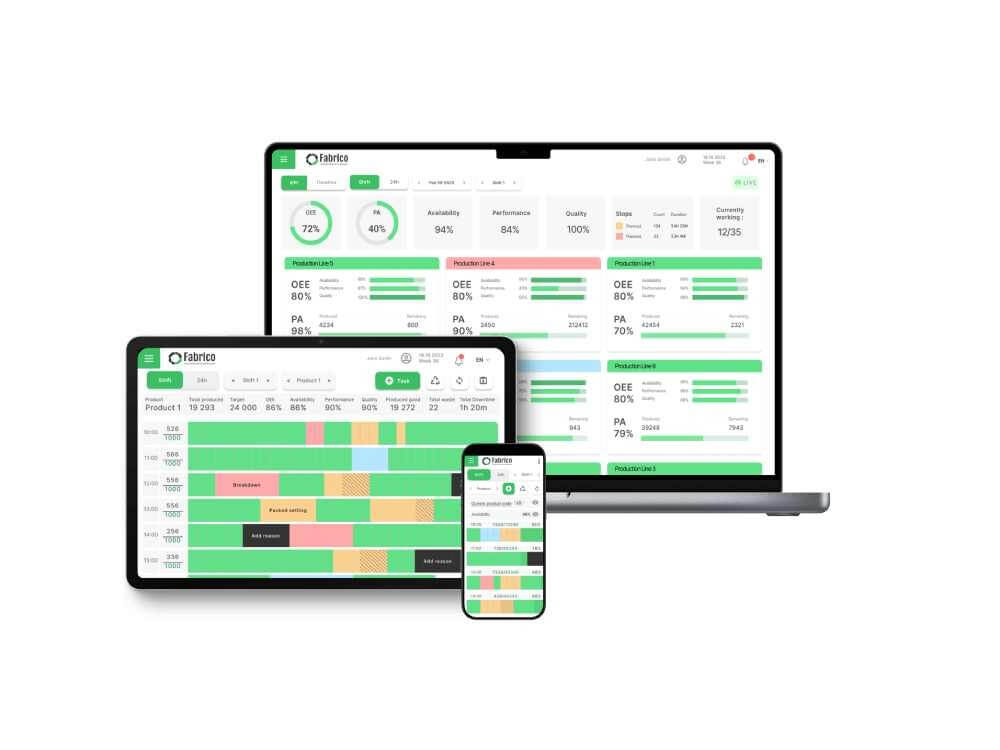
The top CMMS companies for manufacturing in 2026 evaluated here are Fabrico, MaintainX, UpKeep, Limble CMMS, Fiix, IBM Maximo and SAP Plant Maintenance. They differ most in whether the software was built for factory equipment or adapted from generic facilities maintenance, and whether it connects to machine controllers and acts on production data rather than just storing work orders.
New to CMMS? Start with what a CMMS is and how it works.
Key takeaways

Key Takeaways:
Evaluating CMMS companies based on basic features like mobile apps is a strategic error that will cost your factory money.
Most CMMS software companies build their platforms for property managers, entirely ignoring the complexities of high speed manufacturing.
See how Fabrico unifies OEE and maintenance in one platform.
Request a demoWorld class operations evaluate vendors based on their ability to connect directly to machine controllers and automate the repair cycle.
Unifying your Overall Equipment Effectiveness data with a mobile execution platform completely eliminates decision latency.
Transitioning to a platform with quick response code asset tagging drastically increases your preventive maintenance compliance rate.
The seven CMMS companies this review evaluates for manufacturing in 2026 are Fabrico, MaintainX, UpKeep, Limble CMMS, Fiix, IBM Maximo and SAP Plant Maintenance. The article ranks them on how well each fits a factory rather than a generic facility, with Fabrico placed first for connecting directly to machine controllers and acting on production data.
This is one of the three questions the article tells buyers to ask a CMMS vendor before purchasing, because generic platforms built for property management often cannot read machine controllers at all.
A CMMS that connects to PLCs can trigger work orders from real machine performance instead of waiting for an operator to log a fault. Fabrico connects to machine PLCs for OEE and cycle-time data and turns faults into prioritized, parts-ready digital work orders.
The article frames this as a buying question because checklists that are signed off without the work being done leave equipment exposed. Software can reduce pencil whipping by enforcing checklist steps at the point of work rather than trusting a tick-box.
Fabrico uses QR-enforced checklists so a technician completes each step on the asset, and pairs this with computer vision that captures the true cause of downtime. See how the work-order flow works in a Fabrico demo.
Generic CMMS apps struggle in factories because they were designed for property and facilities management, not production equipment, so they store and organise work orders without connecting to the machines or the production schedule.
The article argues effective manufacturing CMMS must connect to machine controllers, trigger work orders automatically from performance data, and understand the production schedule to cut decision latency. The practical gap is between software that records maintenance and software that closes the loop from fault to verified fix.
Keeping OEE and CMMS in one platform matters because it removes the handoff between the team that sees a machine slowing down and the team that fixes it, which is where decision latency builds up.
When real-time OEE and the maintenance system share data, a downtime event can become a prioritized work order automatically instead of being re-keyed across tools. Fabrico combines real-time OEE/MES and a full CMMS in one system so the fault-to-fix loop stays connected.
For European manufacturers, where the CMMS stores machine and maintenance data can matter for GDPR and data-sovereignty requirements, so it is worth asking each vendor directly. CMMS platforms differ in whether data sits in the EU or in another jurisdiction, which affects compliance and procurement reviews. Fabrico is EU-built, with headquarters in Bulgaria, which supports EU data residency for buyers who require it.
If you are tasked with selecting a new maintenance platform, you are likely overwhelmed by the sheer number of vendors on the market. Every software company promises to reduce downtime, eliminate paper workflows, and boost your operational efficiency.
However, these marketing promises often fall apart when tested on a complex factory floor.
The software market is heavily saturated with generic tools. A platform designed to help a hotel maintenance crew fix a broken ice machine is not equipped to manage a high speed stamping press.
You cannot afford to invest in a passive digital filing cabinet. This guide completely redefines how you should evaluate maintenance vendors. It breaks down the top CMMS companies for 2026 and shows you exactly which vendor aligns with your specific operational reality.
The vast majority of CMMS software companies are built by developers who have never worked in a manufacturing environment. They build generic platforms designed for the widest possible audience.
This creates a massive operational blind spot. Generic software forces your maintenance team to operate in a silo, completely disconnected from your live production schedule.
When a machine faults, a generic app waits for a human operator to notice the problem, walk to a computer, and type in a work request.
This manual communication introduces massive decision latency into your factory. Every minute your team spends communicating the problem inflates your Mean Time To Repair.
To maximize your production capacity, you must choose a CMMS company that eliminates the human middleman.
You need one system that turns the data into action. Your chosen vendor must offer direct machine connectivity so that a drop in machine performance automatically triggers a prioritized mobile work order.
Fabrico is engineered specifically for discrete and process manufacturing. It natively unifies real time machine tracking with a field ready mobile maintenance system.
Instead of relying on delayed human reporting, Fabrico connects directly to your existing machine controllers. It can also utilize gateway devices for legacy assets. When a machine hits a specific cycle count or drops in speed, Fabrico automatically generates a condition directed work order.
Technicians scan a code on the physical machine to instantly access digital cleaning and lubrication checklists. For manual assembly stations, Fabrico utilizes computer vision. Overhead cameras detect manual inefficiencies and capture video clips of downtime events for precise visual root cause analysis.
Please note that our artificial intelligence agent for schedule optimization and our generative troubleshooting assistant are currently in beta and on our immediate development roadmap.
Best for: Multi site manufacturing groups that want to tie real time machine performance directly to automated maintenance execution.
MaintainX is a highly popular tool known for its consumer grade mobile interface. The application mimics standard messaging platforms, making it exceptionally easy for frontline workers to learn and adopt.
The software excels at digitizing paper checklists and managing basic safety audits. However, MaintainX is a generalist platform built to serve restaurants, schools, and retail operations.
It is less focused on native production tracking capabilities. It relies entirely on external application programming interfaces rather than direct machine connectivity. This makes it difficult to execute true usage based maintenance on high speed factory floors.
Best for: Small businesses, commercial facilities, and light manufacturing operations looking to eliminate paper checklists.
UpKeep pioneered the mobile first approach to maintenance management. It offers a robust framework for tracking work orders, managing schedules, and controlling basic inventory.
UpKeep performs exceptionally well for commercial real estate, HVAC servicing, and vehicle fleet management. Yet it operates in a silo away from the factory production schedule.
Without a native interactive planning board that reacts to real time machine availability, maintenance tasks in UpKeep frequently collide with critical production runs.
Best for: Facility managers and property groups focused on general asset upkeep rather than unified production efficiency.
Limble provides excellent usability and fast implementation timelines. It gives maintenance managers a solid foundation for organizing preventive schedules and controlling costs.
While Limble is a massive step up from spreadsheets, it remains focused on maintenance workflows rather than machine-level signals. It is not positioned to ingest bill of materials or production routing data.
Because of this disconnect, the software is not positioned to automatically adapt maintenance schedules based on real time production output or unexpected speed degradation.
Best for: Mid sized maintenance teams focused purely on traditional calendar based preventive maintenance.
Fiix is an enterprise grade system backed by Rockwell Automation. It provides unmatched tracking and high level corporate governance for global industrial conglomerates.
Fiix offers deep reporting and specialized industrial integrations. However, the implementation process can be exceptionally lengthy and expensive. The user interface is notoriously complex and desktop heavy.
This complexity creates massive friction on the shop floor, often resulting in poor adoption and inaccurate data entry by technicians.
Best for: Massive industrial operations that require deep reporting and have dedicated teams to manage complex software training.
IBM Maximo is the historical giant of the enterprise asset management space. It provides incredible depth for massive infrastructure planning and highly regulated industries like power generation.
Maximo offers near infinite customization for enterprise reporting. Unfortunately, this scale comes with a massive total cost of ownership. The system is designed for financial accountants rather than frontline mechanics.
Most agile manufacturers find Maximo far too heavy for daily shop floor execution.
Best for: Massive utility companies and heavy infrastructure operations with dedicated information technology teams.
SAP Plant Maintenance is a heavyweight module integrated directly into the broader SAP ecosystem. It provides seamless financial tracking for global conglomerates.
Like Maximo, SAP is built primarily for financial compliance. The desktop heavy interface creates massive friction on the factory floor.
Most modern manufacturers are forced to connect agile mobile platforms like Fabrico to their SAP instance just to bridge this usability gap and get technicians to log their work.
Best for: Global enterprises that require absolute financial integration and are willing to sacrifice frontline usability.
| CMMS Company | Primary Industry Focus | Native Production Tracking | Machine Connectivity | Frontline Usability |
| Fabrico | Manufacturing | Yes | Direct Connect | High (Mobile Native) |
| MaintainX | General Facilities | No | API Only | High (Mobile Native) |
| UpKeep | Property Management | No | API Only | High (Mobile Native) |
| Limble | Field Service | No | API Only | High (Mobile Native) |
| Fiix | Heavy Industrial | Requires Integration | Yes | Moderate (Complex) |
| IBM Maximo | Infrastructure & Utilities | Requires Custom IT | Yes (Complex) | Low (Desktop Heavy) |
| SAP PM | Financial ERP | Requires Custom IT | Yes (Complex) | Low (Desktop Heavy) |
Before you sign a contract with a software vendor, you must force them to answer these three critical manufacturing questions.
1. Does your platform connect directly to my machine controllers?
If the vendor relies entirely on manual data entry or third party middleware, you will suffer from decision latency. You need a platform that reads actual cycle counts to trigger usage based maintenance.
2. How does your software prevent preventive maintenance pencil whipping?
If the software only requires a single checkmark to close a work order, your data is compromised. You need digital audit trails equipped with user credentials and geolocation to guarantee the work was performed.
3. Does your system understand my production schedule?
If the CMMS operates in a vacuum, your maintenance tasks will continuously interrupt your production runs. You need an interactive planning board that merges machine availability with your bill of materials and routing data.
Treating your maintenance department as a disconnected cost center is a massive strategic failure. Generic CMMS companies will digitize your paper processes, but they will not reclaim your lost factory capacity.
To maximize your revenue, you must partner with a software vendor that speaks the language of manufacturing. By unifying real time machine data with a mobile execution system, you empower your technicians to act instantly.
This connected approach eliminates data silos and transforms your maintenance operations into a true competitive advantage.
See Fabrico live. Request a demo.
Request a demoCurious what honest, real-time OEE looks like on your floor?
Request a demo

























Programați o întâlnire individuală cu experții noștri sau înscrieți-vă direct în planul nostru gratuit.
Nu este nevoie de card de credit!






 Login
Login
 Blog
Blog