Best Real-Time Production Monitoring Software: 7 Tools Compared (2026)
04 Feb 2026
11 min.
Production monitoring software compared: Fabrico's MES and OEE platform, Guidewheel, L2L, Mingo, Shoplogix, Sight Machine and Worximity, with 5 real-time tests.
Contents:
TL;DR
Production monitoring software records what every machine is doing as it happens: running, stopped, slow, and how many parts it made. This guide compares 7 tools, including Fabrico, and gives you 5 tests for what "real time" has to mean on your shop floor before you choose one.
"Real time" only helps if the data arrives while the shift can still react, and if short stops are captured instead of averaged away.
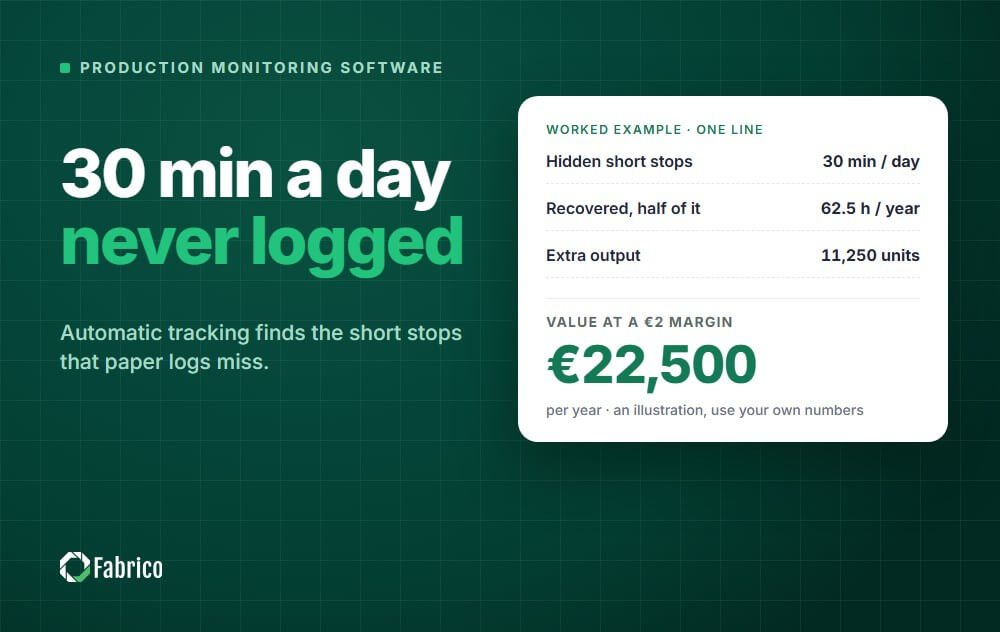
Automatic tracking can show stops that paper logs miss. The worked example below turns 30 hidden minutes a day into a business case.
Each vendor description is based on the vendor's own website, checked in September 2026. The "Things to consider" notes are our own suggestions, and Fabrico is our product.
Run a 30-day pilot on one bottleneck machine with a written scorecard before you roll anything out.
What is production monitoring (production tracking) software?
Production monitoring software collects data from manufacturing equipment and shows it on live dashboards, so supervisors, operators and maintenance see the same picture during the shift.
Most tools track machine state, part counts, cycle times and stops, and calculate OEE from them, which is why the category overlaps with OEE monitoring software.
Production tracking software is a closely related term. It often puts more weight on orders, jobs and operator input, while monitoring puts more weight on machine data.
Start with state and counts, because they are automatic and hard to argue with.
Add stop reasons next, using a short list, as our guide to downtime reason codes explains.
Manual tracking vs production tracking and reporting software
Paper or spreadsheet
Production monitoring software
When you see a loss
After the shift, or the next day
While it is happening
Short stops
Rarely written down
Captured from machine data
Accuracy of durations
Rounded, often from memory
Timestamped events
Effort for operators
Writing and adding up
Picking a stop reason
Cost to start
Very low
Software, and sensors for machines without a usable signal
Manual tracking is a good way to start the habit. It stops being enough once you need to find the losses nobody writes down.
Worked example: the business case for one line
Here is a simple way to size the value before you buy anything. The numbers are an illustration, so replace them with your own.
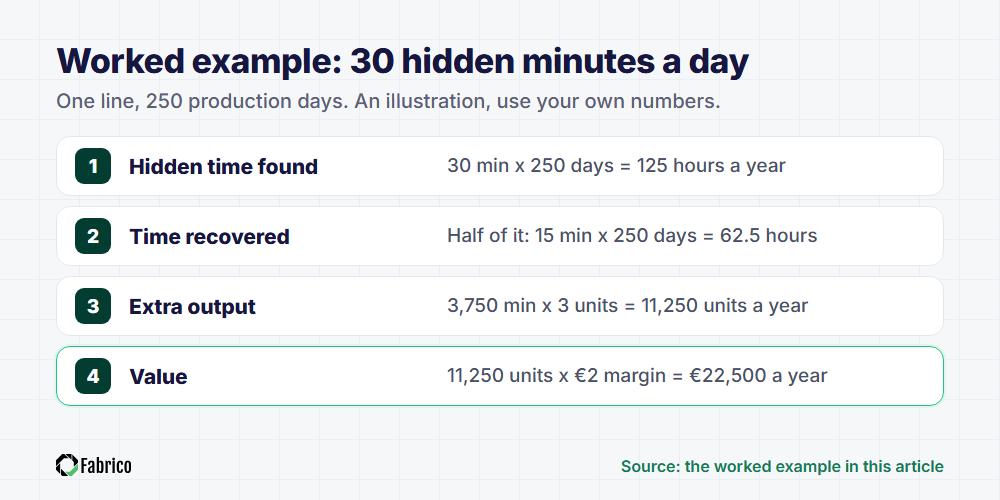
From 30 hidden minutes a day to a yearly value. An illustration: replace the numbers with your own.
Item
Value
Line speed at the ideal cycle time
3 units per minute
Short stops found by automatic tracking, not in the paper log
30 minutes per day
Share you expect to remove in the first year
Half, so 15 minutes per day
Production days per year
250
Contribution margin per extra unit sold
€2
Hidden time found: 30 × 250 = 7,500 minutes, or 125 hours a year.
Time recovered: 15 × 250 = 3,750 minutes, or 62.5 hours a year.
Extra output: 3,750 × 3 = 11,250 units a year.
Value: 11,250 × €2 = €22,500 a year, if you can sell the extra units.
If the plant cannot sell more, value the recovered time as avoided overtime or a shift you no longer need. Then compare the result with the full cost of the system, including sensors and the time your team spends on it.
7 real-time production monitoring and intelligence tools at a glance
We picked tools that sell real-time production monitoring or production intelligence on their own websites, checked on 17 September 2026.
Fabrico is listed first because it is our product. The other six are listed in alphabetical order, not ranked.
Sources: each vendor's public website, checked on 17 September 2026. Product names are trademarks of their owners.
Features change often, so confirm details with each vendor.
Tool
Data and maintenance, per the vendor
Fabrico
Data: PLCs, IoT sensors and AI cameras Maintenance: Full CMMS built in
Guidewheel
Data: Clip-on sensors that read a machine's electrical signature, plus operator input at the line Maintenance: Maintenance requests from the floor, and actions triggered through your CMMS
L2L
Data: PLCs, SCADA, IIoT devices and operator entry Maintenance: Its own CMMS
Mingo Smart Factory
Data: PLC hardware, retrofit sensors and operator entry Maintenance: CMMS integrations, naming Fiix and UpKeep
Shoplogix
Data: Machine signals, PLCs, sensors and OPC, plus operator reason entry Maintenance: Its own Maintenance (CMMS) module
Sight Machine
Data: Controls, historians, MES and ERP Maintenance: Predictive maintenance recommendations
Worximity
Data: Sensors, PLCs and APIs, plus operator input Maintenance: CMMS integration through APIs, plus maintenance forms
1. Fabrico
Disclosure: Fabrico is our product.
What it is: an OEE platform with a full CMMS built in, so the losses you track and the maintenance work that fixes them sit in one system.
How it tracks production
Connects to machines through PLCs, IoT sensors and AI cameras, so machines without a usable control signal can be tracked too.
Calculates OEE in real time, with availability, performance and quality for every machine.
Detects micro stops and shows downtime, MTTR and MTBF by machine, with Excel export.
Sends push, in-app and email notifications based on rules you configure.
Includes an AI assistant and multi-plant views with cross-plant benchmarking.
Connects to SAP PM, to other ERP systems through custom integrations, and to your own tools through a REST API and webhooks.
Maintenance
Your team can open work orders, run recurring preventive maintenance, manage spare parts and use approval workflows in the same platform.
Technicians use the iOS and Android apps and scan QR codes on machines. Fabrico is certified to ISO 27001, ISO 9001 and ISO 20000-1 and hosted on AWS in the EU.
Things to consider
Production scheduling is on Fabrico's roadmap, not in the product today. Plan scheduling in your ERP or a dedicated tool.
Machines without a usable signal need a sensor or camera first. Include that in your rollout plan.
2. Guidewheel
What it is: Guidewheel calls its platform FactoryOps and says it "gives your team machine intelligence, real-time visibility, and the AI-ready data layer that drives profitability."
How it tracks production
Guidewheel says its sensor "clips around a machine's power conductor and reads its electrical heartbeat, so you see run, idle and down in real time."
According to Guidewheel, this means "there is no need for PLC access or control-system changes."
Guidewheel says operators or supervisors "tag the reason in a few taps, on a stop the sensor has already recorded".
Guidewheel lists real-time OEE by machine and by plant, cycle and cycle time tracking, planned vs actual production, and mobile alerts.
Maintenance and integrations
Guidewheel describes maintenance requests from the floor, and its site lists "Trigger maintenance actions through your CMMS" as an option.
It says it integrates natively with SAP and connects to ERPs such as Oracle, Epicor and Microsoft Dynamics, plus CMMS, MES and BI tools, through Workato and an open API.
Things to consider
Guidewheel says its sensors reach the cloud "over ethernet, WiFi or LTE, depending on what the site already has". Ask your IT team which option fits your plant.
Guidewheel names executive leaders, maintenance teams and continuous improvement among the roles it serves. Agree who owns the pilot on your side.
3. L2L
What it is: L2L describes itself as a Connected Manufacturing Operations Platform that combines "operational data and AI to drive real-time action on the shop floor".
How it tracks production
L2L says it captures data through "manual inputs from operators via the Operator Portal or Console, automated machine signals, and direct integration with existing systems like ERP and MES."
It describes connections to PLCs, SCADA systems and IIoT devices to automate OEE calculations and downtime tracking.
L2L lists real-time OEE tracking, digital production boards and live run rates across lines and sites.
According to L2L, you can start tracking with operator entry before a full connectivity rollout is complete.
Maintenance and other modules
L2L describes its own CMMS, with preventive maintenance based on time intervals or usage cycles and QR code access to equipment history.
L2L also lists scheduling, digital work instructions and in-platform AI guidance it calls Execution AI.
Things to consider
L2L says its platform covers downtime tracking, maintenance, production goals and frontline skills. Agree which modules your first phase needs.
L2L says it connects with ERP systems like Oracle and SAP. Confirm the connection for the ERP you run.
4. Mingo Smart Factory (now part of Nulogy)
What it is: Mingo describes itself as "a manufacturing productivity and analytics platform that provides visibility into the data from machines, devices, and people and puts it all into context." Its site says Mingo is now a Nulogy company.
How it tracks production
Mingo lists three ways to connect: hardware for existing controllers or PLCs, sensors or wireless nodes to retrofit machines, and, in areas with no machines, operator entry on PCs or tablets.
Mingo says its IoT Edge Platform connects machines to the cloud and stores data if the internet connection goes down.
Mingo lists real-time tracking of availability, performance, quality and downtime, plus scoreboards, operator screens and automatic shift reports.
Mingo says its mobile app for iOS and Android shows downtime alerts, OEE, cycle times and target vs actual counts.
Maintenance and integrations
Mingo describes integrations with CMMS systems, naming Fiix and UpKeep, and says work order requests can be triggered "directly from Mingo."
It offers a managed integration service that, in its words, "connects with most ERP systems", plus an open API.
Things to consider
Mingo says it runs its software "in a dedicated public cloud (AWS) environment". Share that with your IT team early.
Mingo's industry list includes food and beverage, plastic packaging, metal stamping and injection molding. Ask for an example from a process like yours.
5. Shoplogix
What it is: Shoplogix describes a cloud-based platform "that provides manufacturers with real-time data presented in user-friendly visual dashboards". It says it is part of the Constellation Software family.
How it tracks production
Shoplogix says its OneSignal approach turns "part count signals into meaningful production insights for your operation teams."
It says it can use data from PLCs, sensors or OPC protocols, and that it works with any machine "regardless of age or communication protocol".
Shoplogix says operators pick downtime and scrap reasons from a dropdown list, and it lists hour-by-hour OEE in real time.
Shoplogix describes a Digital Andon for real-time alerts and escalation, and an AI assistant called Pulse AI.
Maintenance
Shoplogix describes a Maintenance module with "core CMMS capabilities such as creating, assigning, and scheduling work orders, tracking maintenance history, and logging repair tasks."
It says preventive maintenance can be scheduled on real usage, based on production throughput and run speeds.
Things to consider
Shoplogix lists several modules and add-on sensors. Agree which ones your pilot needs.
Shoplogix says it integrates with common ERP and MES solutions. Confirm the connection for the systems you run.
6. Sight Machine
What it is: Sight Machine presents itself as an agentic manufacturing platform, which it launched in June 2026. Its homepage describes "Agent-powered manufacturing that continuously finds more output, eliminates more waste, and improves with every run".
How it tracks production
Sight Machine says it connects to plant systems such as "controls, historians, MES, ERP, and document repositories".
It says its platform turns raw signals into production events and KPIs, and that agents watch fault signals, event counts and timing patterns.
According to Sight Machine, findings arrive as recommendations in tools such as Microsoft Teams, Microsoft Excel or a kiosk on the floor.
Maintenance
Sight Machine describes agents that monitor signals such as spindle load, vibration and tool wear to surface predictive maintenance recommendations.
Things to consider
Sight Machine says its manufacturing intelligence "flows across the enterprise stack, linking production to supply chain, logistics, and demand". Agree which of those areas your first phase covers.
Sight Machine says each deployment is "single-tenant by design, with its own database, namespace, and keys". Your IT team will want that detail for its review.
7. Worximity
What it is: Worximity sells "OEE and real-time production monitoring that boosts efficiency, improves profitability and empowers your manufacturing workforce", together with continuous improvement coaching.
How it tracks production
Worximity says sensors collect line counts or events and send them to its IoT device, and that data can also come from newer equipment through PLCs.
Its FAQ says the connection device needs power and a machine signal from a PLC, an API or a photoelectric sensor.
Worximity lists real-time OEE, line status, shop floor displays, alerts when lines are down and regular performance reports.
Worximity says operators can justify unplanned downtime in a few clicks, and that Worximity Forms works on phones, tablets and PCs.
Maintenance and integrations
Worximity says push and pull APIs exchange data with back-office systems "like an ERP, MES and CMMS."
Its Forms module lists uses such as "Preventive maintenance checklists, calibration logs, parts requests".
Things to consider
Worximity says it connects to BI platforms "like Power BI or Tableau". Ask which reports your team would build there.
Worximity's industry list includes food and beverage, packaging and co-manufacturing, CPG and machining. Ask to see a reference from a similar line.
Questions to ask in every demo
How do you connect to our oldest machine, the one without a usable PLC signal?
Can you show the raw stop events for one shift, with start and end times?
What is the shortest stop your system records on our type of machine?
How does an operator enter a stop reason, and how long does it take?
Who is notified about a long stop, and through which channel?
Who turns a long stop into maintenance work, and in which system is that work tracked?
Which ERP and other systems do you connect to, and is there an API?
Where is our data hosted, and which security certifications do you hold?
What does a pilot include, and what do we need to prepare?
Can we export our data if we leave?
A 30-day pilot scorecard
Pick your bottleneck machine, agree on the criteria below before the pilot starts, and score the tool at the end.
Criterion
Pass when
Count accuracy
The system's count matches a manual count over a full shift
Stop capture
Short stops you trigger on purpose appear as separate events
Reason coverage
Most stop minutes above your threshold have a reason by the end of each shift
Adoption
Operators enter reasons without daily reminders
Action
The team has fixed at least one loss it found in the data
Trust
The supervisor uses the dashboard in the daily meeting instead of the paper log
Testing on your hardest machine shows a tool's limits early. Our daily OEE meeting guide shows how to use the data once it is trusted.
To see how Fabrico tracks production in real time, with maintenance work in the same platform, request a demo.
Frequently asked questions
What is the difference between production tracking and production monitoring?
Production tracking often focuses on orders, jobs and operator input. Production monitoring focuses on machine data collected automatically.
Many tools cover both, so check what each one captures on your machines.
What does real-time production monitoring mean?
It means machine state and counts update within seconds, every stop is recorded with a start and end time, and the right people see it during the shift.
Can production monitoring software work with old machines?
Often, yes. Machines without a usable control signal can be connected with sensors or cameras, depending on the tool.
Ask each vendor to show the method on your oldest machine.
How long does a production monitoring pilot take?
Plan about 30 days for one machine. That is enough time to check the counts, capture the stops, build the habit of entering reasons and fix a first loss.
What is real-time production tracking software?
It is production tracking software that records output, stops and job progress as they happen, from machine signals and operator input.
Use the five tests in this guide to check whether a tool's tracking is truly real time.
See how Fabrico unifies OEE and maintenance in one platform.
By clicking the Accept button, you are giving your consent to the use of cookies when accessing this website and utilizing our services. To learn more about how cookies are used and managed, please refer to our
Privacy Policy and
Cookies Declaration
We use cookies to personalise content and ads, to provide social media features and to analyse our traffic. We also share information about your use of our site with our social media, advertising and analytics partners who may combine it with other information that you’ve provided to them or that they’ve collected from your use of their services.
Necessary cookies help make a website usable by enabling basic functions like page navigation and access to secure areas of the website. The website cannot function properly without these cookies.
Statistics
Statistic cookies help website owners to understand how visitors interact with websites by collecting and reporting information anonymously.
Marketing
Marketing cookies are used to track visitors across websites. The intention is to display ads that are relevant and engaging for the individual user and thereby more valuable for publishers and third party advertisers.
Cookies are small text files that can be used by websites to make a user's experience more efficient.
The law states that we can store cookies on your device if they are strictly necessary for the operation of this site. For all other types of cookies we need your permission. This means that cookies which are categorized as necessary, are processed based on GDPR Art. 6 (1) (f). All other cookies, meaning those from the categories preferences and marketing, are processed based on GDPR Art. 6 (1) (a).
This site uses different types of cookies. Some cookies are placed by third party services that appear on our pages.
You can at any time change or withdraw your consent from the Cookie Declaration on our website.
Learn more about who we are, how you can contact us and how we process personal data in our Privacy Policy.












 Login
Login
 Blog
Blog