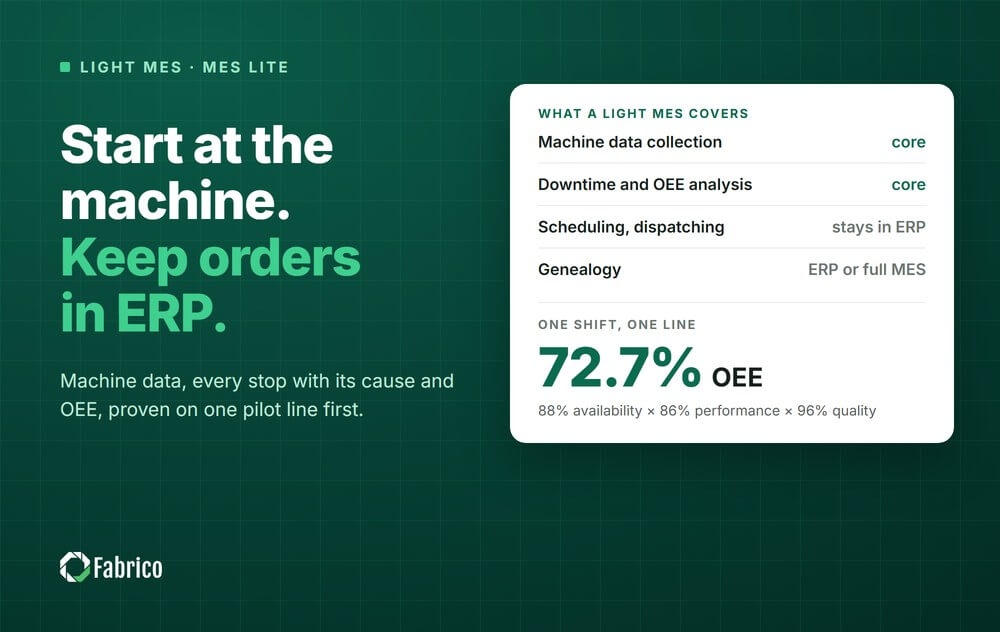

Manufacturing labor is too valuable to plan on guesswork. When production plans are built on yesterday’s numbers and manual reports, shift staffing and overtime decisions quickly drift away from what is really happening on the shop floor. Live OEE data and machine signals change this, giving plant leaders a direct view of where every hour of labor actually adds value.
Fabrico is a cloud-based MES and OEE platform that captures production, downtime and quality data straight from machines, then connects that information to maintenance and production workflows. With live OEE and labor insight in one place, you can align staffing and overtime to real-time conditions instead of static standards.
Most plants still rely on spreadsheets, ERP schedules and shift reports to decide who works where and when. That approach introduces several problems:
The result is familiar: some lines overstaffed while others struggle, overtime used to chase avoidable losses, and no clear feedback loop between labor decisions and OEE performance.
With Fabrico, machines feed production counts, cycle times and downtime events directly into the platform. OEE is calculated in real time, with losses broken down by equipment, product, shift and reason. This live view becomes a practical tool for labor planning in several ways.
Standard rates and routings are useful for planning, but they rarely reflect what is actually happening on each asset. Live OEE and speed data let you see which lines:
This helps you distinguish between capacity limited by physics and capacity limited by losses. You can then allocate operators, technicians and support staff where they unlock real output, rather than simply filling headcount targets.
For a deeper look at how continuous insight into asset performance shapes daily decisions, see this article on real-time OEE.
Overtime is one of your most expensive levers. With a live OEE lens, overtime decisions become far more targeted:
Because Fabrico connects production losses to predefined maintenance and production actions, overtime discussions can include not only “how many hours” but also “what problems must we remove so that we need less overtime next month.”
Long-term labor planning is important, but many of your biggest gains come from better decisions inside each shift. Live production and downtime data gives supervisors a factual basis for those calls.
With real-time OEE and throughput information by line and product, you can see within minutes when one area is falling behind and another is ahead of plan. Instead of waiting for end-of-shift numbers, supervisors can:
Because Fabrico’s built-in maintenance management is integrated, operators can also raise issues from the same environment that shows their line performance. When certain tasks recur, you can plan targeted support on specific shifts, for example assigning a mechanic for the first hour after startup when stoppages are most likely.
Night and weekend shifts often run with thinner staffing and less technical support. Live OEE data across shifts reveals patterns that justify focused labor investments:
Instead of defaulting to blanket shift premiums or broad overtime coverage, you can add targeted labor where it empirically changes OEE.
Unreliable assets undermine even the best staffing plan. Fabrico’s integrated maintenance capabilities ensure that the same live data you use for OEE and labor decisions also drives maintenance priorities.
When a machine logs repeated minor stops or speed losses, Fabrico can create or suggest specific maintenance actions tied to that pattern. This allows you to:
Over time, you can shift from firefighting to planned work that reduces the need for unplanned overtime and extra shift coverage. For more insights on how live equipment data and IoT connectivity support this evolution, explore how Fabrico drives OEE excellence through IoT and smart manufacturing.
A labor and OEE strategy only works if people can see it and act on it. Fabrico provides a single environment where managers, supervisors, maintenance and operators see:
With this shared view, shift handovers become sharper. Outgoing teams can point to specific events and actions, and incoming teams know where to focus. Operations leaders can compare how different staffing models, skill mixes or overtime strategies affect OEE over time, then standardize the approaches that work.
To see how this looks in practice, including examples of OEE dashboards and loss analysis, review the overview article on unlocking smarter manufacturing with Fabrico OEE.
Shifting from static schedules to live-data-driven decisions does not require a disruptive overhaul. Many plants start with a few practical steps:
Once the pilot area shows consistent improvement, you can extend the same approach to more lines and more sites, always grounded in live machine data rather than assumptions.
For manufacturers evaluating MES and OEE platforms, several capabilities are especially important for labor planning and overtime control. Fabrico is designed to support these needs through:
By combining these capabilities in a cloud-based platform, Fabrico gives operations leaders a practical way to link daily labor choices to hard OEE results.
Labor, equipment and materials are your three largest levers. OEE connects the first two, showing exactly how the way you staff and maintain your lines affects actual output. When that information flows directly from machines and is visible during the shift, decisions about who works where and when become sharper, faster and easier to justify.
Fabrico helps manufacturers move from static plans to a living, data-driven model of labor planning and overtime control. With accurate OEE, integrated maintenance actions and clear visibility for every role, your teams can focus their time and budget where it truly improves throughput and reliability.
See how Fabrico unifies OEE and maintenance in one platform.
Request a demo






 Login
 Blog