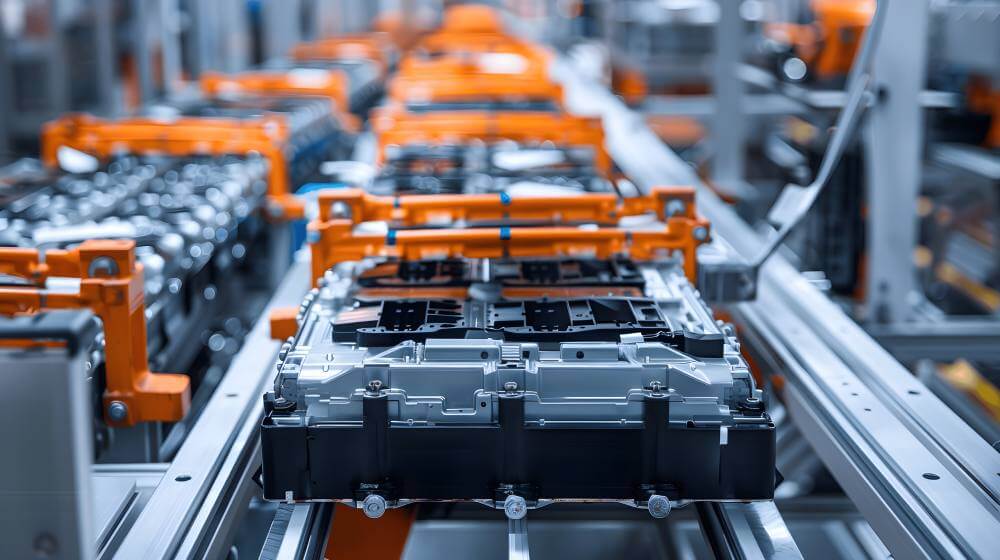

Battery charging room safety covers the hazards concentrated where forklift and industrial batteries charge: hydrogen gas evolved during charging, electrolyte acid, high-current DC connections, and multi-hundred-kilogram batteries moving on rollers and hoists. Charging areas are easy to treat as parking, and everything dangerous about them is invisible until it is not.
Lead-acid batteries release hydrogen while charging, most vigorously near the end of charge.
Hydrogen is colorless, odorless, rises immediately, and becomes ignitable at about 4 percent in air, which is why every code on the subject converges on the same trio: ventilation engineered for the worst-case charging load (with air changes or extraction verified
not assumed), ignition control in the ceiling zone where hydrogen collects, and in many designs hydrogen detection alarming well below the flammable limit, maintained under the same discipline as any gas detection .
A charging room serves 12 forklift batteries overnight. Design ventilation: an extraction fan cycling on charger interlock, sized so hydrogen never exceeds 1 percent at ceiling level under all-chargers-on conditions.
During a quarterly check (this is exactly fan maintenance with higher stakes), measured airflow is down 40 percent, a belt slipping and a grille packed with dust. Arithmetic: at 60 percent flow with all chargers finishing simultaneously, ceiling concentration can plausibly cross 2 percent, one bad night from the ignition range.
The fix is a belt, a cleaning, and an airflow re-check, an hour of work. The alternative failure mode has its own name in loss reports: charging room roof displacement.
Fabrico keeps the room’s invisible systems provably alive: the ventilation fan, hydrogen detectors, chargers, eyewash, and handling gear registered as assets with inspection and test schedules; airflow readings and detector tests recorded with values; defects escalating at safety priority; and the charging-equipment history that turns this room from a dark corner into a maintained system.
Fabrico does not design ventilation or set code requirements; engineers do, and Fabrico makes their assumptions keep being true. EU-built, with EU data residency.
Scale the engineering, keep the logic: even two batteries charging in a corner produce hydrogen and hold acid. Ventilation adequacy, ignition control, eyewash access, and connector condition apply at every size; the paperwork burden scales, the physics does not.
Function checks on a monthly route (fan runs, interlocks work, grilles clear) and measured airflow verification at least annually or per your risk assessment, plus immediately after any fan or ductwork repair. A ventilation system that only looks like it works is the room’s most dangerous component.
Distributed fast charging moves the hydrogen and electrical questions out of one room and into many points: each station needs the same review, ventilation adequacy of the general area, connector condition, and clearance from combustibles and traffic.
Want the charging room’s fans, detectors, and eyewash on schedules that never slip? Book a Fabrico demo to see high-consequence facility care run through a field-ready CMMS.

Zakažite sastanak KSNUMKS-to-KSNUMKS sa našim stručnjacima ili se direktno upišite u naš besplatni plan.
Nije potrebna kreditna kartica!






 Login
Login
 Blog
Blog