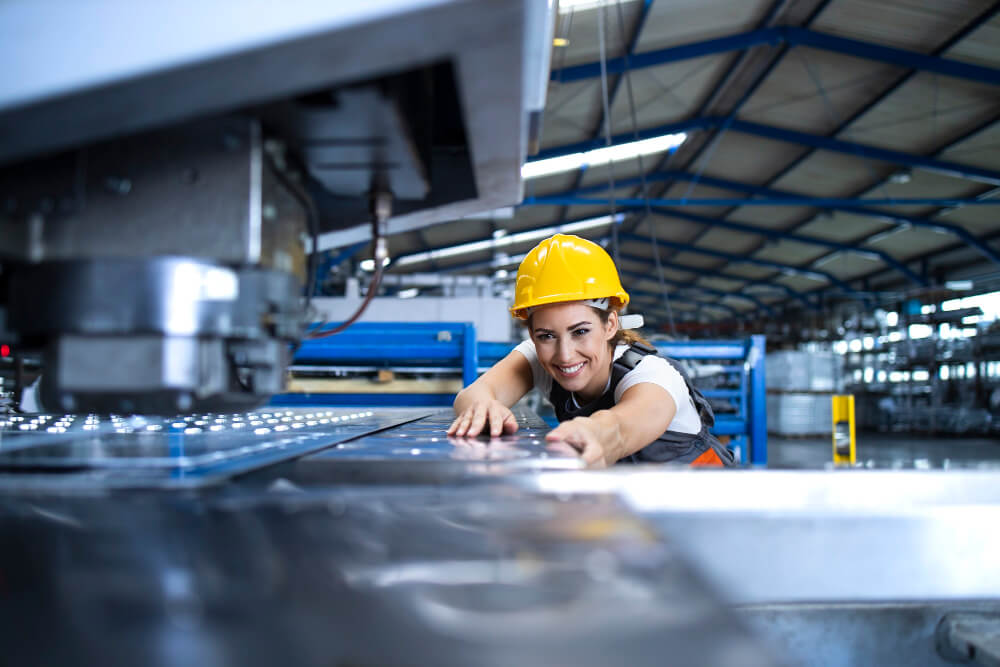

Machine guarding is the family of physical barriers and protective devices that keep body parts out of moving machinery: fixed covers over rotating shafts, interlocked doors on enclosures, light curtains across load points, two-hand controls on presses. Caught-in and struck-by injuries remain among the most severe in manufacturing, and nearly all of them happen where a guard was missing, inadequate, or defeated.
Guards are defeated for predictable reasons: the interlock adds thirty seconds to a task done forty times a shift; the fixed guard blocks the jam point operators must clear hourly; the light curtain trips on package overhang. Every bypass is information: the guard design is fighting the work instead of protecting it.
The durable fix is engineering, a viewing window, a tool-accessible clearing port, a muting function designed for the material flow, not another toolbox talk about the taped-over sensor.
A case packer’s door interlock fails intermittently. Instead of a work order, someone jumpers it, and the machine runs for six weeks with a live hazard behind an unlocked door. The eventual outcome in this case was fortunate: an auditor found the jumper before anyone was hurt.
The consequences were still real: production stopped immediately for 14 hours pending repair and inspection, versus the 2 hours the original repair would have taken, and the plant spent weeks under enhanced scrutiny. The arithmetic never favors the jumper; it only feels that way on the shift where the sensor first fails.
Guards, interlocks, and light curtains fail like everything else: switches drift, actuators crack, curtains lose alignment.
Safeguarding therefore belongs in the maintenance program: periodic function checks on interlocks and presence-sensing devices, guard integrity walks on a route, and immediate repair priority when a safeguard fails, because during the failure window the plant is running on the administrative controls alone.
Maintenance tasks themselves interact with guarding through LOTO : removing a guard is exactly the moment isolation discipline matters most.
Fabrico does not design or certify guards; machine safety engineers do that against the applicable standards. Fabrico gives the guarding program operational teeth: interlock and curtain function tests as recurring work orders with pass/fail evidence, safeguard defects flagged at top repair priority, guard-related downtime coded honestly so the cost of poor access design becomes visible, and the repeat-offender machines exposed by their own history. EU-built, with EU data residency.
The devices on the movable guards deserve their own attention: our guide to machine guard interlocks covers the ISO 14119 types, defeat prevention and the in-service checks.
When access behind it is rare, roughly, needed less often than maintenance intervals. Frequent access through a fixed guard guarantees it will eventually stay off; that is interlock territory, or better, a redesign of why access is needed at all.
They are different tools. Curtains protect while allowing material flow and frequent access, but they depend on correct mounting distance, response time, and control integration. A properly specified physical barrier has fewer failure modes; a properly engineered curtain enables work a barrier would obstruct.
Per the manufacturer and your risk assessment, commonly monthly to annually depending on exposure and duty. The non-negotiable part is that the interval exists, is scheduled, and produces a record, an untested interlock is a hope, not a control.
Want safeguard checks scheduled, evidenced, and impossible to quietly skip? Book a Fabrico demo to see how a field-ready CMMS keeps engineering controls real.

Zakažite sastanak KSNUMKS-to-KSNUMKS sa našim stručnjacima ili se direktno upišite u naš besplatni plan.
Nije potrebna kreditna kartica!






 Login
Login
 Blog
Blog