

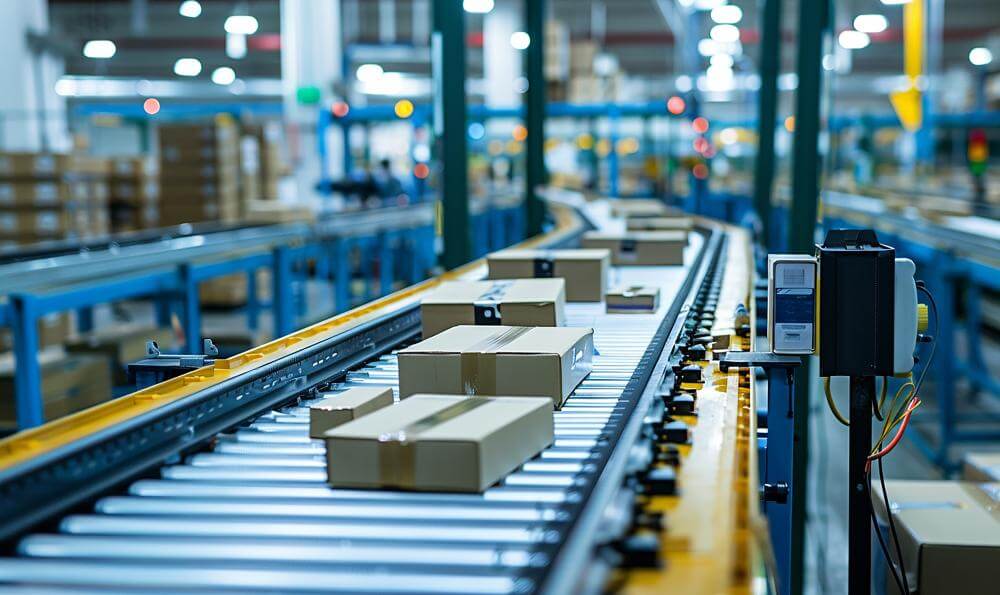

VDA 5050 is a standardized communication interface, published by the German Association of the Automotive Industry (VDA) together with the machinery federation VDMA, that lets automated guided vehicles (AGVs) and autonomous mobile robots (AMRs) from different manufacturers run under one shared master control system.
First released in 2019 and now in its 2.x generation, it defines exactly how a central controller sends transport orders to vehicles and how vehicles report status back, using MQTT messaging with JSON payloads.
It was born on automotive shop floors where three or four robot brands per plant had become normal, and each vendor's software refused to talk to the others. Today it is the de facto European answer to vendor lock-in in intralogistics automation.
Few factories buy every mobile robot from one vendor. Pallet movers, tugger trains, and case-handling AMRs come from different specialists, and expansions add more brands over time. Before VDA 5050, each vendor shipped its own proprietary fleet manager, which created three chronic headaches:
The standard specifies the message contract between a master control system and each vehicle. Communication runs over an MQTT broker, with topics structured by manufacturer and vehicle serial number, for example uagv/v2/vendorX/AGV-042/order. Six channels carry all traffic:
Functional safety stays out of scope: emergency stops and personnel detection remain on the vehicle and are governed by standards such as ISO 3691-4.
VDA 5050 describes every transport job as a graph. Nodes are positions where something happens (pick, drop, charge, wait) and edges are the connections the vehicle travels along. The master control releases the route in two parts. The base is the confirmed portion the vehicle may execute immediately.
The horizon is a preview of what will probably come next, which the controller can still change as traffic evolves. This lets one controller weave vehicles from different vendors through shared aisles, releasing edges one at a time at busy intersections.
In return, each vehicle publishes its state message whenever something meaningful changes and at a regular heartbeat interval, so the controller always knows where every robot is, what it carries, and which errors are active.
Consider a plant running three isolated fleets. Vendor A's pallet AGVs peak at 40 transports per hour, vendor B's tuggers at 35, and vendor C's AMRs at 30. The average transport cycle is 8 minutes, and each fleet is sized for a maximum of 85 percent utilization to allow for charging and surges.
One VDA 5050 master control serves the same demand with 14 vehicles instead of 18, a 22 percent smaller fleet, plus fewer chargers and one integration to maintain instead of three. The savings come purely from pooling capacity that vendor silos kept apart.
The standard is an interface, not a brain. It does not plan routes, resolve traffic, or assign jobs; that intelligence lives in the master control software you choose.
Map formats and navigation methods remain largely vendor-specific, and version compatibility matters: a vehicle speaking version 1.1 exposes fewer capabilities than one on 2.x, so check each vendor's factsheet support and conformance testing (VDMA's AGV Mesh-Up events exist precisely to verify real interoperability).
It also does not connect your fleet to production systems; that vertical integration is still your project.
The deeper lesson of VDA 5050 applies beyond vehicles: heterogeneous equipment becomes manageable the moment it reports into one data layer, the same philosophy behind SCADA for fixed machinery.
A unified state feed lets you compute MTBF and MTTR per vehicle regardless of brand, trigger condition-based maintenance from error codes and battery health, and trace line availability losses back to material starvation when the fleet falls behind. Without that layer, every equipment silo hides its own downtime story.
Fabrico is the real-time data foundation for the production side of that picture. Its real-time OEE and production monitoring shows immediately when a cell starves because transport is late, turning fleet problems into visible availability losses on the OEE dashboard rather than anecdotes.
Its CMMS manages work orders, assets, preventive schedules, and spare parts for the whole ecosystem around your fleet: charging stations, transfer conveyors, dock doors, and the vehicles themselves as maintainable assets. Machines without a PLC can be monitored with computer vision, so older equipment joins the same data layer.
And like VDA 5050 itself, Fabrico is EU-built, with EU data residency.
No. It originated with German automotive manufacturers and the VDMA, but the interface is industry-agnostic and is now used in general manufacturing, warehousing, and logistics wherever mixed fleets need one controller.
VDA 5050 is only the common language. The fleet manager, called master control in the standard, is the software that plans routes, assigns jobs, and manages traffic. The standard guarantees vehicles understand the orders; it does not make those orders smart.
Yes. The standard supports both fixed-path AGVs and free-navigating AMRs by expressing routes as nodes and edges that the vehicle interprets with its own navigation. Confirm in the vendor factsheet which capabilities and standard version each model supports.
Want one real-time view of every machine and line your fleet feeds? Book a Fabrico demo and see your production data unified in days, not months.













Programați o întâlnire individuală cu experții noștri sau înscrieți-vă direct în planul nostru gratuit.
Nu este nevoie de card de credit!






 Login
Login
 Blog
Blog