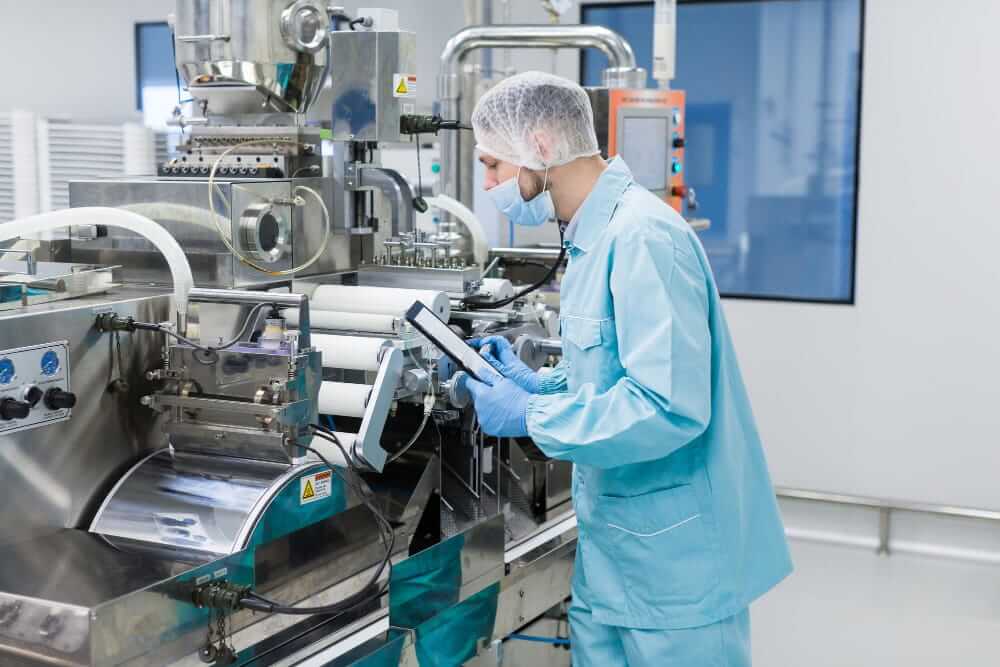
SCADA (Supervisory Control And Data Acquisition) is an industrial control system that gathers real-time data from sensors and machines across a facility, displays it to operators, and lets them supervise and adjust equipment remotely. It combines field devices, controllers, communication networks, and software to monitor and control physical processes at scale.
SCADA gives operators a live window into physical processes and the controls to act on what they see. Rather than walking the floor to read gauges, a control room team watches values stream in and issues commands from a single screen. A typical SCADA deployment handles four core jobs:
SCADA is common in utilities, water treatment, oil and gas, energy, and discrete and process manufacturing, anywhere geographically spread or safety-critical processes need continuous oversight.
A SCADA architecture is layered, moving from physical devices up to operator software. The main building blocks are:
Together these layers form a complete control loop: sense, transmit, display, decide, and command.
SCADA is often confused with MES and CMMS, but each serves a distinct purpose and they frequently coexist. Understanding the boundary prevents costly overlap when planning a technology stack:
A useful way to remember it: SCADA runs the machine, MES runs the production plan, and CMMS keeps the assets healthy. They exchange data rather than replace one another.
SCADA logs are a rich source for reliability analysis because they timestamp every stop and start. Suppose a bottling line logs the following over one 8-hour shift (480 minutes):
From this you can derive two common reliability figures:
These numbers feed directly into broader analysis. For the full method behind reliability figures, see our guide to MTBF and MTTR. Availability is also the first of the three factors in the OEE calculation.
SCADA delivers real operational value, but it is a control system, not a complete plant-management platform. Its strengths include:
Its limits matter too. SCADA typically requires PLCs or RTUs on every monitored asset, which can be costly to retrofit on older machines. It focuses on control and does not manage maintenance workflows, spare parts, or production scheduling. And SCADA data, while abundant, often needs additional tooling to translate into maintenance and productivity insight.
Modern manufacturing monitoring can sit alongside SCADA to close the gaps between control and management. Where SCADA supervises the process, a platform focused on production and maintenance turns machine data into action. A few practical steps for teams evaluating this:
Fabrico is not a SCADA system. It is an OEE and CMMS platform that provides real-time production monitoring, camera-based machine monitoring that works without a PLC, and maintenance management. Used together, SCADA handles process control while a platform like Fabrico turns the resulting data into measurable productivity and reliability gains.
No. A PLC (Programmable Logic Controller) is a hardware controller that runs control logic on a specific machine or process. SCADA is the broader supervisory layer that collects data from many PLCs and RTUs, presents it to operators through an HMI, and enables remote monitoring and control across an entire facility. PLCs are components within a SCADA system.
No. SCADA monitors and controls physical processes in real time, but it does not manage maintenance activities. A CMMS handles preventive maintenance scheduling, work orders, spare-parts inventory, and asset history. The two are complementary: SCADA can flag an abnormal condition, and a CMMS can convert that signal into a scheduled work order and track the repair to completion.
Not necessarily. Traditional SCADA depends on PLCs or RTUs on each asset. Modern monitoring approaches, including camera and computer-vision systems, can track production output and downtime without a PLC. These methods can complement an existing SCADA deployment or provide visibility on older machines that were never wired into a control system.
Want to turn your machine data into measurable OEE and maintenance gains? Book a Fabrico demo to see how real-time production monitoring and CMMS work together alongside your existing control systems.
See how Fabrico unifies OEE and maintenance in one platform.
Request a demo





















 Login
Login
 Blog
Blog