Login
One missed greasing cost a pharma plant six weeks of line time
In early 2023 a weekly greasing on a tablet press was missed three weeks running; a bearing worth about EUR 40 failed, the part took 45 days, and the line stood for six weeks. The plant then moved its planned maintenance out of paper and Excel into Fabrico. Customer name withheld at the plant's request.
- Company: a pharmaceutical manufacturer in Southeast Europe, solid oral dosage forms for the domestic and EU markets, under GMP. Name withheld.
- Plant: more than 120 production-line machines, a lean maintenance team.
- In Fabrico: planned maintenance tasks and task history.
- The incident: early 2023, before Fabrico.
- Where this comes from: the plant's account as published by Fabrico.
The incident: three missed weeks, one EUR 40 part, six weeks of lost line time
The weekly greasing of a critical tablet press was tracked on a paper log. During a period of staff absences and rotations, the log was not updated and nobody noticed.
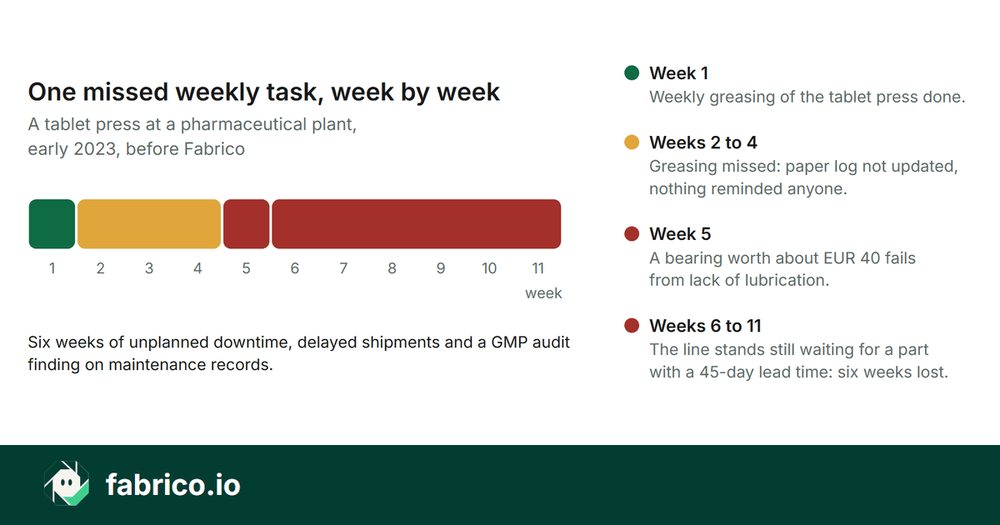
- Week 1: the greasing was done.
- Weeks 2 to 4: the task was missed, and nothing reminded anyone.
- Week 5: a bearing worth about EUR 40 failed from lack of lubrication.
- Weeks 6 to 11: the line stood still while a specialised replacement part arrived, 45 days after ordering.
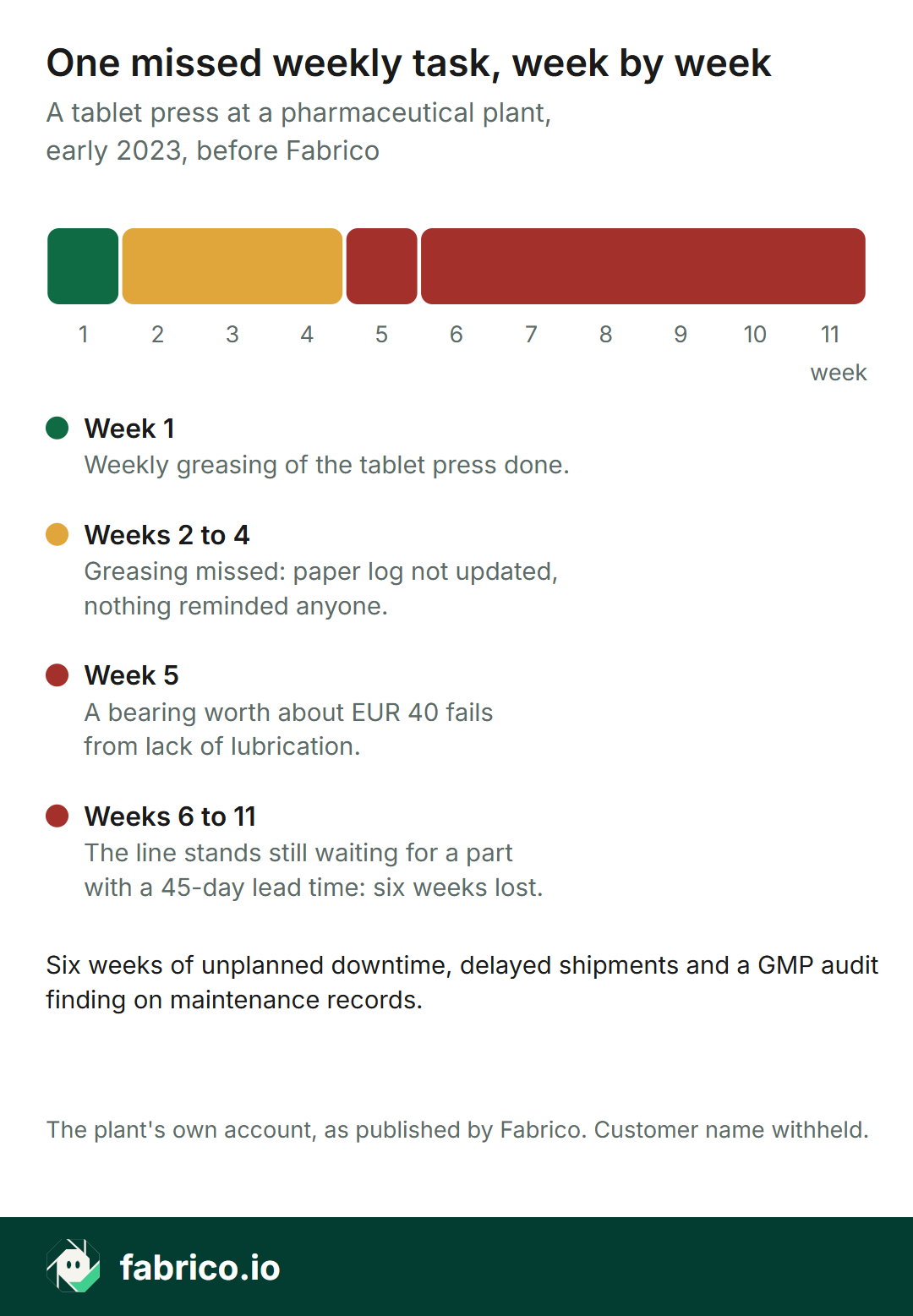
The plant counted six weeks of unplanned downtime on that line, delayed shipments to pharmacy partners and retail chains, and a GMP audit finding of “insufficient traceability in maintenance documentation”.
What the plant found when it looked
Maintenance routines were tracked across three Excel sheets and paper logs. Nothing alerted a technician or a supervisor when a task was missed. Managers had no live view of which tasks were due, overdue or done, so there was no way to step in early. The plant could not prove what had been done, when, or by whom.
The decision: planned tasks in one system, on the technician's phone
The plant moved its planned maintenance out of paper and Excel into Fabrico.
In Fabrico, a planned task such as a weekly greasing recurs on the schedule the plant sets, is assigned to a named technician and is closed with a checklist and a signature. The technician gets it as a push notification on the phone. A task that is not done appears in the summary notification when that option is switched on.
Managers see which machines are due for service, which tasks are overdue, and who is working on what right now. The task history keeps who did what and when, and an audit-log export is available on request. Fabrico's signature on tasks and checklists is a signature with an approval role, not a qualified electronic signature.
What changed
Two things changed with the move:
- Task records are digital and time-stamped, with the person and the time on each one.
- Managers have a live view of due and overdue tasks instead of a paper log.
No downtime or cost figures are shown; no baseline for them was recorded with the account.
Next step: one critical machine of yours
Bring the planned-maintenance list for one machine that must not stop. On a demonstration plant we show how a stop on that machine shows in OEE as lost availability with its reason, the task a stop reason can open by itself when set up that way, what the technician sees on the phone, and what happens when a weekly task is not done.
See how businesses benefit


Real Fabrico tiles, sample data.