Login
 Blog

ROI of Machine Connectivity: Choosing the Right Path for OEE and CMMS Integration

For plant leadership, the technical "how" of machine connectivity is often secondary to the financial "why."
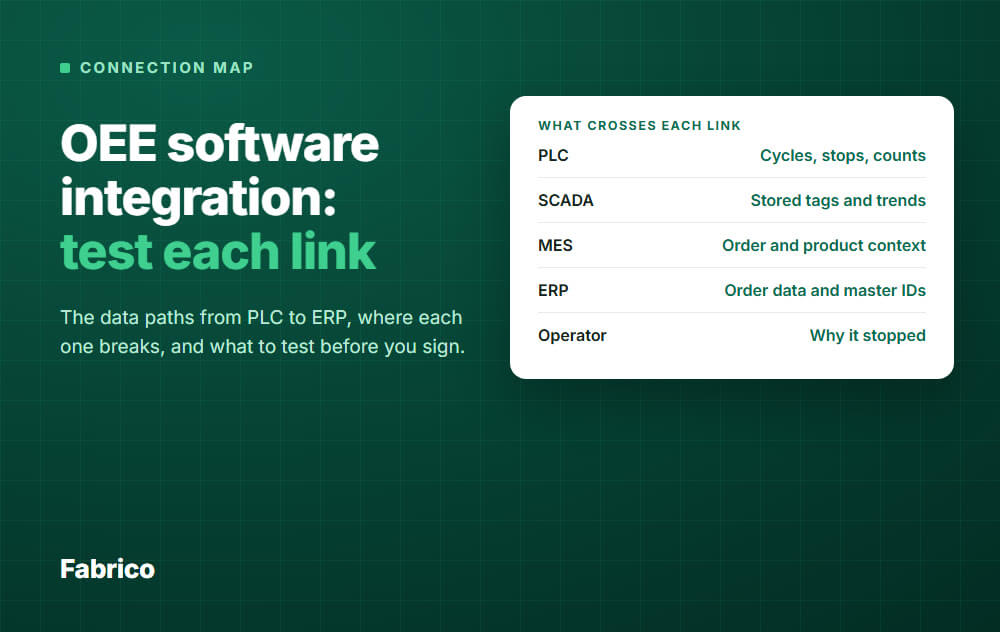
See our roundup of the analytics layer this connectivity feeds.
However, the method you choose to extract data from your shop floor determines the accuracy of your OEE software and the speed of your maintenance response.
To achieve world-class results in 2026, you must select a connectivity path that captures what really happens without creating a massive IT burden.
Key Takeaways
-
Connectivity is the foundation of turning data into action. If your data is inaccurate, your maintenance team will be fixing the wrong problems.
-
Hybrid connectivity is the new standard. A modern factory requires a mix of PLC data, IoT sensors, and Computer Vision to remove the blind spots.
-
Visual proof is the ultimate ROI multiplier. Capturing the "Why" through Computer Vision is more valuable than just capturing the "When" through a sensor.
What is the best way to connect machines for OEE tracking?
The best way to connect machines for OEE tracking is through a hybrid "Visibility Trifecta" that uses direct PLC signals for timing accuracy, IoT sensors for legacy assets, and AI-powered Computer Vision to capture the manual interventions and micro-stops that traditional sensors miss.
This approach ensures that Mike, the maintenance manager, has a single source of operational truth.
Fabrico unifies these inputs, so that a machine signal doesn't just end up on a dashboard but can be turned into a prioritized Work Order in the Field-Ready CMMS.
Option 1: Direct PLC Connectivity (The Digital Heartbeat)
Direct connectivity pulls data straight from the machine’s Programmable Logic Controller (PLC) via industrial protocols like OPC-UA or MQTT.
This is the fastest path to high-accuracy OEE for modern, digitalized lines.
It provides millisecond precision for cycle times, which is essential for capturing the "Reduced Speed" losses in high-speed FMCG and Food & Beverage plants.
For Tom, the technician, PLC data provides the technical error codes needed to arrive at the machine with the correct tools and knowledge.
Option 2: IoT Retrofitting (The Legacy Lifeline)
For "Brownfield" sites with 20-year-old equipment, direct PLC access is often impossible or too expensive to program.
Fabrico uses IoT devices and sensors to capture the machine's "Heartbeat."
These sensors count cycles and detect downtime by "watching" the physical movement of the line without touching the internal wiring.
This method allows you to bring your oldest "Bad Actor" assets into the digital age, reclaiming the Hidden Factory revenue lost in your legacy operations.
Option 3: Computer Vision (The Visual Truth)
Computer Vision is the most advanced layer of the Visibility Trifecta.
Fabrico’s Inefficiencies Zoom-In module uses AI-powered cameras to "see" production events that PLCs and sensors miss, such as operator delays or material jams.
When a performance drop occurs, the system flags a video clip for Mike to review.
Instead of guessing why a labeler failed, your team can "Zoom-In" to see what happened, providing the evidence needed for permanent KAIZEN fixes.
Comparison Matrix: PLC vs. IoT vs. Computer Vision
| Capability | Direct PLC Connection | IoT Retrofitting | Computer Vision (Zoom-In) |
| Accuracy (Timing) | Absolute / High | High | Moderate |
| Context on the Stop | Data-Only | Data-Only | Advanced (Visual Replay) |
| Asset Age | New / Modern | Mid-Life | Legacy / Manual / Hybrid |
| Invasiveness | Low (Software) | Moderate (Hardware) | Zero (Camera Only) |
| Maintenance Link | Native CMMS | Native CMMS | Native CMMS |
| Best For | Smart Factories | Standalone Assets | High-Speed Blind Spots |
Closing the Action Loop: Why Connectivity Choice Drives Maintenance ROI
The value of connectivity isn't the data itself; it is the Decision Latency you eliminate.
If you choose a connectivity path that only provides a post-shift report, you are paying a "Latency Tax" on every downtime event.
Fabrico ensures that regardless of how you connect, the result is data that turns into action.
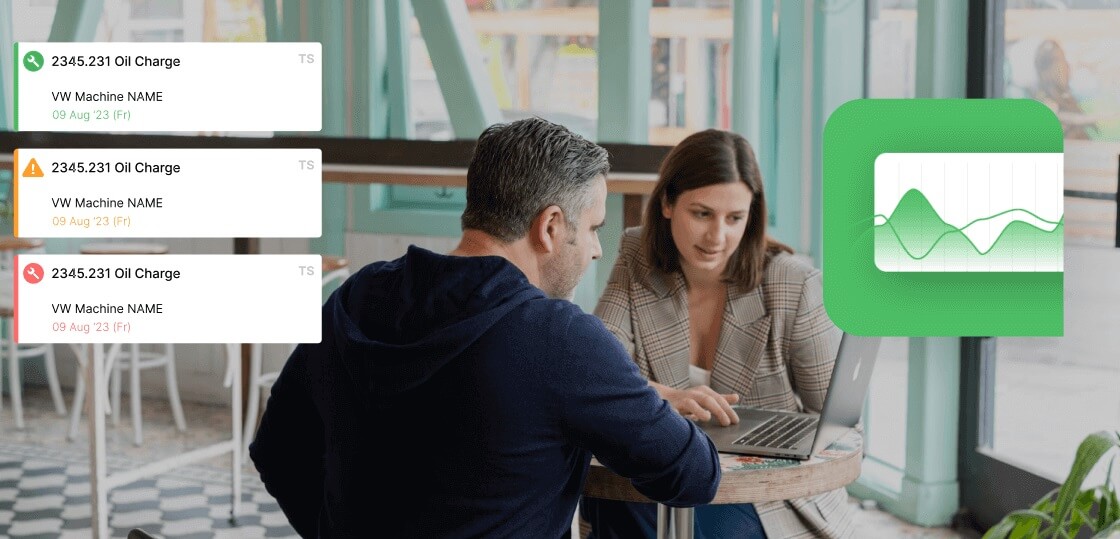
After a "Stop" signal from a PLC or a "Jam" detected by Computer Vision, a stop reason can be configured to open a maintenance task automatically on Tom’s mobile device; people can also create tasks by hand.
This ensures your maintenance effort is always focused on the Value Fulcrum, the specific tasks that directly protect your effective runtime and profit.
The Strategic Verdict: Future-Proof Your Shop Floor
For plant leadership, the decision is about building a scalable foundation.
By consolidating all three connectivity methods into one platform, they avoid the "Frankenstein" tech stack of disconnected tools.
Want OEE captured straight from your machines, no manual logs?
Request a demoRelated articles