Key takeaways
Ideal cycle time is the theoretical minimum time to make one unit, the rate the line would hit if it ran at full speed with no losses. It is sometimes called the nameplate or design rate. In OEE, it is the reference point for the Performance factor: Performance asks how close actual output came to what the ideal cycle time says was achievable in the time the line ran.
That makes it quietly one of the most important numbers in your OEE calculation, and one of the most often fudged.
Performance is, in effect, (ideal cycle time x total count) divided by run time. The ideal cycle time is the multiplier. If it is wrong, Performance is wrong, and so is the OEE built on it. Two plants with identical real output can report very different OEE simply because they set ideal cycle time differently. The pillar on what OEE means shows where Performance sits in the calculation.
Because ideal cycle time is a chosen reference, it invites gaming in both directions:
Either error makes OEE incomparable over time and across lines. The number stops being a measurement and becomes a story.
The defensible basis is the fastest rate the process has actually sustained over a meaningful, stable run of good product, cross-checked against the equipment manufacturer's design rate. If the demonstrated best and the design rate disagree sharply, that gap is itself worth investigating.
Lock the ideal cycle time, document how it was derived, and change it only with the same rigor, so OEE stays comparable over time. Misattributed speed loss is a classic finding in production loss analysis.
A line runs 400 minutes and produces 1,800 good units. If ideal cycle time is 0.2 minutes per unit, ideal output was 2,000, so Performance is 1,800 / 2,000 = 90%.
But if someone had set ideal cycle time at 0.25 minutes (slower), ideal output would be 1,600, Performance would read 112% (capped at 100%), and 200 units of real speed loss would vanish from the books. Same line, same output, very different story, purely from the reference number.
Fabrico records actual cycle times continuously, so the demonstrated best rate is visible from real data rather than guessed, and ideal cycle time can be set and audited against what the line has truly achieved.
Because Performance is then built on a sound reference, the OEE and manufacturing KPIs derived from it are comparable and trustworthy. Fabrico is built and hosted in the EU with data residency in mind and is ISO 27001 certified. To set Performance on honest data, book a demo.
The fastest time a process can produce one good unit under perfect conditions, also called the design or nameplate rate. In OEE it is the benchmark the Performance factor measures actual output against.
Performance compares real output to what ideal cycle time says was possible, so the ideal cycle time directly scales Performance and the OEE built on it. A wrong ideal cycle time produces a wrong OEE even if every other input is perfect.
Performance looks inflated, sometimes above 100%, and genuine speed loss disappears from the numbers. The OEE looks excellent but hides the very losses you want to find, and it is no longer comparable to lines set honestly.
Base it on the fastest rate the line has actually sustained over a stable run of good product, cross-checked against the manufacturer's design rate. Document the basis and change it only with the same rigor so OEE stays comparable over time.
See how Fabrico unifies OEE and maintenance in one platform.
Request a demo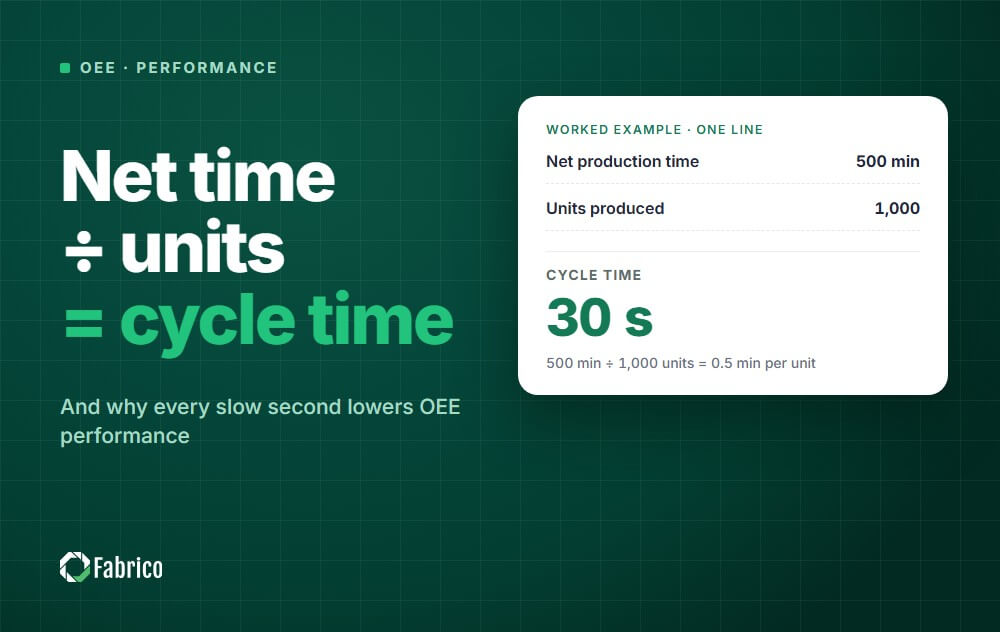











 Login
Login
 Blog
Blog