

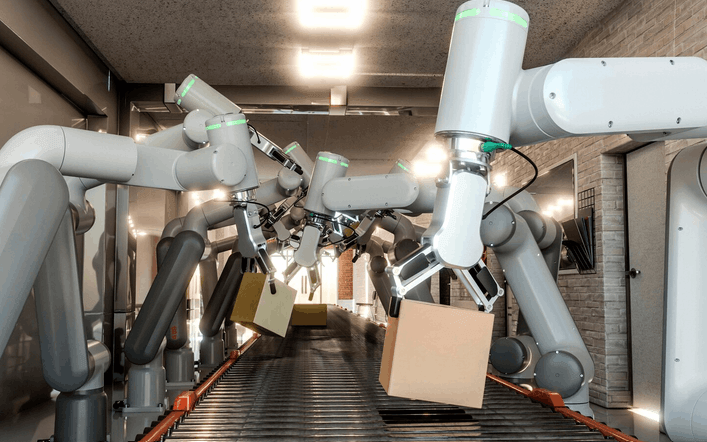

ISO 3691-4 is the international safety standard for driverless industrial trucks, defining how automated guided vehicles (AGVs) and autonomous mobile robots (AMRs) must detect people, control speed, and behave in spaces shared with workers.
Formally titled Industrial trucks, Part 4: Driverless industrial trucks and their systems (current edition 2023), it is the reference document behind CE marking of automated vehicle fleets in Europe. If you specify, integrate, or operate AGVs or AMRs, your risk assessment will be measured against it.
The standard applies to driverless industrial trucks and their systems: the vehicle, its control system, load handling attachments, battery charging stations, and load transfer stations. Navigation technology does not matter: a tape-guided tugger and a free-navigating AMR both fall in scope when they perform truck functions such as towing, carrying, or lifting loads.
ISO 3691-4 does not stand alone: it points to ISO 13849-1 for the reliability of safety-related control functions and to IEC 61496 for electro-sensitive protective equipment such as safety laser scanners.
Driverless trucks placed on the EU market are machinery and must carry CE marking. The EN version of ISO 3691-4 is harmonized under the Machinery Directive (2006/42/EC), so a vehicle designed to it enjoys a presumption of conformity with the essential health and safety requirements the standard covers. From January 2027 the Machinery Regulation (EU) 2023/1230 replaces the directive, with explicit attention to autonomous mobile machinery.
Responsibility is shared: the manufacturer certifies the truck, while the integrator or operating company owns the site-specific application, meaning routes, zones, and the risk assessment, commonly structured with methods such as FMEA and HAZOP.
ISO 3691-4 organizes the shop floor into zones with different rules:
Speed is the master variable: braking capability must match speed and load, and protective fields grow with speed. The best-known number in the standard: where personnel detection is muted or not fully effective, for example when docking, speed must not exceed 0.3 m/s, and compensating risk-reduction measures still apply.
Where people may be present, the vehicle needs a personnel detection system, typically a safety-rated laser scanner projecting a protective field ahead of the vehicle.
The standard verifies detection with two defined test pieces: a vertical cylinder 200 mm in diameter and 600 mm high, and a horizontal cylinder 70 mm in diameter and 400 mm long lying on the floor, representing a person lying down. The vehicle must stop before touching either one.
Good implementations layer the fields: an outer warning field slows the vehicle and triggers audible or visual warnings, while the inner protective field commands a safety stop. Emergency stop devices and clear status signals for pedestrians round out the package. Each safety function must achieve the performance level the standard assigns under ISO 13849-1, often Performance Level d.
Consider an AMR with a maximum speed of 1.5 m/s fully loaded. Its protective field must be at least as long as the distance covered between detecting a person and standing still:
Minimum field length: 0.375 + 0.65 + 0.25 = 1.275 m, so the integrator configures 1.3 m. In a slower zone at 0.5 m/s, the same math gives 0.125 m reaction distance, roughly 0.12 m braking distance, and the same 0.25 m margins: about 0.5 m of field. This is why vehicles switch field sets dynamically with speed, and why every field set must be verified at commissioning.
ISO 3691-4 requires each safety function to be verified by test, measurement, or inspection, and that obligation does not end at commissioning. A sustainable compliance program typically includes:
This is maintenance work, and it belongs in the same system as the rest of your maintenance: a CMMS that schedules the checks, assigns them, and keeps history per vehicle. Treating safety inspections as planned work rather than firefighting is the same shift described in reactive versus proactive maintenance.
Fabrico is the real-time data foundation for this kind of program. In the Fabrico CMMS , each AGV or AMR becomes an asset with its own preventive schedule: shift pre-use checklists, brake tests, and protective field verifications run as recurring work orders.
Every completed task is time-stamped against the vehicle, giving you the audit trail that ISO 3691-4 verification and CE documentation demand. Spare parts management keeps scanner windows and bumpers on hand, and real-time OEE and production monitoring shows whether vehicle stoppages are eating into line performance.
Fabrico is EU-built with EU data residency, keeping compliance records where your auditors expect them.
It applies to driverless industrial trucks regardless of navigation technology, so free-navigating AMRs performing truck functions (carrying, towing, lifting) are in scope alongside classic guided AGVs. In North America, ANSI/ITSDF B56.5 and ANSI/RIA R15.08 cover similar ground.
In defined situations such as docking at a load transfer station, ISO 3691-4 limits speed to 0.3 m/s while detection is muted, with compensating measures such as marked zones and warning signals.
The standard itself is voluntary, but the essential health and safety requirements of EU machinery legislation are not. Because the EN version is harmonized, designing and verifying to ISO 3691-4 is the most practical route to conformity and CE marking.
Ready to turn ISO 3691-4 checklists into scheduled, logged, audit-ready work? Book a live Fabrico demo and see your AGV fleet's inspection history in one place.

























Programați o întâlnire individuală cu experții noștri sau înscrieți-vă direct în planul nostru gratuit.
Nu este nevoie de card de credit!






 Login
Login
 Blog
Blog