
Key takeaways
MES and OEE software overlap more than SCADA or ERP do, which is why the comparison matters. An MES often shows an OEE figure, so it is fair to ask whether you need anything more. The answer depends on how seriously you want to attack losses. The three layers are compared in more detail in production monitoring vs OEE software vs MES.
If attacking losses is the goal, see how Fabrico's OEE software logs every stop and its duration straight from the machine, lets operators or AI computer vision add the cause, and shows OEE by line and shift, all inside a cloud-based MES and OEE platform. For the full buyer's checklist, see how to choose MES software.
A manufacturing execution system (MES) manages production as it happens: releasing and tracking work orders, enforcing routing and process steps, recording quality and traceability, and tying it all to the product genealogy. It is the system of record for what was made, how, and in what sequence.
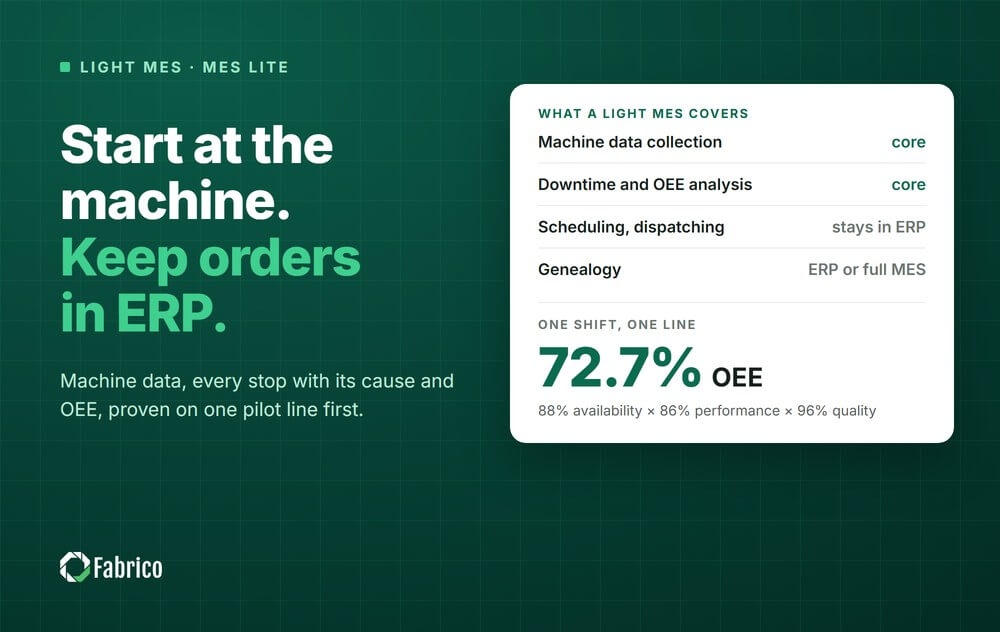
MES is broad by design. OEE is usually one feature within it, not its main purpose.
OEE software is narrow and deep. Its whole job is to measure availability, performance, and quality and to expose the losses behind them, often capturing micro-stops and speed losses that a general MES rolls up or misses. It exists to drive performance improvement, not to manage execution.
An MES reports an order complete, enforces the right process steps, and shows an OEE of 75% for the shift. Dedicated OEE software on the same line resolves that 75% into 140 logged micro-stops, a recurring speed loss on one product, and a quality dip after changeovers, the specific causes an improvement team can act on. The MES managed the work; the OEE tool found the losses.
MES and OEE coexist well. MES provides order and product context and the execution backbone; OEE provides the deep loss analysis that turns performance into action. Where an MES OEE feature is too shallow, dedicated OEE software fills the gap without replacing the MES. Book a Fabrico demo to see deep OEE alongside execution systems. Compare also OEE versus an ERP production module.
Many do, as one feature among many. It is often enough for a headline number but lighter on the detailed loss capture that dedicated OEE software provides for serious improvement.
It is rarely either-or. MES manages and records execution; OEE software measures and improves performance. If you have an MES but losses stay stubborn, dedicated OEE usually adds the missing depth.












 Login
 Blog