

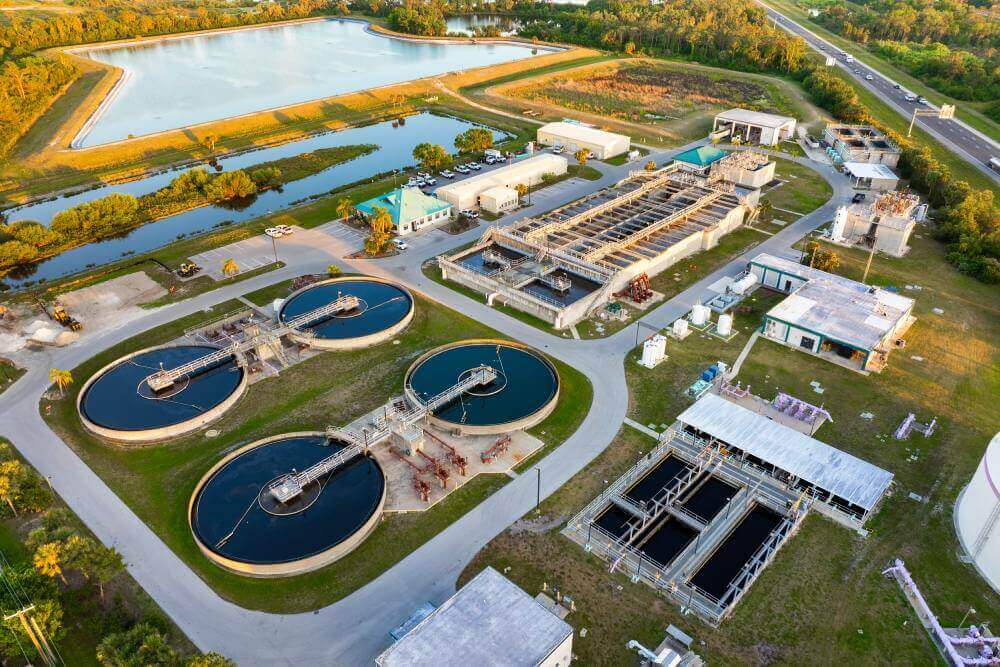

Osmose inverse: membranes, encrassement et entretien est l'étude d'un procédé membranaire actionné par pression qui force l'eau à travers une membrane semi-perméable tout en retenant les sels dissous et la plupart des contaminants, ainsi que des paramètres d'exploitation, des mécanismes d'encrassement et des routines d'entretien qui maintiennent cette membrane productive.
Pour les ingénieurs de maintenance et de fiabilité, un train d'osmose inverse est un système composé d'une pompe rotative et de membranes dont les performances décroissent de façon prévisible, ce qui signifie que ses modes de défaillance peuvent être suivis, anticipés et atténués plutôt que simplement subis.
L'osmose fait passer spontanément l'eau d'une solution diluée vers une solution concentrée à travers une membrane semi-perméable. L'osmose inverse inverse ce flux en appliquant une pression d'alimentation supérieure à la pression osmotique du concentré.
L'eau traverse la couche barrière dense en polyamide d'une membrane composite en film mince tandis que les ions dissous, les matières organiques et les colloïdes sont rejetés et entraînés dans le flux de rejet (saumure).
Les membranes sont enroulées en éléments en spirale, typiquement de 8 pouces de diamètre et 40 pouces de longueur, logés plusieurs par enveloppe sous pression et disposés en plusieurs étages.
Quatre nombres définissent un système OI. La récupération est la fraction de l'alimentation convertie en perméat, Y = Qp / Qf. Le rejet de sel est R = (1 - Cp / Cf) x 100. Le flux est le débit de perméat par unité de surface de membrane, exprimé en litres par mètre carré par heure (LMH). La pression motrice nette est la pression appliquée moins la pression osmotique, moins la contre-pression du perméat, moins les effets de polarisation de concentration. L'eau de mer à 35 g/L de matières dissoutes totales a une pression osmotique proche de 28 bar, donc l'OI pour eau de mer fonctionne à 55 à 70 bar ; l'OI pour eaux saumâtres fonctionne bien plus bas.
| Paramètre | OI pour eaux saumâtres | OI pour eau de mer |
|---|---|---|
| Pression d'alimentation (bar) | 10 à 25 | 55 à 70 |
| Rendement du système (%) | 75 à 85 | 40 à 50 |
| Rejet de sel (%) | 97 à 99,5 | 99,4 à 99,8 |
| Flux de conception (LMH) | 20 à 30 | 12 à 17 |
Les performances des membranes déclinent pour un petit nombre de raisons, chacune présentant une signature caractéristique. L'encrassement colloïdal et particulaire augmente la pression différentielle aux éléments de tête. L'entartrage minéral, généralement du carbonate de calcium, du sulfate de calcium ou de la silice, se forme là où la récupération concentre des sels peu solubles au-delà de la saturation et apparaît d'abord dans les éléments de queue. L'encrassement organique et la bio-encrassement forment une couche de gel ou de biofilm qui réduit le flux et augmente le passage de sel. La bio-encrassement en particulier est auto-propagatrice et partage sa microbiologie avec la corrosion influencée microbiologiquement observée ailleurs dans les systèmes d'eau.
| Type d'encrassement | Symptôme typique | Mesures d'atténuation |
|---|---|---|
| Colloïdal / particulaire (limon, argile, fer) | Augmentation de la pression différentielle en tête, SDI plus élevé à l'alimentation | Améliorer la filtration de prétraitement, CIP alcalin à pH élevé, contrôle de la coagulation |
| Entartrage minéral (CaCO3, CaSO4, silice) | Baisse du débit de perméat, augmentation du passage de sel dans les éléments de queue | Dosage d'antiscalant, réduction du taux de récupération, CIP acide à pH bas |
| Encrassement organique (humique, huile) | Perte de flux progressive, TOC élevé à l'alimentation | Coagulation, charbon actif, CIP alcalin à pH élevé |
| Bio-encrassement (biofilm) | Augmentation de la pression différentielle et du passage de sel, odeur marquée lors de l'inspection | Biocide non oxydant, CIP à pH élevé, chlorination et déchlorination appropriées de l'alimentation |
La durée de vie de la membrane se joue en amont.
L'indice de densité de limon (SDI, ASTM D4189) doit se situer entre 3 et 5 avant les membranes; l'alimentation doit être exempte d'oxydants qui attaquent le polyamide, de sorte que le chlore résiduel est éliminé par du charbon actif ou du bisulfite de sodium en amont des éléments.
Un antiscalant est dosé pour supprimer la précipitation des carbonates et des sulfates, et des filtres cartouches de 5 microns retiennent les particules errantes. Un mauvais prétraitement est la cause racine la plus fréquente de remplacement prématuré des éléments.
La même logique qui gouverne les boucles ouvertes de recirculation dans le traitement des eaux de refroidissement s'applique ici: contrôlez la chimie de l'eau et l'équipement s'en portera mieux.
Lorsque le flux normalisé baisse d'environ 10 à 15 %, ou que la pression différentielle ou le passage de sel augmente d'une marge similaire, les éléments sont nettoyés en place.
Un nettoyage à faible pH (acide citrique ou acide chlorhydrique, pH 2 à 4) dissout l'entartrage minéral et les oxydes métalliques; un nettoyage à pH élevé (hydroxyde de sodium avec un tensioactif, pH 10 à 12) décolle les matières organiques et le biofilm.
L'ordre est important: nettoyer d'abord en milieu alcalin lorsque la bio-encrassement domine, car la matière organique peut lier l'entartrage. La température est maintenue près de 35 °C et jamais au-dessus de la limite de la membrane, et le nettoyage s'effectue étage par étage afin de ne pas pousser l'encrassement plus profondément dans l'assemblage.
L'OI est un actif riche en données, et la normalisation est ce qui rend les données fiables.
Selon ASTM D4516, le débit de perméat, le passage de sel et la pression différentielle sont corrigés à une température et une pression de référence afin que les variations saisonnières de l'alimentation ne se fassent pas passer pour de l'encrassement.
Trois courbes racontent l'histoire: une baisse du débit de perméat normalisé indique un encrassement ou un entartrage, une hausse du passage de sel normalisé indique une détérioration de la membrane ou un biofilm, et une augmentation de la pression différentielle indique un colmatage particulaire ou biologique.
L'enregistrement de ces paramètres, conjointement avec les vibrations de pompe et l'énergie par mètre cube, permet à une équipe de planifier les CIP et les remplacements d'éléments avant qu'une perte de qualité n'intervienne, la même discipline prédictive utilisée contre l' encrassement des échangeurs de chaleur .
Une plateforme de maintenance telle que Fabrico peut centraliser les tendances normalisées, l'historique des nettoyages et les numéros de série des éléments dans un seul dossier. Réservez une démo Fabrico pour voir le flux de travail.
Au fur et à mesure que le perméat est retiré, le concentré devient plus salé et sa pression osmotique augmente. Au-delà d'environ 45 à 50 % de récupération pour l'eau de mer, la pression osmotique de la saumure approche la limite pratique de la pompe et le risque d'entartrage augmente fortement, de sorte que la récupération en un seul passage est plafonnée à ce niveau.
Le chlore libre et autres oxydants. Le polyamide composite en film mince a une très faible tolérance au chlore, si bien qu'une exposition même brève au chlore résiduel dégrade de façon permanente la rétention. Une déchlorination fiable en amont des membranes est essentielle.
Avec un prétraitement adéquat et un nettoyage rigoureux, les éléments en spirale durent couramment cinq à sept ans. Le remplacement est guidé par les tendances du passage de sel et du flux normalisés plutôt que par un calendrier fixe, ce qui explique pourquoi le suivi des tendances est plus important qu'un intervalle de maintenance prédéterminé.
Il s'agit de l'accumulation locale de sels rejetés dans la couche limite à la surface de la membrane, ce qui augmente la pression osmotique effective que la pompe doit vaincre et favorise l'entartrage. Une vitesse d'écoulement transversal adéquate maintient le facteur de polarisation près de 1,1 à 1,2 et limite la pénalité.


















 Connexion
 Blog
Blog