
Key Takeaways: See our roundup of affordable CMMS software.
Evaluating production maintenance software requires removing the silo between your operators and your technicians.
Generic facility applications cause operational latency by ignoring real time machine cycle times.
Native OEE tracking provides the machine validated truth needed to schedule Condition Directed tasks.
Computer Vision acts as your visual diagnostic tool to record every production anomaly.
Your planners must see active repair work and the maintenance calendar before they commit manufacturing runs.
Selecting the right production maintenance software is a critical decision that directly impacts your supply chain.
For decades, factory leadership has allowed a massive divide to exist between the operations team and the reliability team.
Production managers want to keep the machines running at all costs to meet their quotas.
Maintenance managers want to take the machines offline to perform necessary preventative servicing.
When your factory uses disconnected software for these two departments, you guarantee constant internal friction.
Here is the strategic 2026 guide to evaluating software that bridges this exact gap.
We will explore why you must unify your asset data to protect your profit margins and achieve true operational excellence.
Production maintenance software is a specialized digital platform that aligns manufacturing output goals with equipment reliability tasks. It combines real time machine performance tracking with a mobile work order system.
The primary objective is to maximize scheduled capacity without sacrificing the long term health of the physical assets.
Many manufacturing plants attempt to run their operations using two completely different technology stacks.
The production team uses passive scoreboards to monitor cycle times and output counts.
Meanwhile, the reliability engineers use a separate task management application to schedule their daily work orders.
This disconnected approach creates a severe intelligence gap across the entire facility.
If a packaging machine starts running ten percent slower, the production dashboard will turn red.
However, because the systems do not communicate, the maintenance team is completely unaware of the problem.
Engineers only find out about the issue hours later when the machine finally suffers a catastrophic breakdown.
This reactive firefighting destroys your Wrench Time metrics and severely inflates your Mean Time To Repair.
To eliminate unplanned downtime, your maintenance technicians must see the exact same data as your machine operators.
You cannot optimize your factory if your performance metrics and your work orders live in separate silos.
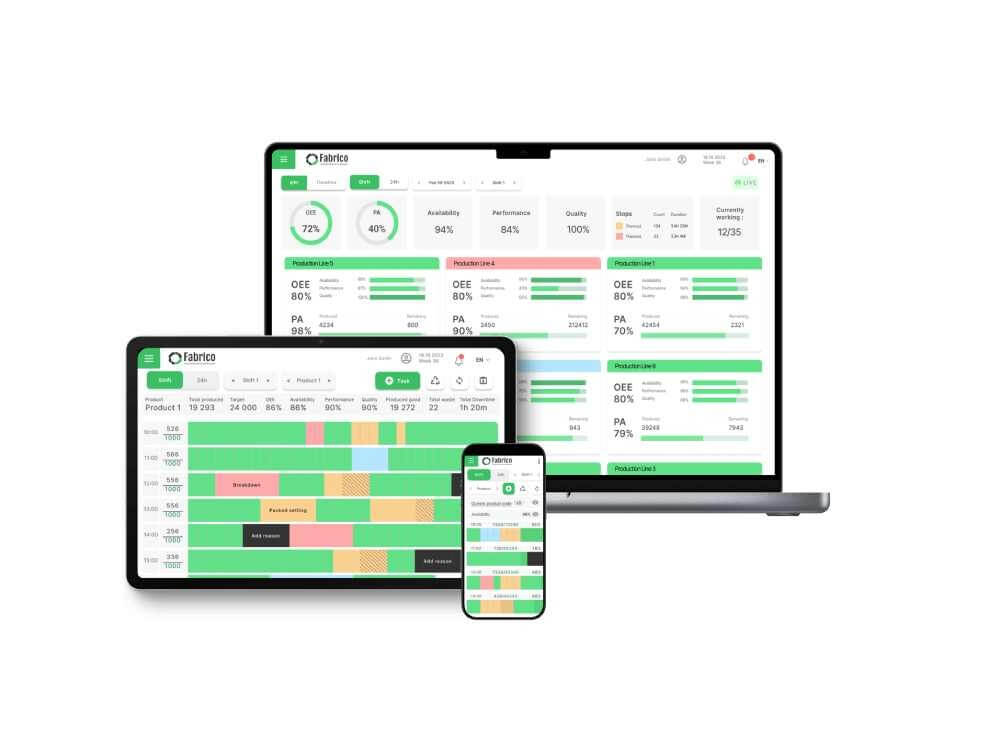
A unified manufacturing platform solves this intelligence gap by deploying Native OEE tracking.
By connecting directly to your existing logic controllers, the system monitors Availability, Performance, and Quality automatically.
When a critical asset begins to degrade, the system detects the anomaly instantly.
It alerts the right people, and the team can open a prioritized work order from the same machine record in the Field Ready CMMS before the asset actually fails.
This empowers both departments to agree on executing Condition Directed tasks based on absolute mathematical truth.
Sensors are highly effective at registering a sudden drop in machine speed.
Unfortunately, traditional sensors are incapable of explaining the human variables that often cause these slowdowns.
A sudden bottleneck might be a mechanical failure, or it might result from an operator fumbling with raw materials.
Leading factories solve this diagnostic mystery by demanding Computer Vision capabilities.
Industrial cameras mounted above the production lines act as an objective digital witness.
When a downtime event occurs, engineers and operators can use the Inefficiencies Zoom In feature to watch a video replay.
You gain absolute visual proof of the root cause, completely eliminating the need for departmental finger pointing.
A brilliant automated alert is useless if your technicians cannot execute the repair flawlessly.
If a system requires technicians to return to a desktop computer to read a manual, they will simply guess the procedure.
A Field Ready CMMS allows technicians to receive work orders directly on their mobile devices.
They simply scan a QR code on the broken asset to instantly access digital standard operating procedures.
Your software must also support compliance on the shop floor.
By adding photos and digital sign-offs to Digital CILs, you keep a record of how the work was done.
This gives your boardroom an auditable history of every closed work order for ISO and FDA audits.
Selecting the right technology stack dictates the financial success of your continuous improvement program.
Fragmented point solutions will continually bottleneck your technicians and production planners.
| Feature Category | Generic CMMS Apps | Fabrico Unified Platform |
| System Philosophy | Isolated task management | Unified production and maintenance |
| Data Collection | Manual human entry | Automated Native OEE tracking |
| Diagnostic Method | Vague operator descriptions | Computer Vision with video replay |
| Shop Floor Execution | Basic digital forms | Field Ready CMMS with QR scanning |
| Production Alignment | Blind to manufacturing schedules | Live machine status and maintenance calendar for planners |
Maintenance interventions directly impact your factory output.
When a technician takes a machine offline for a critical repair, your production planners must know instantly.
Disconnected software leaves your logistics team completely in the dark.
The ideal manufacturing platform shows your planners real time asset health and the maintenance calendar in one place.
Production planning itself is on Fabrico's roadmap; today planners use this view to adjust upcoming runs in their own planning tool based on active maintenance constraints.
Your leadership team never has to overpromise on deliverables because the schedule reflects the actual reality of the shop floor.
The next generation of industrial maintenance will rely entirely on automated intelligence.
We are actively developing advanced AI capabilities to support your frontline workers.
The Fabrico AI Agent is an artificial intelligence engine on our product roadmap.
It will autonomously analyze your historical OEE data to suggest predictive maintenance schedules and continuous improvement tasks.
Concurrently, the Fabrico AI Assistant, already live, serves as a generative AI troubleshooting guide.
Technicians can query complex equipment manuals using natural language directly from their smartphones.
You cannot achieve world class manufacturing efficiency using disconnected task applications.
Your maintenance department requires immediate access to the exact performance metrics of your production line.
By choosing a unified platform that combines machine validated data with mobile work execution, you eliminate decision latency.
This integrated strategy maximizes your scheduled capacity and ensures your factory remains a highly profitable asset.
Turn downtime into a number your team can actually act on.
Request a demo





 Login
 Blog