

Oui, vous pouvez générer des codes QR pour les machines, les biens et les matériaux.
Cameras act as an additional visibility layer in Fabrico’s OEE system — capturing the human and process context that sensors or PLC data alone can’t provide. Combining machine + human interface + camera data allows Fabrico to move from partial to full visibility.
Vous n'avez pas besoin d'un appareil spécifique pour utiliser la fonctionnalité de numérisation QR. Vous pouvez simplement utiliser l'appareil photo de votre téléphone portable.
La page d'analyse n'affiche que des données en temps réel basées sur vos critères de recherche.
The PDCA cycle (Plan-Do-Check-Act) is a foundational continuous improvement methodology utilized in Lean manufacturing to systematically test, analyze, and implement operational solutions.
Instead of deploying massive, unverified mechanical overhauls, reliability engineers use this four-step iterative framework to propose a localized fix, physically execute it, mathematically verify the results, and then standardize the success.
When meticulously executed through a digitized system of action, the PDCA cycle completely eliminates trial-and-error troubleshooting and physically guarantees a permanent increase in Effective Runtime.
Most manufacturing executives actively bleed working capital because their continuous improvement (CI) initiatives operate at the agonizingly slow speed of human administration.
When a facility executes a traditional PDCA cycle, engineers spend weeks standing on the shop floor with clipboards, attempting to manually document a highly chaotic changeover process.
Because legacy systems of record lack real-time telemetry, the "Check" phase relies entirely on end-of-month accounting reports to see if the localized fix actually worked.
This analog latency creates a catastrophic fiduciary blind spot for the boardroom.
You cannot maximize your enterprise valuation if your multi-million-dollar process engineering decisions take six weeks to validate.
By the time the CI team realizes their proposed mechanical fix completely failed to stabilize the machine, the facility has already suffered a month of depressed production output and inflated Maintenance Cost Per Unit (MCPU).
To execute a world-class continuous improvement strategy, strategic leaders must transition from subjective human observation to objective visual verification.
Fabrico achieves this operational clarity during the "Plan" phase by deploying its "Inefficiencies Zoom-In" module, utilizing overhead computer vision cameras to continuously monitor the production environment.
When native OEE detects a persistent cycle delay or micro-stop, the system automatically flags the exact timestamp and links it to the corresponding high-definition video footage.
The CI team can instantly watch a replay of the inefficiency from their web dashboard, visually diagnosing the exact ergonomic wastes, unnecessary motion, or clunky tooling interactions.
This indisputable visual evidence entirely replaces the analog clipboard, providing the precise mechanical intelligence required to engineer a highly targeted, highly effective process improvement plan.
Engineering a brilliant process improvement provides zero financial ROI if the actual execution on the shop floor descends into administrative chaos.
Fabrico bridges the gap between CI theory and physical execution by deploying a native, offline-capable mobile application directly to your frontline reliability workforce.
When the engineering team finalizes the mechanical modification for the "Do" phase, they instantly generate a prioritized work order in the Field-Ready CMMS.
The dispatched technician must physically scan the asset's QR code with their mobile device to unlock the newly updated, version-controlled Standard Operating Procedure (SOP).
By forcing the execution of the experimental fix through strict digital checklists at the point of action, the system completely eliminates the risk of human-induced process defects.
The technician digitally logs their exact labor hours and writes off consumed MRO spare parts, ensuring the pilot improvement is executed exactly as the engineering team designed it.

The most critical phase of the cycle is the "Check," where the engineering team must mathematically prove whether the physical intervention actually improved the machine's baseline performance.
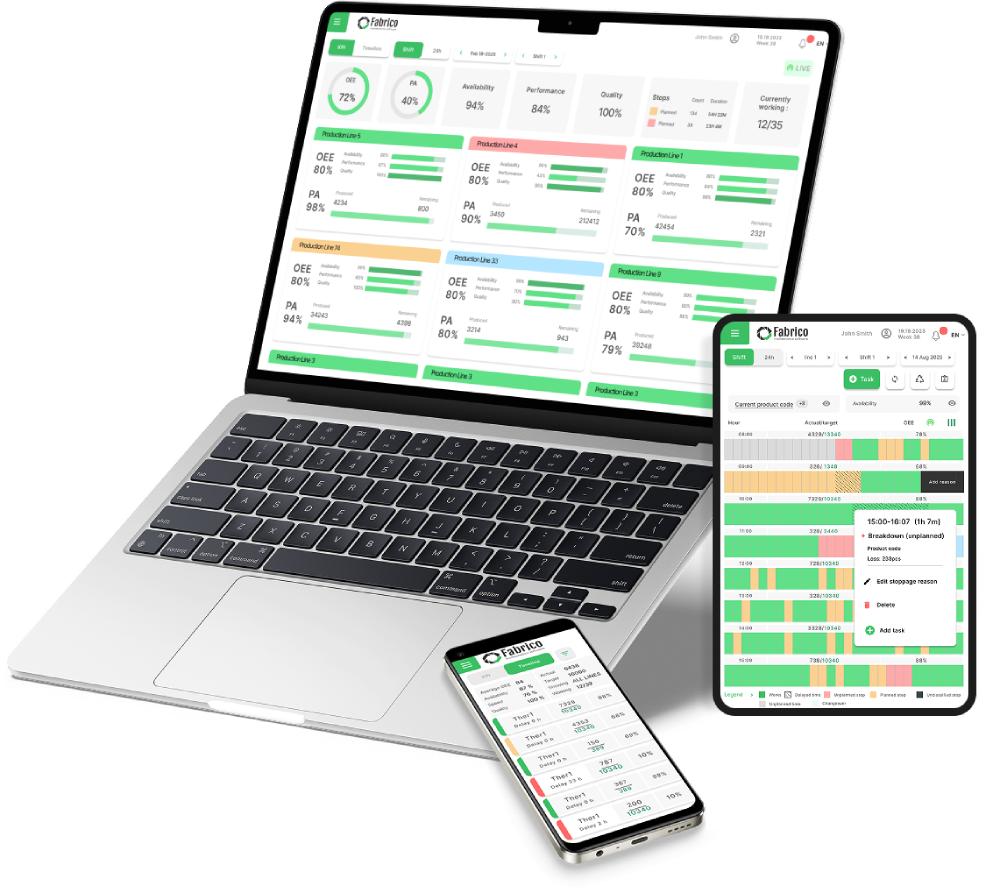
By unifying native OEE tracking directly within the core CMMS architecture, Fabrico completely automates this performance validation in real time.
The system continuously captures telemetry from your PLCs, logging the exact cycle counts, throughput variance, and minor speed losses the very second the machine is restarted.
If the newly engineered fix successfully stabilized the process, the native OEE dashboard instantly reflects a mathematically perfect, flat performance trendline.
Conversely, if the intervention failed, the system immediately registers the returning cycle delays, allowing the CI team to instantly pivot their strategy rather than waiting for an end-of-month report.
Industrial boardrooms are aggressively pushing to deploy Artificial Intelligence to autonomously execute rapid PDCA cycles and continuously refine machine centerlining parameters.
However, AI algorithms are fundamentally useless, and highly dangerous, if they are trained on a factory floor governed by whiteboard sticky notes and unverified analog time studies.
Before a factory can trust an AI to autonomously restructure a multi-million-dollar production line, it must establish at least 12 months of clean, verified, and visually backed master data.
By implementing Fabrico’s visual RCA and mobile CMMS architecture today, you are actively building the contextualized continuous improvement dataset that future automation requires.
Advanced capabilities, such as the Fabrico Agent for autonomous process optimization and the Fabrico Assistant for AI-driven Kaizen guidance, are currently on our strategic roadmap.
Forcing digital execution and capturing exact OEE validation metrics right now is the mandatory first step toward an AI-ready, hyper-agile manufacturing facility.
Les tâches urgentes sont programmées par défaut pour le jour même. Elles sont signalées par une icône d'avertissement spéciale qui empêche de les manquer.
Non, vous pouvez bénéficier d'un large éventail de fonctionnalités utiles quel que soit votre plan tarifaire.
Vous bénéficierez d'une présentation personnalisée expliquant comment Fabrico contribue à réduire les temps d'arrêt imprévus, à suivre les opérations de maintenance, à gérer les pièces détachées et à améliorer la réactivité des techniciens. Nous nous concentrerons sur les aspects les plus importants pour votre entreprise.
Fabrico fonctionne sur le nuage, vous n'avez donc pas besoin d'installer ou de gérer des serveurs. Il vous suffit d'un appareil mobile ou d'un navigateur pour y accéder.
Il existe plusieurs types de graphiques montrant les statistiques sur les temps d'arrêt et la répartition des tâches par type et par état.
A preventative maintenance system is software for planned maintenance that identifies potential issues in equipment, machinery or infrastructure before they lead to costly failures.
The major goal of preventive maintenance is to proactively maintain equipment to prevent failures, increase uptime and extend assets' lifespan.
Oui, toutes les mises à jour logicielles sont déployées automatiquement et incluses dans l'abonnement mensuel, sans perturber le travail quotidien.
Généralement d’environ 30 minutes — court, ciblé et adapté aux besoins de votre équipe.
La page "Analyses" contient de nombreux graphiques montrant la répartition des types de tâches sur une période donnée. Vous pouvez vérifier le pourcentage de tâches urgentes parmi les autres types de tâches.
Seul le plan gratuit est destiné à un seul utilisateur. Tous les plans payants offrent un accès à un nombre illimité d'utilisateurs et ne limitent pas les licences.
Non, tout est compris dans l'abonnement mensuel. Vous n'aurez pas à vous soucier de frais d'installation ou de maintenance supplémentaires.
Fabrico avertit instantanément le technicien concerné lorsqu'une panne est signalée et lui donne tout le contexte dont il a besoin.
Autonomous maintenance (AM) assigns the responsibility for equipment maintenance to operators. Preventive maintenance (PM) is conducted by maintenance workers.
Oui. 100 % gratuit. Sans engagement, sans carte de crédit.
CMMS tracks inventory by utilising built-in asset management features within the software. Users can input inventory information, such as item descriptions, quantities, locations, or suppliers. They can also track inventory in real time by monitoring automatic changes in stock levels and generate reports for better decision-making.
Oui. Que vous exploitiez une ou dix usines, Fabrico s'adapte à vos besoins et optimise les flux de travail d'urgence : rien n'est perdu, quelle que soit la taille de l'équipe.
Our CMMS software helps reduce costs by automating maintenance activities, optimising repair expenses and reducing costly downtime. It enables maintenance teams to streamline their processes and increase productivity, leading to significant cost savings in the long run.
Nous recommandons d’inclure toute personne impliquée dans la maintenance, les opérations ou la gestion de la production, généralement les responsables de la maintenance, les directeurs d’usine ou même les parties prenantes de niveau C si les économies stratégiques sont une priorité.
Nous utilisons un large éventail de mesures, notamment l'authentification multifactorielle, la protection IP, le cryptage SSL, les sauvegardes quotidiennes sur plusieurs serveurs et sites, et bien plus encore. Nous nous engageons à protéger vos données et nous sommes certifiés ISO pour attester de nos normes de sécurité.
Non, tout est compris dans l'abonnement mensuel. Vous n'aurez pas à vous soucier de frais d'installation ou de maintenance supplémentaires.
Oui, Fabrico est conçu pour s'intégrer aux systèmes industriels courants. Dites-nous quels outils vous utilisez et nous vous montrerons comment il s'intègre.
Les clients de Fabrico bénéficient d'un conseiller CMMS dédié qui peut être contacté par téléphone, par chat en direct ou par courrier électronique. Nous sommes toujours là pour vous aider.
Les techniciens ou opérateurs peuvent signaler rapidement un problème depuis n'importe quel appareil (mobile, tablette ou ordinateur). Le système enregistre automatiquement la machine, le type de panne et avertit les membres de l'équipe responsables.
Our preventive maintenance software is extremely easy to use, with a simple and intuitive interface. It offers a seamless user experience whether monitoring asset conditions, creating work orders or accessing real-time data. Fabrico's simple maintenance program digitises regular maintenance task visibility, making it easy for technicians to track them.
Oui. Les utilisateurs peuvent télécharger des images, des vidéos et des notes pendant ou après la réparation, ce qui facilite la documentation du problème et garantit un suivi ou des audits de qualité.
Fabrico offre une grande flexibilité en termes de fréquence périodique. Les tâches récurrentes peuvent être programmées sur une base quotidienne, hebdomadaire ou mensuelle, avec quelques ajustements supplémentaires basés sur la fréquence d'occurrence.
Oui, vous pouvez demander une démonstration en nous contactant via le formulaire ci-dessous.
Fabrico fonctionne sur le nuage, vous n'avez donc pas besoin d'installer ou de gérer des serveurs. Il vous suffit d'un appareil mobile ou d'un navigateur pour y accéder.
Les clients ont signalé une réduction des temps d'arrêt, des temps de réponse plus rapides des techniciens, un meilleur suivi des pièces de rechange et des enregistrements de maintenance clairs, ce qui a entraîné des économies de coûts importantes.
Vous pouvez définir à l'avance la date de fin du groupe. Cette date définira la dernière occurrence possible des tâches périodiques du même groupe.
Absolument. Fabrico applique les meilleures pratiques du secteur en matière de protection et de sécurité des données. Vos données opérationnelles sont chiffrées et stockées en toute sécurité.
Oui. Les temps d'arrêt sont suivis pour chaque événement d'urgence.
Our solution extends beyond day-to-day maintenance into full Enterprise Asset Management (EAM). By integrating with your ERP, we track all costs associated with an asset—initial purchase, labor, parts, and service contracts—from acquisition to decommissioning. This comprehensive view allows finance and reliability teams to accurately calculate Residual Value and make data-backed decisions on asset repair vs. replace strategies.
While OEE is critical, our advanced analytics dashboards provide deep visibility into dozens of core maintenance and reliability Key Performance Indicators (KPIs), including:
These insights empower Reliability Engineers to conduct effective Root Cause Analysis (RCA) and continuously optimize maintenance programs.
Yes, we offer a mobile app that provides on-the-go access to work orders and real-time updates. The app allows maintenance team members to stay connected and manage maintenance activities from anywhere, enhancing overall effectiveness. They also get instant notifications for preventive maintenance work tasks or emergency repairs straight to their assigned mobile device.
Yes, Fabrico's online preventive maintenance software is designed to help minimise reactive maintenance (due to sudden equipment malfunctions). It automates maintenance requests and helps with work order management. By reducing unplanned downtime, businesses prevent expensive repairs and improve overall production efficiency.
We eliminate the paper trail by digitizing and centralizing all critical documentation. When a technician scans an asset or accesses a work order on the mobile app, they instantly receive the latest, version-controlled SOPs, checklists, safety warnings, and high-resolution schematics. This guarantees work is performed correctly and safely every time, protecting both your personnel and the quality of your output.
Preventive maintenance management can be applied in many industries, including:
Deploying preventive maintenance tracking software can help them streamline equipment maintenance processes and avoid production delays due to machine malfunctions.
You can use preventive maintenance software to facilitate the planning and execution of maintenance tasks. Such tools help you schedule maintenance activities, track work orders and generate reports for analysis.
 Connexion