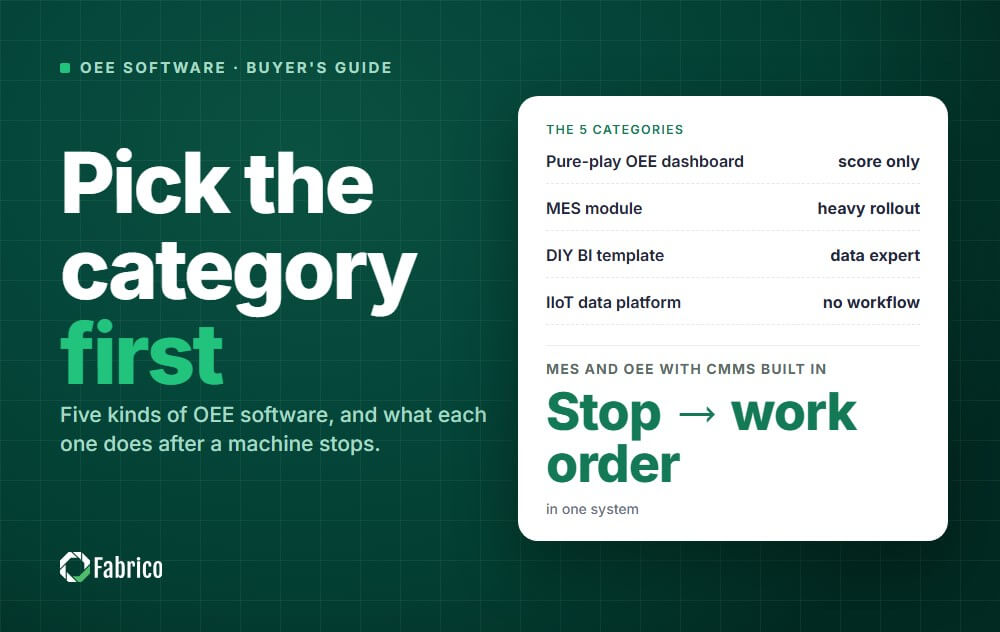
Her „OEE yazılımı" aynı şey değildir. 5 net kategori vardır, her biri farklı felsefe ve takasla.
Kategori 1: Saf OEE Panosu
Felsefe: OEE rakamlarını göster. Nokta. Vorne, Evocon gibi araçlar.
Artısı: hızlı uygulama, güzel UI. Eksisi: CMMS entegrasyonun olmadığı için veri asla eyleme dönüşmez.
Kategori 2: MES Modülü
Felsefe: OEE, MES'ine eklenti (Siemens Opcenter, Wonderware).
Artısı: derin ERP entegrasyonu. Eksisi: 12+ ay uygulama, pahalı lisans, BT'ye bağımlı.
Kategori 3: DIY BI Aracı Şablonu
Felsefe: Power BI/Tableau + Excel iskeleti.
Artısı: ucuz, esnek. Eksisi: her şeyden sen sorumlusun, toplama, doğrulama, uyarılar. Data scientist için harika, operatör için korkunç.
Kategori 4: IIoT Veri Platformu
Felsefe: PLC'lerden ham veri (AWS IoT, ThingWorx). OEE downstream hesaplanır.
Artısı: devasa ölçek. Eksisi: 6 ay kurulum, data engineer gerekir, plug-and-play değil.
Kategori 5: Entegre OEE+CMMS Platformu
Felsefe: OEE ve bakım tek bir yerel UI'da. Kayıp olayı otomatik olarak iş emri oluşturur.
Artısı: veriden eyleme kapalı döngü, hızlı uygulama (CV ile 4 saat). Eksisi: daha yeni kategori, daha az „kurumsal" isim. Fabrico öncü örnektir.
Kategori, „Tedaviye" bağlı mı?, Kullanım kolaylığı, Uygulama hızı
Saf OEE, Hayır, Yüksek, 1 hafta
MES Modülü, Kısmen, Düşük, 12+ ay
DIY BI, Hayır, Düşük, 1-3 ay
IIoT Platformu, Hayır, Düşük, 6+ ay
Entegre OEE+CMMS, EVET, Yüksek, 4 saat
Saf bir OEE aracı bir termometredir. Sana makinenin ateşi olduğunu söyler, ama onu tedavi etmez.
Entegre OEE+CMMS platformu doktordur. Hem teşhis koyar hem de tedaviyi tek bir akışta yazar.
Çoğu tesis için „en iyi" OEE yazılımı, değer döngüsünü en az adımda kapatandır. Fabrico, entegre OEE+CMMS platformunun öncü örneğidir.
Once you know which category fits, compare the vendors on your shortlist with the same questions. Ask each one to answer for a real line in your plant, not for a demo data set.
For the full 10-criteria scorecard, a worked OEE check on one shift and the ROI method, see our guide on how to evaluate OEE software.
| Criterion | What to ask | Why it matters |
|---|---|---|
| Data capture | Can it read PLC signals, add sensors to old machines and cover manual lines? | One method rarely fits every machine. |
| Time to first data | How long until one line shows live data, and who does the work? | Until then, losses are still counted by hand. |
| OEE math | Can it show the math behind each OEE number? | Two tools can give the same shift a different OEE. |
| Stop reasons | Can operators tag the cause of a stop on a tablet at the line? | A stop with no cause shows lost time, not what to fix. |
| Reports | Can you see OEE by line, machine and shift, and open the stops behind it? | A plant average hides the worst machine and shift. |
| Work orders | Can a technician start a work order from a stop, on a phone or tablet? | Retyping stops into another tool loses detail and time. |
| ERP link | What data moves to and from your ERP, and who keeps it working? | Orders and products usually start in the ERP. |
| Cloud security | Where is the data hosted, who can see it, and which ISO audits has the vendor passed? | IT will ask this before the first machine is linked. |
| Total cost | What does the first year cost in full, with hardware, setup and training? | The license is only one part of the total. |
For a fair cost comparison, ask every vendor for a written quote that covers one pilot line end to end, plus the price of each extra line. Our guide to OEE software pricing explains what drives the total.
On hosting and security, Fabrico hosts data in the AWS EU region, encrypts it at rest and in transit, and holds ISO/IEC 27001, ISO/IEC 20000-1 and ISO 9001 certificates.
Give each vendor the data from one real shift and ask them to show how the software turns it into an OEE number. Check the result by hand with the OEE formula, then ask about these four inputs.
Planned time: are breaks, meetings and hours with no orders removed before OEE is calculated?
Ideal cycle time: is it the design speed or the best demonstrated speed, and can it differ by product? If it is set too slow, performance can read above 100%.
Micro-stops: what is the short stop threshold? Stops shorter than it lower performance, and longer stops lower availability.
Changeovers: are they counted as stop time or removed from planned time? Removing them makes OEE look higher with no change on the floor.
The data source decides how complete the stop list is and how much setup each machine needs. Many plants need more than one source to cover every line.
| Method | Best for | Watch for |
|---|---|---|
| PLC and machine signals | Machines whose PLC already reports run state and part counts | Old or locked PLCs may need extra setup work, and a run signal shows that a machine stopped, not always why. |
| Add-on IoT sensors | Older machines with no usable PLC | A sensor reads a simple signal, such as power draw or a part count, so the operator still adds the stop reason. |
| AI cameras | Manual and hybrid lines with no machine signal to read | Each camera needs a clear view of the work area, and the team should know what is recorded and why. |
Ask whether all three sources feed the same stop list and the same OEE, so a PLC line and a manual station can be compared in one report. In Fabrico's downtime tracking software, stops are logged automatically from the PLC, an IoT sensor or a camera, and the operator tags the cause on a tablet.
Fabrico's cameras detect when a line stands still, including manual and hybrid stations, and Inefficiencies zoom-in links each stop to a short video clip of that moment. See how each connection method works in our machine monitoring software.
Feature lists look alike from one vendor to the next, so compare how each product handles the same situations. These steps keep the comparison fair.
Shortlist by category. Use the five categories above to drop the tools that cannot reach your goal, then compare only what is left.
Run the same demo script. Ask every vendor to show a micro-stop, a changeover, a breakdown that needs a technician and a manual station with no machine signal.
Score right after each demo. Rate every vendor on the checklist above with the same weights, before the next demo blurs the details.
Watch for red flags. OEE shown as one number, not split into availability, performance and quality; stop reasons entered only after the shift; reports that only work in a spreadsheet.
Ask what is live today. In Fabrico, for example, the AI Assistant answers questions from manuals and maintenance history today, while the AI Agent is planned and production planning is on the roadmap.
Call a reference with similar lines. Ask how long setup took, whether operators kept tagging stop reasons after the first weeks and what they would do differently.
Run the pilot on one line, agree the success criteria before it starts and give it enough time to cover every shift and several changeovers. By the end, it should give you five results.
A week-by-week pilot plan is in our guide to evaluating OEE software.
Live data from one line: stops and counts arrive every shift with no manual fixes.
A baseline OEE: the starting OEE for that line, checked by hand against one shift's planned time, ideal cycle time and counts.
The top 3 losses by cause: the three causes that cost the most time, based on stop reasons tagged by operators, not guessed afterwards.
Operator adoption: operators tag stop reasons during the shift, and the share of stops without a cause falls week by week.
A link to maintenance: technicians open work orders from the logged stops that need a repair.
Before you add lines, collect the ideal cycle time for every product on the next lines, a stop reason list agreed with operators and the capture method for each machine: PLC, sensor or camera. Then name one owner per line who reviews OEE every week.
With Fabrico, a pilot site is operational in days, and most customers see ROI in 3 to 6 months. For OEE with hardware, connecting the devices takes about 1 month and the full rollout 3 to 4 months.
Our OEE software shows OEE live by line, machine and shift.
Results from Fabrico customers:
OEE yazılımının ortalama maliyeti nedir?
Saf $200/makine/ay'dan başlar. MES yılda $50k+ uygulama. DIY $0'dan (senin zamanın). Entegre OEE+CMMS kullanıcı başına ayda €30'dan, 100 varlıklı bir tesis için genelde ayda €2k altı.
OEE yazılımı için hazır olduğumuzu nasıl bilirim?
Kayıplarının yüzde 40'ını üreten 1 varlığın varsa ve neden olduğunu tam bilmiyorsan, hazırsın. O varlıkta 30 günlük pilotla başla.
Bulut mu, kurum içi mi?
Vakaların yüzde 95'inde bulut. Daha ucuz, daha hızlı kurulum, BT yükü yok. Kurum içi sadece air-gapped ortam için düzenleyici gerekliliğin varsa.
Kategorizasyon kendi başına bir amaç değildir. 5 seçenekten 4'ünü hızlıca eleyip doğrusuna odaklanmak için bir araçtır.
OEE verisi ve bakım eylemini tek bir üründe isteyen çoğu tesis için, seçim entegre OEE+CMMS platformudur.
Bugün kişiselleştirilmiş bir Fabrico demosu ayırt.






 Login
 Blog