TL;DR
OEE software pricing is usually quoted, not listed, because the cost depends on how many machines you connect, how each one sends its signal, which systems you integrate and how many sites you roll out to. Compare quotes on total cost of ownership, because hardware, connectivity, implementation, training and support sit outside the license line.
Written for plant managers and operations directors who need a budget for OEE software, or who hold two quotes that do not line up. It quotes no prices: a figure without your scope behind it would mislead you.
New to the metric itself? Start with our guide to overall equipment effectiveness.
Two plants can ask for the same OEE software and need very different projects. One has CNC machines with modern PLCs on one network; the other runs older fillers, labellers and case packers with no usable controller signal.
The software may be identical, but the work around it is not. That is why vendors price from your scope, not a public list.
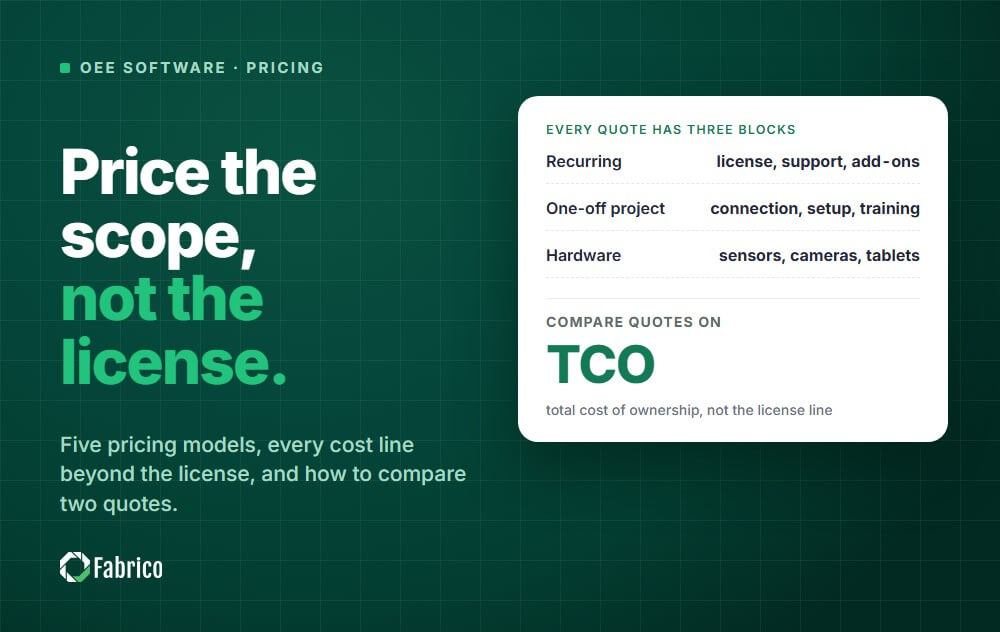
Almost every quote has three blocks, even when it shows one total.
Ask for them as separate lines to see which part grows with the next line or plant.
PLC-based measurement reads the existing machine controls: a clean signal, but each machine needs a PLC that can share its data. IoT sensors read power draw or a part count on older machines, and the operator adds the stop reason.
Computer vision OEE uses cameras over the line, so manual stations can be measured too. Each method carries a different hardware and installation cost, and one plant can mix all three.
Still choosing a tool? See our comparison of production monitoring systems, our review of OEE monitoring software and our guide to the best OEE software.
Each model decides what happens to your bill when you add a machine, a shift team or a plant, so pick the one that matches how you plan to grow.
| Pricing model | How it works | Fits best | Watch for |
|---|---|---|---|
| Per machine or per line | A fee for each machine or line that sends data. | A single-line pilot or a phased rollout. | Whether a sensor or camera counts as a machine, and how many users are included. |
| Per site | One fee per plant, often capped on machines or users. | One plant with every line and shift on the system. | The cap, and the price of the first machine past it. |
| Per user | A fee for each named person who logs in. | Small teams where a few engineers read the data. | Every operator and technician needs access, so seats add up. |
| Platform fee plus modules | A base fee, with OEE, CMMS or vision added as modules. | Plants that want OEE and the CMMS in one system. | Which tier holds what you need, such as ERP integration. |
| Enterprise agreement | One contract for several sites, with volume terms. | A multi-site group standardising on one system. | Minimum commitments, and billing for sites not yet live. |
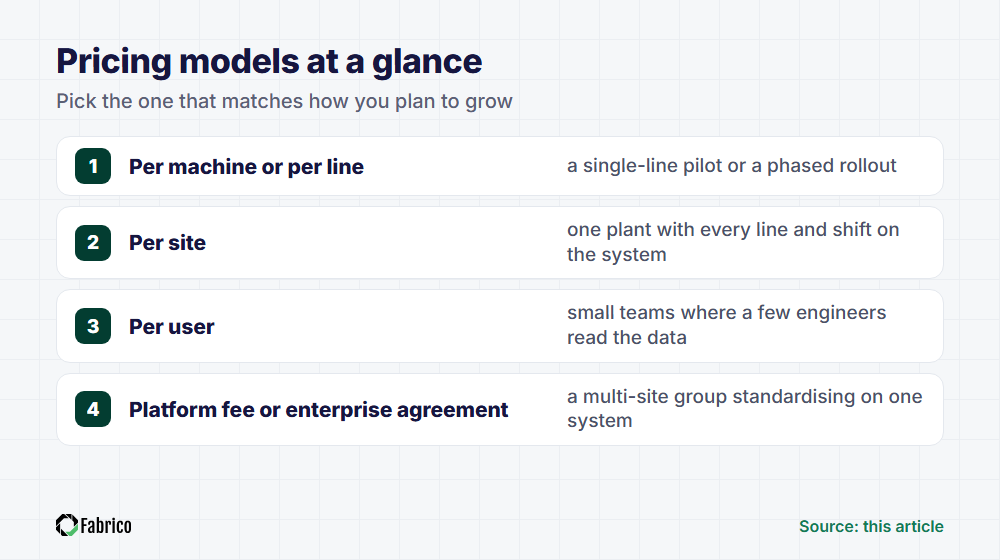
Many quotes mix two models. Whatever the mix, ask for the price of your first line and of each line after it, so you can see what every addition costs.
A pilot proves that the data is right and that the losses it reveals are worth recovering. An enterprise license pays to run that proof on every line and site.
Pilots are priced as a fixed project fee, the normal subscription on a small scope, or a fee credited against the full contract. Ask which applies before you start.
Pricing usually moves to a site or group basis with volume terms. Setup per line shrinks as the pilot's stop reasons and reports are reused, while training, ERP and MES integration and the support tier grow.
A multi-site group should not pay for several single plants added together. A group deal usually has three layers: a group platform fee or enterprise agreement, a per-site or per-machine element, and a rollout plan that adds plants in waves.
The biggest mistake in an OEE software evaluation is comparing license prices alone. The license is one line of the total cost of ownership (TCO), and in year one it is often not the largest.
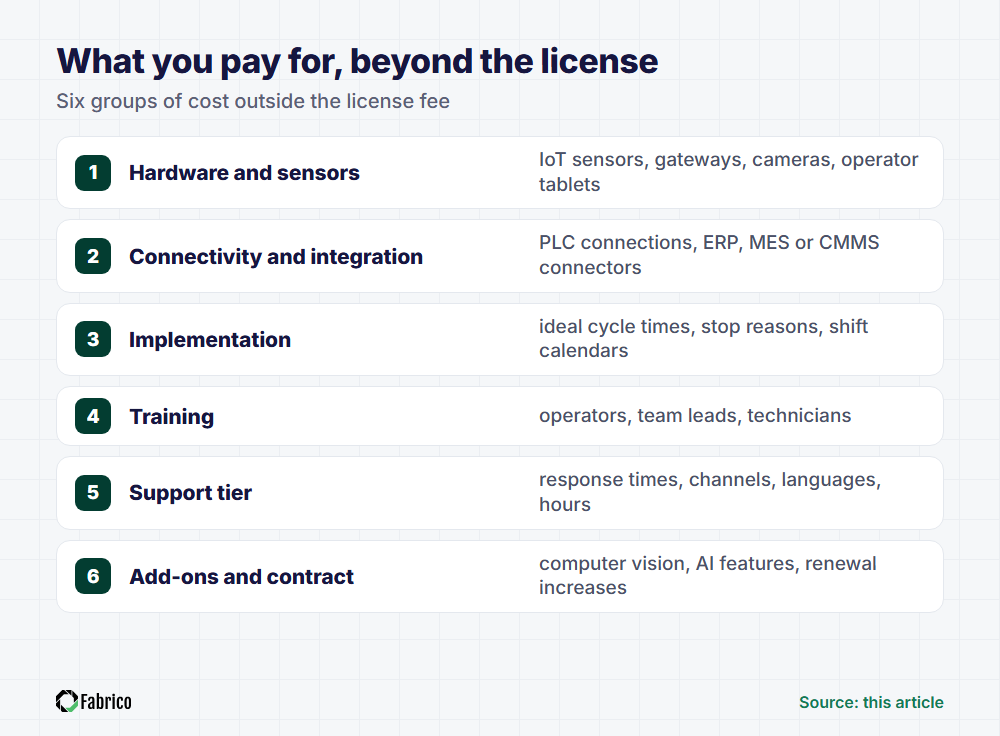
Mark each line in every quote as included, priced separately or missing.
A dashboard that only shows OEE tells you a machine stopped. Someone still has to find the cause, call a technician and log the repair in a separate CMMS, while the line waits.
That extra downtime never appears on a quote. A platform with a CMMS built in may cost more per month than a dashboard, but it shortens the hand-off, so ask each vendor to show the path from a logged stop to a closed repair.
Cloud-based OEE software is usually one subscription with hosting, backups and upgrades inside it. On-premise software moves the servers, patches, upgrades and IT time to you, on top of a license and yearly maintenance.
Two quotes are only comparable when they price the same scope. Have three answers ready before you ask for one.
With these answers a vendor can return a scoped quote in days instead of weeks.
| Question to ask | Why it matters | Red flag |
|---|---|---|
| What does the license count: machines, lines, sites or users? | It decides how the bill grows after the pilot. | A vague unit, or a different one per module. |
| What do the next line and the next plant cost? | The entry price says little about full scale. | A pilot price only, scale "to be discussed". |
| Which hardware is included, bought or rented? | Sensors, cameras and tablets are often priced outside the software. | No hardware line at all. |
| Which connections and integrations are in scope? | Integration is the most under-estimated line in most OEE projects. | "Standard connectors" with no list of systems. |
| Who sets up stop reasons, cycle times and shifts? | Wrong setup data makes the OEE figure wrong from day one. | Setup left to you, with no hours or template. |
| Which shifts do training and support cover? | Night shifts log stops and need answers too. | Support in office hours only. |
| What happens at renewal, and how do we export our data? | It sets your costs from year three and protects your stop history. | No cap on renewal increases, or export for a fee. |
A vendor that answers all seven clearly and in writing is usually one you keep. For the maintenance side, see our CMMS quote guide; for what to test in a demo, read how to evaluate OEE software for your plant.
Set the yearly value of the losses you recover against the total cost from your quotes. Use your own line data, not a vendor's average.
One bottle filling line runs 250 production days a year at a rated speed of 40 bottles a minute, with a margin of €0.10 per bottle. The team targets 15 minutes a day of short stops it can recover.
| Step | Calculation | Result |
|---|---|---|
| Recovered time | 15 minutes × 250 days | 3,750 minutes a year |
| Extra output | 3,750 minutes × 40 bottles | 150,000 bottles a year |
| Yearly value | 150,000 bottles × €0.10 margin | €15,000 a year |
| Monthly value | €15,000 ÷ 12 | €1,250 a month |
| Payback | Your first-year total cost ÷ €1,250 | Months to pay back |
Every input is a number your team can check, and your quotes go into the last row.
Fabrico is a cloud-based MES and OEE platform with maintenance management (CMMS) built in. It logs stops automatically from the PLC, an IoT sensor or a camera, operators tag the cause on a tablet, and a technician opens the work order in the built-in CMMS straight from the logged stop.
Fabrico's pricing is custom and not published. Each quote is built from your machines, how they connect, your sites and your integrations.
A pilot site is operational in days. For OEE with hardware, connecting the machines takes about a month and the full rollout 3 to 4 months, and most customers see ROI within 3 to 6 months.
See how customers use Fabrico, contact us with your line count for a scoped quote, or request a demo on a line like yours.
See how Fabrico unifies OEE and maintenance in one platform.
Request a demoIt depends on the number of lines, how each machine connects and how much integration you need. Ask for machine connection, setup, integration, training and the subscription as separate lines, so you can compare vendors on the same terms and see which part grows as you scale.
There is no honest single figure, because the price follows your scope: the number of machines, signal sources, hardware, integrations and sites. Ask vendors to price the same scope, then compare total cost of ownership over three years rather than the monthly license.
Multi-site deals usually combine a group-level fee with a charge for each plant or machine, and add plants on a schedule. Ask whether the first plant's setup is reused, whether a cross-site OEE dashboard costs extra, and how a small plant is priced.
A pilot is usually priced per machine, or as a fixed project with a short subscription, on one line. An enterprise license covers whole sites or the group, with volume terms, wider integrations and a higher support tier. Downtime tracking software follows the same models.
Fabrico gets a pilot site running in days. Where OEE needs hardware, installing and connecting the devices takes about a month, and the full rollout 3 to 4 months. Whichever vendor you choose, ask for a written rollout plan with dates for each site.
Often yes, if the scope is tight: a single line or a couple of critical machines, with success criteria agreed up front. Ask each vendor how the pilot is priced and whether the fee counts towards the full contract, and get the next step's price in writing.
Some vendors include basic hardware in the subscription, others sell or rent it separately. Software-only modules such as a CMMS need no machine hardware, while OEE needs a signal from each machine you measure, from a PLC, an IoT sensor or a camera, plus operator tablets.










 Login
Login
 Blog
Blog