"I don't need another graph. I need to know why my OEE dropped."
This is the common frustration of the Data Age. We have more charts than ever, but decision-making hasn't gotten faster.
Legacy Business Intelligence (BI) tools require you to be a data analyst. You have to filter, pivot, and drill down to find the root cause.
In 2026, AI-Powered Analytics flips the script. Instead of you hunting for insights, the software pushes them to you.
It uses Machine Learning to spot trends that are invisible to the human eye (like a 0.5% speed loss correlated with humidity).
Here are the 5 best tools that turn data into direction.
The Comparison Matrix (2026)
| Software |
Best For... |
Analytics Type |
AI Maturity |
Data Source |
| 1. Fabrico |
Operational Insights |
Prescriptive (Roadmap) |
Developing (Agent) |
Native (PLC/Vision) |
| 2. Sight Machine |
Enterprise Data |
Predictive |
High |
Data Lake |
| 3. Seeq |
Process Engineers |
Time-Series |
High |
Historian |
| 4. Power BI (Copilot) |
General BI |
Generative |
High (General) |
Connectors |
| 5. Braincube |
Process Optimization |
Digital Twin |
High |
IIoT Sensors |
1. Fabrico: The "Actionable" Analytics Platform
Verdict: The best choice for factories that want to turn analytics into Work Orders, not just presentations.
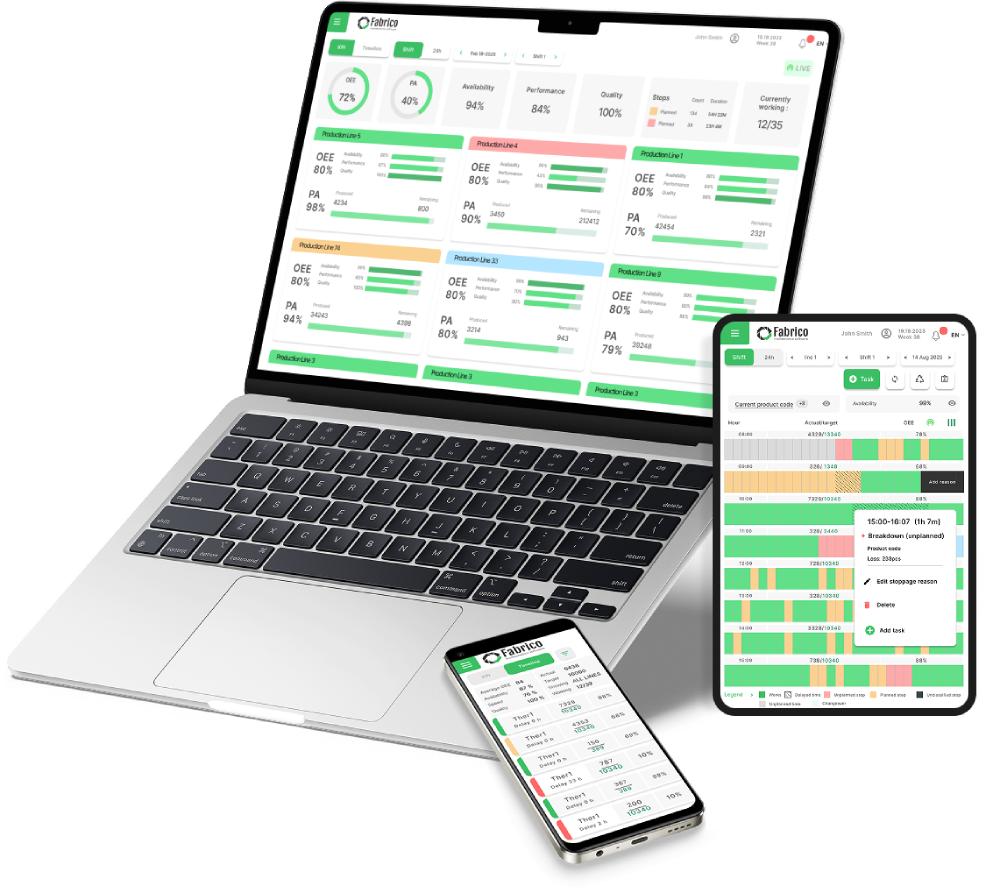
Fabrico is built on the belief that data is useless unless it drives action. Our analytics suite focuses on the "Six Big Losses" of OEE. While our core platform delivers best-in-class Descriptive Analytics (Real-Time OEE & Downtime), we are actively building the next generation of AI Agents.
Why It Wins on Insights:
-
The Foundation (Today): Fabrico captures the highest fidelity data in the industry by combining PLC Signals with Video Context. This ensures that your analytics are based on "Ground Truth," not manual guesses.
-
Visual Analytics: We don't just show a bar chart of "Top 5 Downtime Reasons." We let you click the bar to watch a Video Montage of those stops. This is "Visual Analytics"—instant context without spreadsheets.
-
Future Intelligence (In Development): Our roadmap includes the Fabrico Agent, an optimization engine designed to scan your production history and automatically flag opportunities (e.g., "Shift B runs 12% slower on Product X than Shift A. Recommended training on Setup.").
Best For: Plant Managers who want to link data directly to improvement tasks.
2. Sight Machine: The "Data Lake" Engine
Verdict: The heavyweight champion for global enterprises aggregating data from 50+ factories.
Sight Machine is a true "AI Platform." It ingests data from everywhere—SAP, SQL, PLCs, Historians—and normalizes it into a common model.
Pros:
-
Cross-Factory Benchmarking: It can compare a machine in Ohio with a machine in Germany, adjusting for different sensor types.
-
Correlations: Its AI finds hidden links (e.g., "Yield drops when raw material vendor is Acme").
Cons:
Best For: Global Fortune 500 manufacturers.
3. Seeq: The "Engineer's" Tool
Verdict: The standard for Process Engineers analyzing time-series data (pressures, temperatures, flows).
Seeq sits on top of your Data Historian (like OSIsoft PI). It uses AI to help engineers "search" data like Google.
Pros:
-
Pattern Recognition: You can highlight a "Good Batch" on a graph, and Seeq finds every other time that profile occurred in history.
-
Scalability: Handles billions of data points effortlessly.
Cons:
-
Expert Focus: It is designed for engineers, not for the maintenance technician or the line operator.
-
Disconnect: It identifies the issue, but doesn't natively manage the repair workflow.
Best For: Chemical, Oil & Gas, and Pharma.
4. Microsoft Power BI (with Copilot): The "Custom" Builder
Verdict: The most flexible tool for building your own AI dashboards, if you have the team to do it.
With the addition of Copilot, Power BI now allows you to ask questions like "Summarize the downtime trends for last month" and get an AI-generated narrative.
Pros:
Cons:
-
No Industrial Logic: It doesn't know what "OEE" is unless you teach it. You have to build the data model from scratch.
-
Maintenance: "Home-grown" dashboards often break when the person who built them leaves the company.
Best For: IT teams supporting the business with custom reports.
5. Braincube: The "Process" Twin
Verdict: An IIoT platform that uses Digital Twins to find the "Golden Batch" settings.
Braincube is excellent for continuous processes where quality is determined by complex variable interactions.
Pros:
-
Golden Batch AI: It tells you exactly what settings (Speed, Temp, Pressure) produce the best product based on historical analysis.
-
Edge Computing: Processes data close to the machine for speed.
Cons:
Best For: Paper, Steel, and Continuous Process industries.
Conclusion: Data is the Fuel, AI is the Engine
You can't have AI insights without a clean data pipeline.
-
If you need Process Engineering deep dives, buy Seeq.
-
If you need Global Benchmarking, buy Sight Machine.
-
If you want to build a High-Fidelity Data Foundation (PLC + Video) today that prepares you for the AI Agents of tomorrow, Fabrico is the 2026 solution.


 Login
Login
 Blog
Blog