There is a massive difference between a Maintenance Manager and a Reliability Manager.
-
The Maintenance Manager asks: "How quickly did we fix it?" (MTTR).
-
The Reliability Manager asks: "Why did it break, and how do we stop it from happening again?" (MTBF).
Most CMMS tools are built for the first question. They are excellent at logging repairs but terrible at analyzing root causes.
Asset Reliability Management Software is different. It is designed to extend the life of your equipment through data, prediction, and elimination of defects.
We reviewed the top 5 tools that help you manage Reliability, not just Repairs.
1. Fabrico (Best for Manufacturing Reliability)
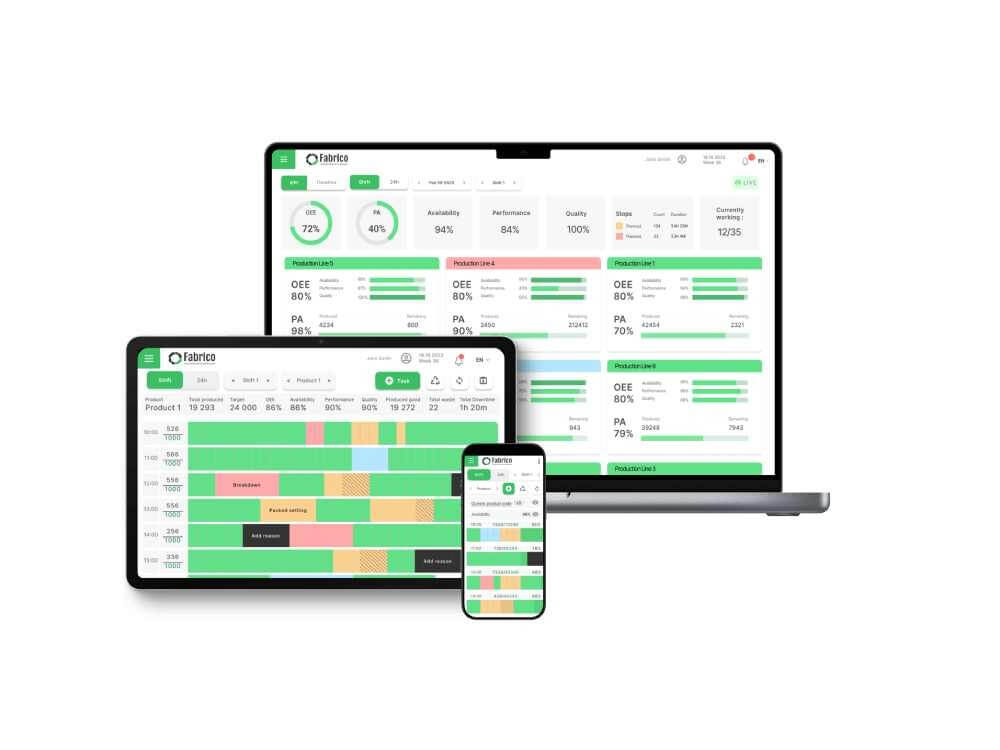
The Verdict: The only platform that combines Maintenance Execution, OEE Analytics, and Visual Root Cause Analysis to drive asset reliability.
Fabrico treats reliability as a "Factory-Wide" metric. Unlike traditional tools that only look at "Breakdown Count," Fabrico looks at "Performance Loss." It connects to the PLC to see if a machine is running at optimal speed.
If reliability drops (e.g., frequent micro-stops), it flags the asset as a "Bad Actor" and triggers a root cause workflow using Computer Vision evidence.
Key Reliability Features:
-
Bad Actor Analysis: Automatically ranks assets by "Downtime Hours" and "Frequency of Stops" (Pareto Analysis).
-
Inefficiencies Zoom-In: Uses cameras to capture the exact moment of failure. You can't improve reliability if you don't know why it broke.
-
Unified OEE: Correlates Maintenance efforts with Production results. Did the PM actually improve the machine's speed?
-
Condition-Based Triggers: Moves you from "Guesswork PMs" to "Usage-Based PMs" via PLC integration.
Best For: Reliability Engineers in manufacturing who need to prove the link between maintenance and production uptime.

2. IBM Maximo (Best for Heavy Industry & Utilities)
The Verdict: The global standard for enterprise reliability in complex sectors like Utilities, Oil & Gas, and Transportation.
Maximo (part of IBM Manage) is the heavyweight champion. It is designed for assets where failure is catastrophic (e.g., a power plant turbine). It has deep "Reliability Centered Maintenance" (RCM) modules and integrates with IBM Watson for AI prediction. It is incredibly powerful but requires a massive budget and team to maintain.
Pros:
-
Deepest RCM and FMEA (Failure Mode and Effects Analysis) capabilities.
-
Excellent for linear assets (pipelines, rail) and complex fleets.
-
Predictive maintenance via IBM Watson IoT.
Cons:
-
Complexity: Not user-friendly for the average factory technician.
-
Cost: Enterprise-level pricing (CapEx heavy).
-
Slow to Adapt: Changing workflows often requires IT intervention.
Best For: Massive enterprises (Energy, Rail, Government) managing critical infrastructure.
3. Fiix (Best for Asset Risk Prediction)
The Verdict: A strong cloud-based tool that uses AI to forecast asset failure risks based on historical data.
Fiix (by Rockwell Automation) has a specific focus on "Asset Risk." Its "Fiix Foresight" AI engine analyzes your historical work orders to predict which assets are likely to fail next. This helps Reliability Managers prioritize their budget and PM schedules. It is a great bridge between a standard CMMS and a full Reliability suite.
Pros:
-
"Asset Risk" AI scoring is easy to understand.
-
Strong integration with Rockwell Automation hardware.
-
Multi-site benchmarking allows you to compare asset performance across plants.
Cons:
-
OEE Gap: While it predicts risk, it doesn't natively track real-time OEE (Production Speed) without integration.
-
Documentation: SOP builder is less visual than some modern competitors.
Best For: Organizations that want AI-driven risk forecasting without the complexity of Maximo.
4. UpKeep (Best for Asset Operations)
The Verdict: A mobile-first platform that focuses on "Asset Operations"—keeping assets running through better communication.
UpKeep positions itself as an "Asset Operations Management" platform. It is excellent at capturing data from the floor via mobile. While it lacks the deep engineering analysis tools (like Weibull curves) of Maximo, its "Meters" feature allows you to trigger maintenance based on simple IoT sensor readings (Temperature, Vibration).
Pros:
-
Excellent mobile app ensures high data capture from technicians.
-
"Meters" feature allows for easy condition-based triggers.
-
Simple, clean dashboards for tracking uptime.
Cons:
Best For: Light manufacturing and facilities focusing on operational visibility.
5. Limble CMMS (Best for MTBF/MTTR Basics)
The Verdict: The easiest way to start tracking core reliability metrics (MTTR/MTBF) automatically.
Limble is fantastic at the basics. It automatically calculates Mean Time Between Failures (MTBF) and Mean Time To Repair (MTTR) for every asset based on work order history. If your reliability program is currently "Zero" (just fixing things), Limble gives you the baseline metrics you need with zero setup effort.
Pros:
-
Automated MTTR/MTBF reports.
-
"Custom Fields" allow you to track specific failure codes easily.
-
Very high adoption rate among technicians.
Cons:
Best For: Smaller teams starting their reliability journey from scratch.
Comparison Matrix: The 2026 Landscape
| Feature |
Fabrico |
IBM Maximo |
Fiix |
UpKeep |
Limble |
| Primary Focus |
OEE + Reliability |
Infrastructure RCM |
Risk Prediction |
Asset Ops |
Basic Metrics |
| Bad Actor Analysis |
✅ Auto-Pareto |
✅ Advanced |
✅ AI Risk Score |
⚠️ Manual |
✅ Basic |
| Visual Root Cause |
✅ Video Zoom-In |
❌ No |
❌ No |
❌ No |
❌ No |
| OEE Integration |
✅ Native |
❌ No |
⚠️ Integrated |
❌ No |
❌ No |
| User Experience |
Modern / Fast |
Complex |
Modern |
Mobile-First |
Simple |
Conclusion: Reliability Requires Context
If you are running a Nuclear Plant, buy Maximo. If you want simple metrics, buy Limble.
But if you are a Manufacturer who wants to improve reliability by connecting the Machine's Reality (PLC/OEE) with the Technician's Action (Video/Repair), Fabrico is the only tool built for that unified mission.
Stop fixing. Start improving.
[Request a Demo] and see how Fabrico identifies your Bad Actors instantly.


 Login
Login
 Blog
Blog