Every plant manager has experienced the frustration of a daily production meeting where the numbers simply do not add up.
Your end-of-shift spreadsheet proudly displays an 82% Overall Equipment Effectiveness (OEE) score.
Yet, your shipping dock is entirely empty, and you missed your On-Time In-Full (OTIF) delivery targets by a massive margin.
The discrepancy exists because your performance data is completely subjective.
When operators are forced to manually log every downtime reason on a clipboard or a disjointed tablet app, they default to generic codes like "General Fault" or "Unknown."
Strategic operations directors know that running a factory on human estimation is a boardroom fiduciary risk.
If your continuous improvement team has to guess why a machine lost twenty minutes of capacity, you cannot execute a successful Kaizen event.
You must completely remove the friction of data collection from the shop floor.
Your factory requires a system that automatically extracts undeniable truth directly from the equipment.
What is an Automatic OEE Tracking System?
An automatic OEE tracking system is a digital manufacturing platform that connects directly to a machine's Programmable Logic Controller (PLC) or IoT sensors to calculate availability, performance, and quality in real time without requiring manual operator data entry.
The High Cost of the "Subjectivity Tax"
Manual OEE calculation is a legacy habit that actively destroys your profit margins.
In a high-speed manufacturing environment, operators are paid to keep the machines running, not to act as administrative data clerks.
If a packaging line jams and takes thirty seconds to clear, the operator will not spend two minutes logging the event into a software terminal.
This creates a massive "Hidden Factory" composed entirely of undocumented micro-stops and reduced speed losses.
By the end of the month, these unrecorded events compound into hundreds of hours of lost production capacity.
Furthermore, when operators manually categorize downtime, they often shield themselves or other departments from blame.
To achieve true operational excellence, your data must be objective, instantaneous, and machine-validated.
Comparison Matrix: Top 5 Automatic OEE Platforms
| Feature |
Fabrico |
MachineMetrics |
Evocon |
Redzone |
SAP MII |
| Direct PLC Connectivity |
Yes (Native) |
Yes |
No (Hardware Pulse) |
Partial |
Yes (Complex) |
| Computer Vision Zoom-In |
Yes (Visual RCA) |
No |
No |
No |
No |
| Native CMMS Execution |
Yes (Fault-to-Fix) |
No |
No |
Partial |
No (Needs SAP PM) |
| Interactive Planning Board |
Yes (Maintenance-Aware) |
No |
No |
No |
No |
| Deployment Speed |
30 Days (Pilot) |
Fast |
Fast |
Slow |
12+ Months |
1. Fabrico (The Unified System of Action)
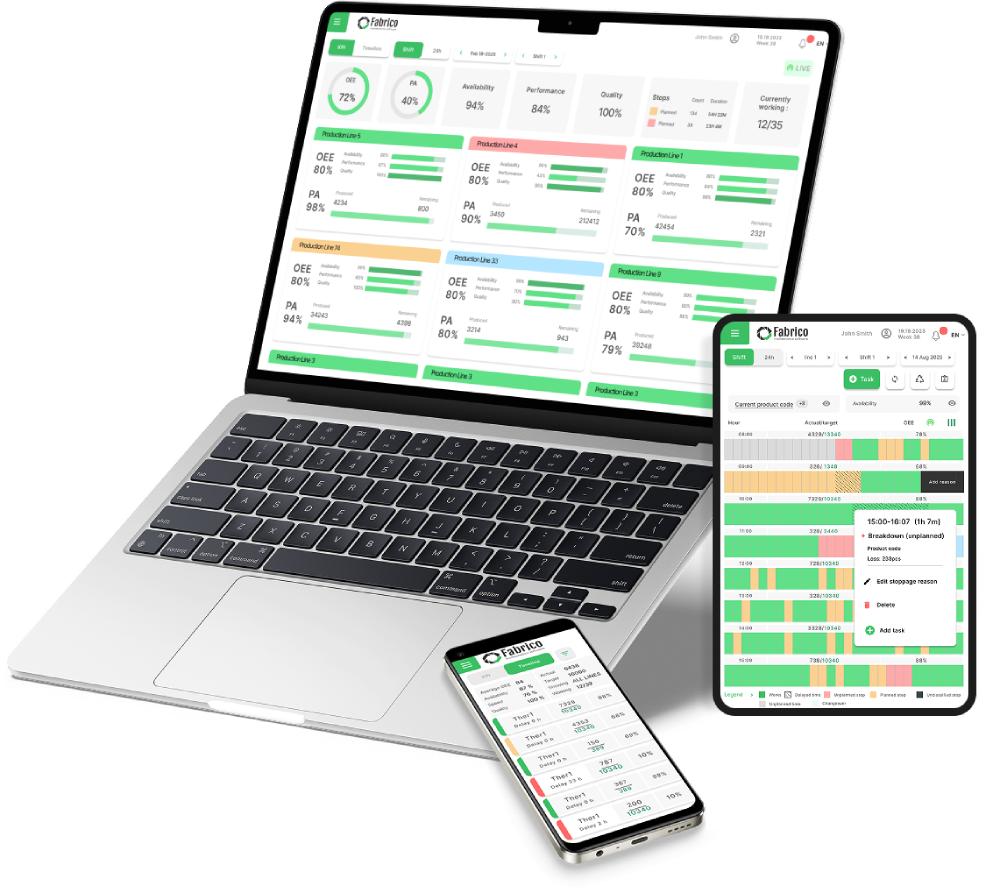
Fabrico is the definitive manufacturing execution platform because it guarantees 100% visibility into your production inefficiencies.
It completely automates OEE tracking by offering three flexible connectivity options tailored to your factory's exact maturity level.
For modern equipment, Fabrico connects directly to your existing PLCs to automatically capture cycle starts, stops, and error codes.
For legacy equipment, Fabrico deploys rapid-install IoT gateways and optical sensors to pull accurate pulse data without requiring complex rewiring.
However, Fabrico’s ultimate competitive advantage is its Computer Vision Zoom-In module, which captures what traditional sensors cannot see.
When a machine automatically registers a micro-stop, cameras positioned above the line capture a short, synchronized video clip of the event.
Instead of relying on an operator to explain the jam, your continuous improvement engineers can simply watch the video replay to validate the exact root cause.
Because Fabrico is a unified "System of Action," this automatic data does not just sit on a dashboard.
When a performance drop is detected, Fabrico automatically generates a condition-based work order via its native, field-ready mobile CMMS.
Additionally, Fabrico is actively developing the Fabrico Agent—an AI optimization engine currently on the roadmap—that will automatically analyze these historical data patterns to suggest real-time schedule refinements.
By unifying automatic machine data, visual evidence, and immediate maintenance execution, Fabrico turns passive monitoring into active profit generation.
2. MachineMetrics
MachineMetrics is an incredibly powerful Industrial IoT platform designed primarily for discrete manufacturing and CNC machining environments.
It excels at pulling high-frequency, complex data sets directly from modern machine controls via advanced edge devices.
The software automatically categorizes downtime and provides highly detailed analytics regarding spindle speeds, feed rates, and tooling wear.
The critical limitation is that MachineMetrics operates strictly as a monitoring and analytics tool.
It lacks the native CMMS execution capabilities required to dispatch a technician, manage spare parts inventory, or govern preventive maintenance schedules.
You will have perfect automatic data, but you will still have to purchase a second software platform to actually execute the repair.
3. Evocon
Evocon is a highly visual, user-friendly OEE tracking system that relies on a simple hardware device to capture production pulses.
It is incredibly fast to install and immediately provides management with real-time speed tracking and shift reports.
While the system automatically detects when a stoppage occurs, it still relies entirely on the operator to tap a screen to explain why it occurred.
This means your data remains highly susceptible to human error, subjectivity, and the dreaded "Unknown" downtime category.
Evocon will accurately tell you that you lost capacity, but it lacks the visual root cause analysis required to permanently eliminate the bottleneck.
4. Redzone
Redzone is a premium frontline operations platform that focuses heavily on cultural transformation and Lean manufacturing coaching.
It utilizes iPads on the shop floor to drive communication, standardize shift handovers, and track basic OEE metrics.
While it can connect to machines for basic pulse tracking, its core philosophy relies heavily on operator engagement and manual interactions.
This semi-automatic approach means your operators are still burdened with administrative tasks during high-stress breakdown scenarios.
Without Computer Vision or deep PLC error-code mapping, your engineering teams are still relying on subjective frontline narratives to solve complex mechanical issues.
5. SAP MII / OEE (The Legacy Giant)
SAP Manufacturing Integration and Intelligence (MII) provides ultimate financial governance for massive global enterprises.
When properly configured, it can automatically pull data from the shop floor and instantly update corporate ERP ledgers and material consumption rates.
Unfortunately, SAP is notoriously rigid and incredibly hostile to the realities of an agile shop floor.
Connecting SAP directly to individual PLCs often requires armies of external IT consultants and months of complex, highly expensive integration work.
Furthermore, because its user interface is designed for accountants rather than technicians, executing the subsequent maintenance work order remains a slow, painful process.
The Fabrico Framework: The Machine-Validated Truth
The Fabrico Framework operates on the core principle that production data is only valuable if it is an undeniable fact.
You cannot maximize your asset utilization if your board-level metrics are based on operator guesswork and delayed spreadsheet entry.
To reclaim your hidden factory, you must transition entirely to Machine-Validated Truth.
When an industrial robot slows down, the PLC automatically notifies Fabrico, the camera records the anomaly, and the interactive planning board automatically adjusts the schedule.
This closed-loop system removes human bias, eliminates administrative latency, and ensures that your continuous improvement team is always solving real problems.
Conclusion: Your Next Step
Accepting manual, unverified OEE data is a failure of manufacturing leadership.
Every time your operators falsify a downtime reason code just to clear a screen, your company absorbs the cost of unsolved inefficiencies.
You must abandon disjointed apps, paper clipboards, and passive dashboards that merely report the news.
Implement an automatic OEE tracking system that pulls data directly from the machine, validates it with video evidence, and executes the repair via a native CMMS.
Equip your factory with a true system of action, and you will permanently close the gap between reporting a loss and reclaiming your revenue.


 Login
Login
 Blog
Blog