Manufacturing Building Materials (Shingles, Siding, Drywall, Insulation) is a unique mix of Process Manufacturing and Web Handling.
You are managing massive ovens, high-speed rollers, and chemical mixers.
-
If a Bearing seizes in the oven, the board burns.
-
If the Web Tension is off, the shingles tear.
-
If a Mixer clogs, the entire line shuts down.
Generic "Facility" software cannot handle this. It treats a 300-foot continuous drywall line like a collection of separate assets.
It misses the interconnected nature of the process.
You need Continuous Process Maintenance Software that links Line Speed (OEE) to Asset Health.
Here are the 7 Best CMMS Software Tools for Building Materials in 2026.
1. Fabrico: The "Continuous Reliability" Solution
Best For: Manufacturers who need to link Web Speed and Quality to Maintenance.
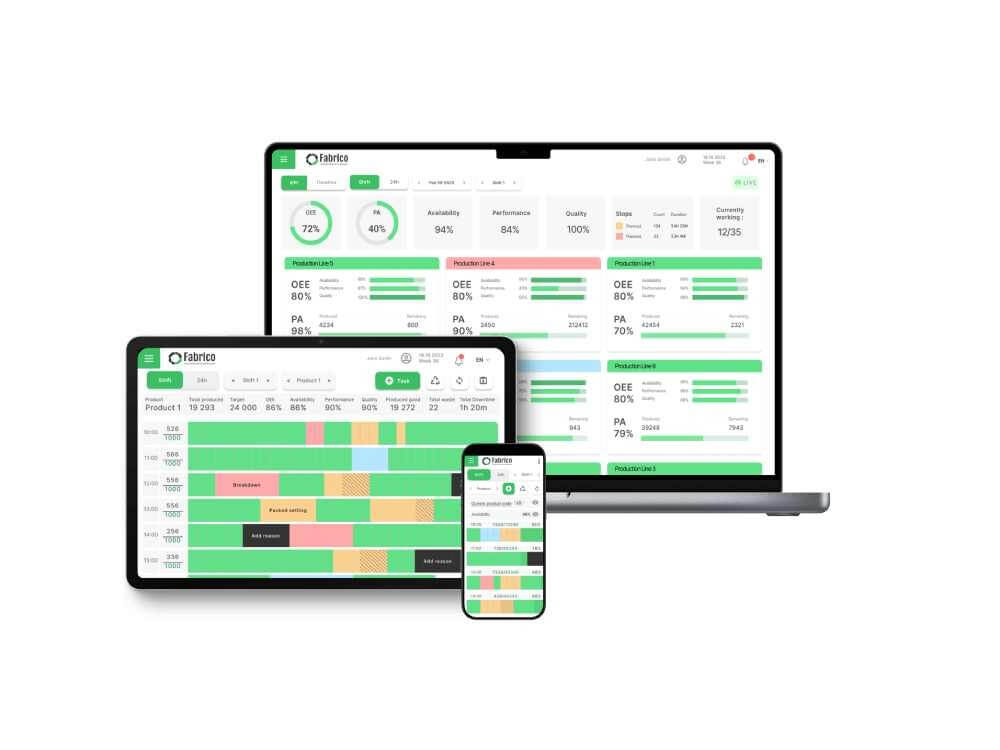
Fabrico excels in Building Materials because it understands the "Continuous Line." We connect the sensor data from the wet end (mixing) to the dry end (packaging) in one platform.
Why Plant Managers Choose Fabrico:
-
Line Speed Monitoring (OEE): Fabrico connects to the line PLC. It tracks not just "Downtime," but "Speed Loss." If your shingle line slows down by 5% due to a worn roller, Fabrico alerts Maintenance immediately.
-
Wear Part Tracking: Gypsum and fiberglass destroy equipment. Fabrico tracks the "Tonnage" or "Linear Feet" processed by specific assets. It triggers a "Replace Liner/Blade" work order based on actual usage, preventing catastrophic failure.
-
Thermal Monitoring: Ovens and kilns are critical. Fabrico ingests temperature data. If a zone drifts out of spec, it triggers a calibration work order, saving the product quality.
-
Digital Handover: These plants run 24/7. Fabrico’s Digital Shift Handover ensures the night shift knows exactly which motor was vibrating during the day shift.
The Verdict: If you want to keep the web moving and the quality high, Fabrico is the specialized choice.

2. IBM Maximo
Best For: Global conglomerates (Saint-Gobain, Owens Corning scale).
Maximo is the standard for massive multi-site enterprises.
-
Pros: Unmatched Supply Chain integration. If you need to share spare parts between 50 factories globally, Maximo handles the logistics perfectly.
-
Cons: It is heavy and expensive. Implementation takes years. It is often too complex for the local plant maintenance team to configure for day-to-day agility.
-
The Niche: Global Enterprise.
3. Aveva (Asset Performance)
Best For: Process control integration.
Aveva (formerly Wonderware) is strong on the "Wet End" or "Hot End" of the process.
-
Pros: Deep integration with SCADA/HMI. It gives engineers a perfect view of the chemical mixing or melting process. Excellent for energy management.
-
Cons: It is an engineering tool, not a workflow tool. It monitors the process well but is less effective at managing the "Wrench Time" of the mechanical team.
-
The Niche: Process Engineering.
4. Fiix (Rockwell Automation)
Best For: Automated packaging and palletizing.
The "End of Line" (bundling shingles, stacking drywall) is heavily automated. Fiix connects well here.
-
Pros: Strong integration with Rockwell hardware. AI-driven insights help predict failures on robotic palletizers and wrappers.
-
Cons: It is a generalist tool. It requires configuration to handle the specific "Continuous Web" logic of the upstream manufacturing process.
-
The Niche: Automated Finishing.
5. eMaint (Fluke)
Best For: Vibration analysis on rollers and fans.
Building material lines have hundreds of rollers. Vibration is the enemy.
-
Pros: Seamless connection to Fluke vibration sensors. Great for route-based maintenance to check for bearing wear on long conveyor runs.
-
Cons: The interface is dated. It lacks the modern OEE visualization that helps you understand the cost of that bearing wear in terms of lost speed.
-
The Niche: Condition Monitoring.
6. UpKeep
Best For: Facility and fleet management.
If you need to manage the forklifts in the yard and the HVAC in the warehouse, UpKeep is solid.
-
Pros: Very easy to use. Great for managing the mobile fleet that moves raw materials.
-
Cons: It lacks the deep "Process" integration. It treats the massive production oven the same way it treats a dock door.
-
The Niche: Yard & Fleet.
7. Limble CMMS
Best For: Quick adoption.
Limble is the "Low Friction" tool for teams moving off paper.
-
Pros: Technicians love the app. It is very fast to implement.
-
Cons: Like UpKeep, it is a maintenance island. It doesn't natively integrate with the line PLCs to track OEE or web speed.
-
The Niche: Rapid Digitization.
Comparison Matrix: Process vs. Discrete
| Feature |
Fabrico |
Maximo |
Aveva |
Fiix |
eMaint |
| Line Speed (OEE) |
✅ Native |
❌ Custom |
✅ Native |
⚠️ Add-on |
❌ No |
| Wear Part Logic |
✅ Usage |
✅ Deep |
⚠️ Basic |
✅ Good |
⚠️ Basic |
| Thermal Monitoring |
✅ Native |
✅ Custom |
✅ Deep |
⚠️ Add-on |
✅ Native |
| Mobile UX |
Excellent |
Complex |
Complex |
Good |
Dated |
| Setup Speed |
Weeks |
Years |
Months |
Months |
Months |
Summary: Keep the Web Moving
In building materials, you make money on volume. Every minute the line stops is tons of product lost.
-
Choose Maximo if you are a global giant standardizing financials.
-
Choose Aveva if you are focused purely on process control.
-
Choose Fabrico if you are a Plant Manager. If you need to monitor the entire line—from the mixer to the palletizer—and trigger maintenance based on real-time speed and wear data, Fabrico is the unified solution.
Built for the heavy jobs.
[Book a Demo with Fabrico] to see how we handle continuous process maintenance.


 Login
Login
 Blog
Blog