In 2026, a "Smart Factory" cannot run on manual data entry.
If your maintenance strategy relies on a technician walking up to a machine, reading an hour meter, writing it on a clipboard, and then typing it into a computer, you are living in the past. This process is slow, error-prone, and enables "pencil whipping."
The modern standard is Direct PLC Integration.
Your production machines (Siemens, Allen-Bradley, Omron, Mitsubishi) already know exactly how many cycles they have run, what their temperature is, and why they stopped.
You need a CMMS that listens. Here are the 5 best CMMS tools with Direct PLC Integration to automate your maintenance.
Why "PLC Integration" is the Future of CMMS
Connecting your CMMS to the Programmable Logic Controller (PLC) changes maintenance from Reactive to Automated.
-
Accuracy: No more typos. The "Run Hours" in your CMMS match the machine exactly.
-
Timeliness: Instead of waiting for a monthly manual check, the PM is triggered the second the machine hits 500 hours.
-
Context: The PLC provides the exact error code (e.g., "Fault 304: Servo Overload"), saving the technician 30 minutes of diagnosis time.
Top 5 CMMS Software with Direct PLC Integration (Ranked)
1. Fabrico
Best For: Native Connectivity & Unified Data.
The "Plug-and-Play" Advantage:
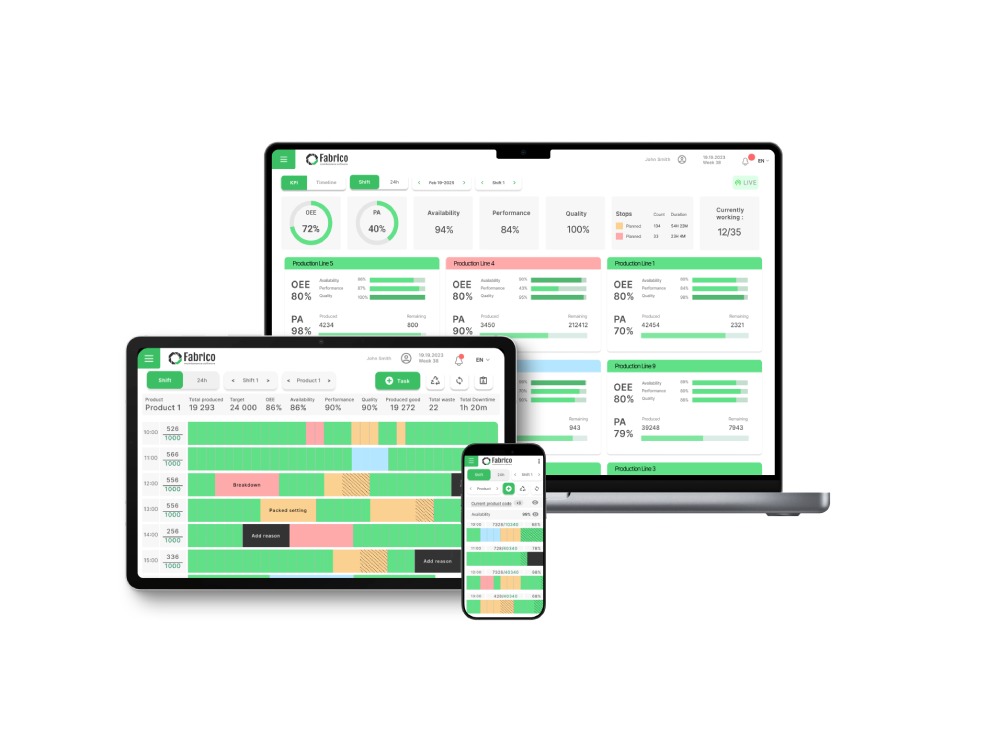
Fabrico is built on the philosophy of Unified Data Intelligence. It doesn't treat PLC connectivity as an expensive "Add-On"; it is the core of the platform.
Fabrico connects to your existing machine controllers (via standard protocols like OPC-UA, Modbus, or native drivers) to pull critical tags:
-
Cycle Counts: To drive Usage-Based Maintenance.
-
Machine State: To calculate OEE (Availability).
-
Fault Codes: To trigger Corrective Work Orders automatically.
How It Works:
When the PLC registers a "Fault," Fabrico instantly creates a Work Order, assigns it to the right technician, and populates the ticket with the specific error code and machine status. No human intervention required.
Pros:
-
Eliminates the "Middleware" complexity of many enterprise tools.
-
Uses the same data stream for OEE and Maintenance, ensuring total alignment.
-
Fast setup for common industrial protocols.
Cons:
2. Fiix (Rockwell Automation)
Best For: Rockwell / Allen-Bradley Ecosystems.
Overview:
Since being acquired by Rockwell Automation, Fiix has become the premier choice for factories running on Allen-Bradley PLCs. Its "Integration Hub" allows for deep, seamless communication between the factory floor hardware and the cloud software.
Key Integration Features:
-
FactoryTalk Integration: Native talk with Rockwell's SCADA/MES layer.
-
Tag Mapping: Drag-and-drop mapping of PLC tags to asset fields.
-
Predictive Models: Uses historical tag data to predict asset health (Asset Risk Predictor).
Pros:
Cons:
-
Cost: The integration capabilities often come with a higher enterprise price tag.
-
Can be more complex to set up in "Mixed Fleet" environments (e.g., connecting to older Siemens or Mitsubishi PLCs).
3. Limble CMMS + IoT
Best For: Add-On Hardware Connectivity.
Overview:
Limble CMMS offers a robust "IoT" module. While it can connect to PLCs via APIs, their preferred method is often using IoT Sensor Bridges. This is a great solution if your PLCs are old, locked, or if your IT department won't let you touch the network.
Key Integration Features:
-
Sensor Bridge: Hardware that sits between the machine and the cloud.
-
REST API: Open API allows customized connections if you have developers.
-
Threshold Rules: Simple "If/Then" logic for triggering tasks.
Pros:
Cons:
4. Fracttal
Best For: IoT-Native Asset Management.
Overview:
Fracttal is a CMMS designed from day one as an "Internet of Things" platform. Its "Fracttal Sense" device and software layer are designed to read signals directly from control units and sensors to visualize asset health in real-time.
Key Integration Features:
-
Fracttal Sense: Dedicated IoT hardware.
-
Live Dashboard: Real-time visualization of PLC variables (Temp, Speed, Vibration).
-
Predictive Logic: Built-in algorithms to analyze the data stream.
Pros:
Cons:
5. UpKeep Edge
Best For: Sensor Integration (Facilities).
Overview:
UpKeep Edge is the IoT wing of the popular UpKeep CMMS. It focuses heavily on connecting to Sensors and Gateways rather than deep PLC logic. It is ideal for reading simple values like Temperature, Humidity, or Vibration from add-on devices.
Key Integration Features:
-
Sensor Ecosystem: Integration with Monnit, Samsara, and other sensor brands.
-
Edge Gateway: Hardware to collect and transmit data.
-
Alerts: SMS/Email triggers based on data thresholds.
Pros:
Cons:
Comparison Matrix: Connectivity Depth
| Feature |
Fabrico |
Fiix |
Limble CMMS |
Fracttal |
UpKeep Edge |
| Connectivity Type |
Native PLC (OPC-UA) |
Rockwell Native |
IoT Bridge / API |
IoT Native |
Sensor Gateway |
| Trigger Logic |
Advanced (CBM/OEE) |
Advanced |
Simple Rules |
Advanced |
Simple Thresholds |
| Requires Middleware? |
No |
No (for Rockwell) |
Often |
No |
Yes (Gateway) |
| Best For |
Mixed Mfg. Fleets |
Rockwell Sites |
IT-Restricted Sites |
Tech-First Teams |
Facilities Sensors |
The ROI of PLC Integration
Why bother with the cables and IP addresses?
-
Calendar PMs: You service the machine every 30 days. (Cost: High, Accuracy: Low).
-
PLC Usage PMs: You service the machine every 10,000 cycles. (Cost: Optimized, Accuracy: 100%).
Switching to Usage-Based Maintenance via PLC integration typically reduces maintenance costs by 20% and breakdowns by 50%.
Conclusion
-
If you are a Rockwell Shop, choose Fiix.
-
If you need to monitor Temperature/Vibration via add-on sensors, choose UpKeep.
-
If you want to connect your Mixed Fleet (Siemens, Omron, AB) directly to your maintenance workflow to trigger automated, data-driven actions, Fabrico is the best choice.
Let your machines talk. Connect them with Fabrico.


 Login
Login
 Blog
Blog