There is a constant tension between Maintenance and Finance.
Maintenance needs the part now.
Finance needs the Purchase Order (PO) approved first.
This friction leads to "Shadow Purchasing." Technicians drive to the local hardware store, swipe a company card, and lose the receipt.
Or worse, they hoard parts in their lockers so they don't have to deal with the purchasing department.
This destroys your inventory accuracy and blows up your budget.
To solve this, you need a CMMS with Native PO Management.
You need a system where the "Need" (Work Order) seamlessly creates the "Purchase" (PO) without double entry.
Here are the 6 best CMMS tools that satisfy the Finance Director while keeping the Maintenance Manager moving.
1. Fabrico (Best for Just-in-Time Ordering & Vendor Logic)
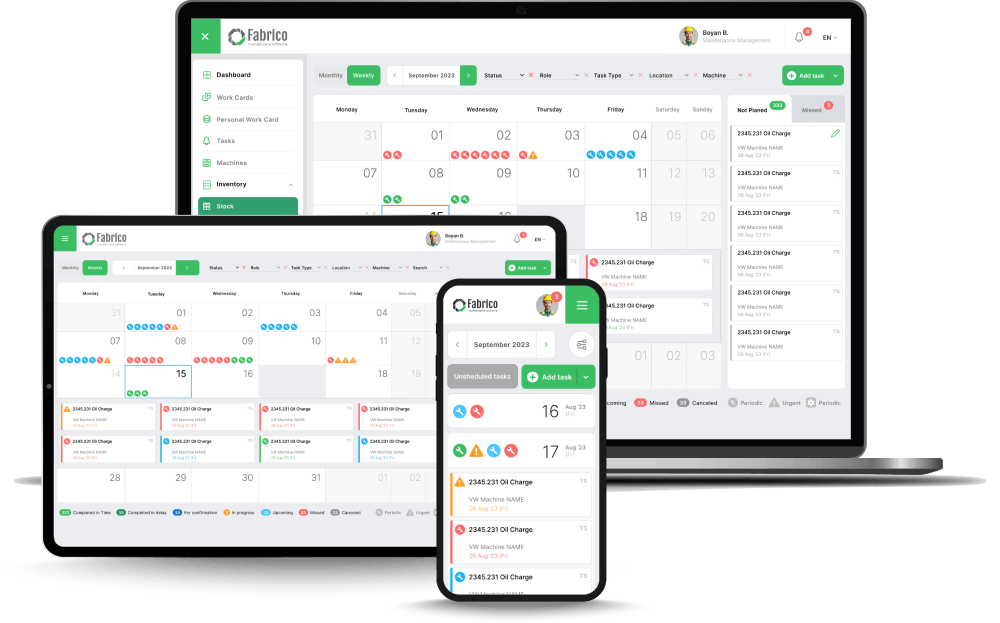
Fabrico simplifies the purchasing chain by linking it directly to the machine's needs.
Instead of purchasing happening in a silo (Email/Phone), it happens inside the maintenance workflow.
If a technician scans a machine and sees a "Low Stock" alert for a filter, they can trigger a Purchase Request instantly.
Key Purchasing Features:
-
Low-Stock Triggers: Automatically suggests a PO when inventory hits the "Min" level. No more manual stock checks.
-
Vendor Management: Stores supplier catalogs and pricing history. You know exactly what you paid last time vs. what they are quoting now.
-
Receipt to Inventory: When the part arrives, receiving it against the PO automatically updates the "Quantity on Hand" in the storeroom. One click, two updates.
-
Cost Allocation: Automatically assigns the shipping and part cost to the specific asset (Total Cost of Ownership), not just a general ledger code.
Best For: Maintenance teams who need to streamline the "Request-to-Stock" cycle.
2. eMaint (Best for Complex Approval Workflows)
eMaint (by Fluke) is a powerhouse for Workflow Logic.
If your company has strict financial rules (e.g., "Requests under $500 go to Mike; Requests over $500 go to Paula; Requests over $5,000 go to the VP"), eMaint handles this perfectly.
It allows for complex routing of approvals via email. It creates a rigid audit trail that satisfies even the strictest corporate controllers.
Best For: Large enterprises with complex, multi-tier financial approval hierarchies.
3. Fiix (Best for RFQ Management)
Fiix (by Rockwell) adds a layer for RFQs (Request for Quotes).
Before you cut a PO, you might want to ask three vendors for a price. Fiix allows you to manage this bidding process inside the software.
It allows you to send the RFQ to multiple vendors and convert the winning bid into a PO seamlessly. This is great for expensive, non-stock items like motors or gearboxes.
Best For: Teams that frequently bid out expensive spare parts.
4. Limble CMMS (Best for Simple Purchasing)
Limble keeps purchasing simple and visual.
It focuses on the Vendor Card. You can see exactly what you buy from Grainger vs. McMaster-Carr.
It has a straightforward "Parts Needed" dashboard. It doesn't have the complex multi-tier routing of eMaint, but for a team of 5-10 techs, it removes the friction of "ordering stuff."
Best For: Smaller teams needing a lightweight purchasing tool.
5. UpKeep (Best for Mobile Requests)
UpKeep excels at the Technician Request.
Because their mobile app is so strong, it makes it very easy for a tech in the field to say, "I need to buy this."
They can snap a photo of a part, attach it to a Purchase Request, and send it to the manager. It reduces the "forgot to order it" problem by capturing the need at the point of discovery.
Best For: Teams where technicians are empowered to initiate purchase requests from the field.
6. Procurify (Best Non-CMMS Option)
Procurify is not a CMMS; it is a dedicated Spend Management platform.
Sometimes, Finance refuses to let Maintenance do purchasing inside the CMMS. They want one purchasing tool for the whole company (Marketing, IT, Maintenance).
Procurify is excellent for this. However, it requires an integration (API) to talk to your CMMS. If you don't integrate it, you have to manually update inventory levels when parts arrive, which is a risk.
Best For: Companies where Finance mandates a centralized purchasing platform outside of Maintenance.
Comparison: Who holds the checkbook?
Which tool fits your financial controls?
| Feature |
Fabrico |
eMaint |
Fiix |
Limble |
UpKeep |
Procurify |
| Primary Strength |
Auto-Replenish |
Approval Workflow |
RFQ / Bidding |
Simplicity |
Mobile Request |
Company Spend |
| CMMS Native |
Yes |
Yes |
Yes |
Yes |
Yes |
No (Integration) |
| Min/Max Trigger |
Yes |
Yes |
Yes |
Yes |
Yes |
No |
| Workflow Logic |
streamlined |
Complex |
Advanced |
Simple |
Simple |
Advanced |
| Vendor Mgmt |
Yes |
Yes |
Yes |
Yes |
Yes |
Yes |
Conclusion: Stop the "Credit Card" Maintenance
Purchasing shouldn't be a battle.
If you have complex corporate governance, eMaint allows you to map every rule.
If you need to manage competitive bidding, Fiix helps you save money.
But if you want to ensure that Critical Spares are replenished automatically so that machines never stop waiting for a part, Fabrico offers the tightest integration between the machine's health and the inventory shelf.
Ready to automate your reordering?
See how Fabrico triggers POs from low inventory levels automatically.
Book a Demo with Fabrico Today


 Login
Login
 Blog
Blog