Sensors are great, but they are blind.
A PLC can tell you that the conveyor motor stopped.
It cannot tell you that it stopped because a bottle fell over, or because the operator was late returning from lunch, or because a raw material pallet was empty.
This is the "Context Gap" in manufacturing data.
Computer Vision solves this. By using cameras and AI, you can automatically categorize the "Why" behind every stop.
However, many manufacturers make the mistake of buying "Science Projects" expensive AI tools that generate cool heatmaps but don't actually help the maintenance team fix the root cause.
You need a system that connects Visual Detection to Physical Action.
Here are the 5 best Computer Vision tools for manufacturing OEE in 2026.
1. Fabrico: The "Actionable Intelligence" Solution
Best For: Manufacturers who want to link Computer Vision directly to OEE and Maintenance Work Orders.
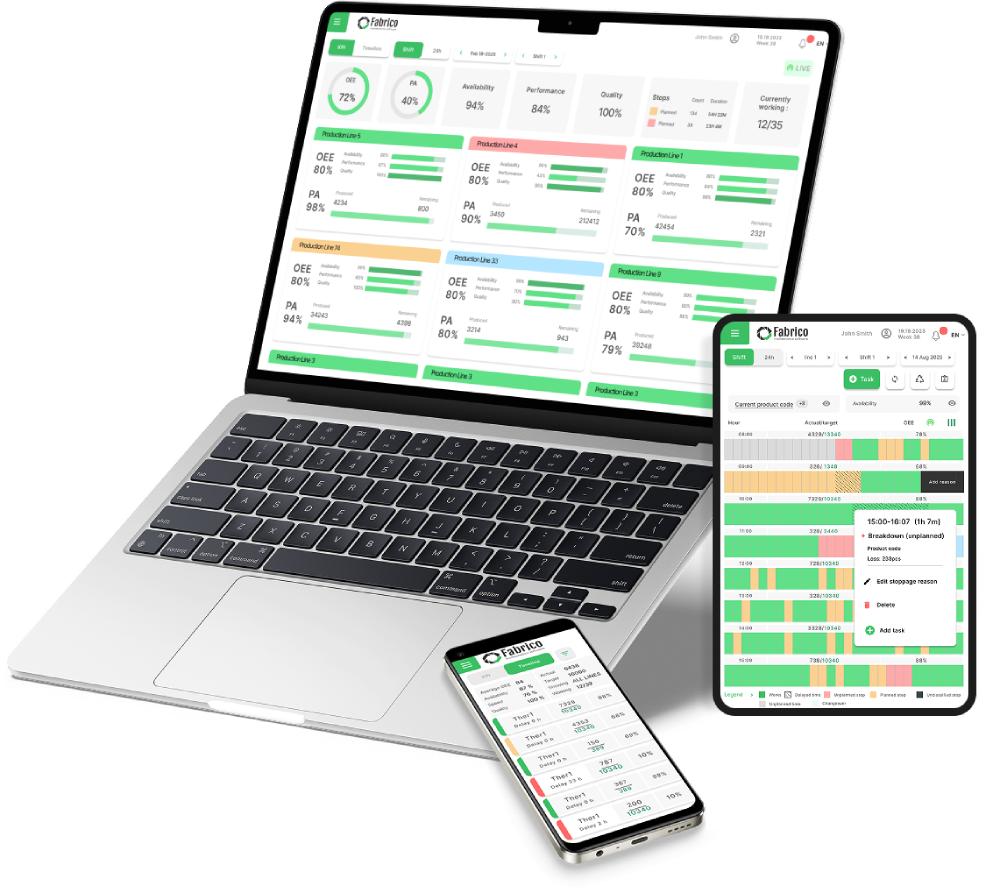
Fabrico is unique in this list because it is not just a vision tool. It is a complete Factory Operating System (OEE + CMMS). We use Vision as a trigger for action, not just for reporting.
Why Innovation Leaders Switch to Fabrico:
-
Automated Work Orders: If the camera detects a specific fault (e.g., "Guard Door Open" or "Jam at In-Feed"), Fabrico doesn't just log it. It creates a Work Order and alerts the technician immediately.
-
The "Micro-Stop" Killer: Sensors often miss short stops. Fabrico’s Vision AI detects and categorizes every micro-stop, giving you a true OEE Performance score that accounts for manual inefficiencies.
-
No "Integration Tax": With other tools, you have to pay to integrate the Camera software with the Maintenance software. With Fabrico, they are the same platform.
-
Privacy-First: Fabrico focuses on the process, not the person, ensuring you get productivity data without infringing on operator privacy rights (GDPR compliant).
The Verdict: If you want your cameras to actually drive repairs and process improvements, Fabrico is the integrated choice.
2. Drishti
Best For: Manual assembly line optimization.
Drishti is a market leader in analyzing human motion. If your process is highly manual (e.g., assembling electronics or medical devices by hand), Drishti is powerful.
-
Pros: Incredible depth on "Cycle Time Analysis." It can tell you that Station 4 is 5 seconds slower than Station 3 because the operator has to reach too far for a part.
-
Cons: It is expensive and focused heavily on manual assembly. It is less focused on automated machine reliability or maintenance management.
-
The Difference: Drishti analyzes the human; Fabrico analyzes the machine (and helps the human fix it).
3. Retrocausal
Best For: Quality assurance and mistake-proofing (Poka-Yoke).
Retrocausal focuses on "guiding" the worker. It uses cameras to watch the operator's hands and alerts them if they miss a step.
-
Pros: Great for training and quality. If an operator forgets a screw, the system flashes a red light and stops the line before the defect moves forward.
-
Cons: It is a Quality tool, not a Maintenance tool. It doesn't track the health of the conveyor or the motor. It prevents defects, but it doesn't prevent machine downtime.
-
The Difference: Use Retrocausal to stop bad parts; Use Fabrico to stop machine failures.
4. Cognex (VisionPro)
Best For: High-speed defect detection.
Cognex is the hardware giant. If you need to inspect bottles moving at 1,000 per minute to see if the label is crooked, Cognex is the standard.
-
Pros: Unmatched speed and precision. It catches defects that the human eye cannot see.
-
Cons: It is a "Sensor," not a "System." It will spit out a "Fail" signal, but it won't tell you why the labeler is drifting or automatically schedule a maintenance calibration task. You need a CMMS like Fabrico to handle the "Fix."
-
The Difference: Cognex finds the defect; Fabrico manages the repair.
5. Landing AI (LandingLens)
Best For: DIY Engineering teams building custom models.
Founded by AI legend Andrew Ng, Landing AI offers a platform that makes it easy to train your own computer vision models.
-
Pros: Very user-friendly for engineers. You can upload photos of "Good" and "Bad" parts and train a model in an afternoon.
-
Cons: It is a toolkit. It gives you the model, but you still have to build the integration to your shop floor systems. It doesn't come with a built-in Maintenance module or OEE dashboard.
-
The Difference: Landing AI is for building models; Fabrico is for running operations.
Comparison Matrix: Seeing vs. Doing
| Feature |
Fabrico |
Drishti |
Retrocausal |
Cognex |
| Primary Focus |
OEE & Maintenance |
Manual Assembly |
Quality/Training |
High-Speed QA |
| Actionable Output |
✅ Work Orders |
⚠️ Analytics |
⚠️ Alerts |
❌ Signal Only |
| Maintenance Link |
✅ Native |
❌ No |
❌ No |
❌ No |
| Setup Difficulty |
Low |
High |
Medium |
High |
| Cost |
Value |
Premium |
Premium |
Hardware
|
Summary: Don't just buy "Eyes," buy a "Brain."
Installing cameras is easy. Getting value from them is hard.
If you buy a standalone vision tool, you will end up with a lot of video footage and very little improvement. You need to connect that vision data to your Maintenance Workflow.
-
Choose Cognex if you need to spot microscopic scratches at high speed.
-
Choose Drishti if you want to optimize manual hand movements.
-
Choose Fabrico if you want to improve OEE. If you want your cameras to detect downtime and automatically dispatch the help needed to fix it, Fabrico is the only platform that closes the loop.
See the problem. Fix the problem.
[Book a Demo with Fabrico] to see our Computer Vision OEE in action.


 Login
Login
 Blog
Blog