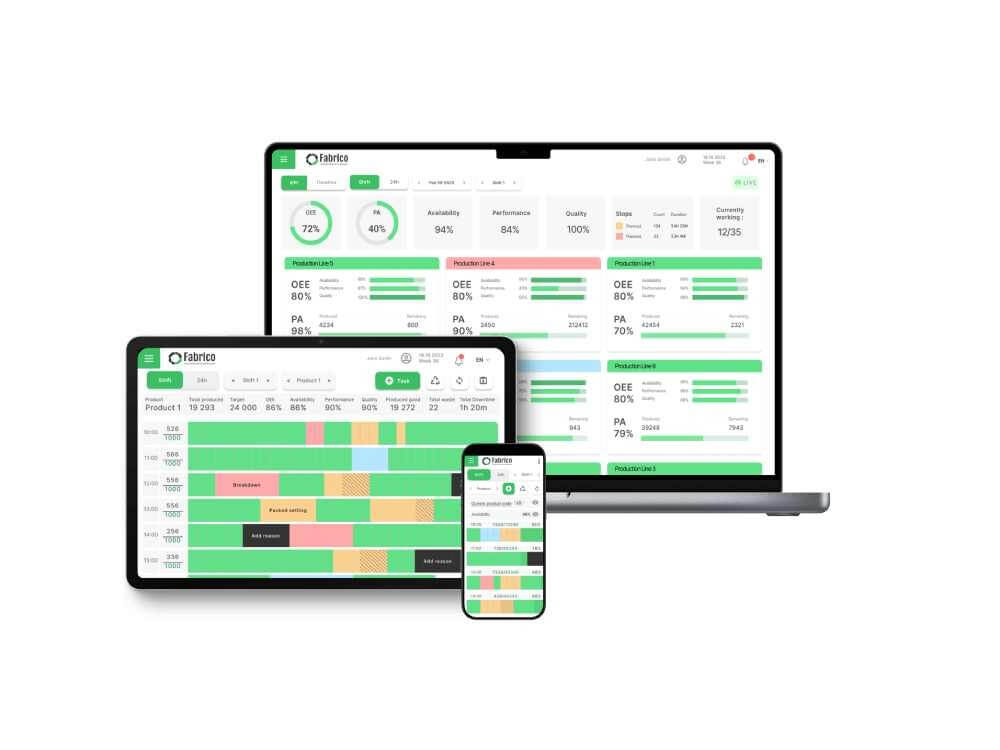
What is digital CIL software?
Digital CIL (Clean, Inspect, Lubricate) software is a mobile-first manufacturing platform that replaces paper operator checklists with interactive, digital workflows to guide frontline workers through autonomous maintenance tasks while providing real-time data to production and maintenance managers.
For Mike (the Tactical Manager), digital CILs are the end of the "Post-Breakdown Investigation."
Instead of finding out a machine failed because of a missed lubrication point, he uses Fabrico to ensure every check is timestamped, geolocated, and visually verified.
1. Fabrico: The Integrated System of Action
Fabrico is the only platform built to natively merge Digital CILs with real-time Native OEE and a Field-Ready CMMS.
Why it wins for high-speed lines:
Fabrico treats operator checklists as a "System of Action." If Tom (the Technician) or an operator identifies a worn belt during a digital round, the system doesn't just record a "fail"—it automatically triggers a prioritized Work Order.
By utilizing the "Visibility Trifecta," Fabrico links CIL data to Inefficiencies Zoom-In (Computer Vision) footage. This allows Mike to see if a quality defect recorded in a checklist matches a mechanical drift seen on camera, reclaiming the capacity lost in the Hidden Factory.

2. Poka
Poka is a leading "Connected Worker" platform that excels at knowledge management and operator training through micro-lessons and video content.
The Trade-off:
Poka is an excellent training tool, but it is not a technical maintenance engine. While it handles communication well, it lacks the native high-frequency PLC integration and deep spare parts management required to function as a full System of Action for complex reliability strategies like Reliability-Centered Maintenance (RCM).
3. Parsable
Parsable provides a flexible "Dynamic Work Instructions" platform designed to digitize complex industrial workflows for enterprise-level manufacturers.
The Trade-off:
Parsable is highly sophisticated, which often leads to high implementation costs and a "Complexity Tax." For many mid-to-large-scale plants, the setup time is too long, and the lack of a native, built-in OEE monitoring module creates a data silo between production truth and operator activity.
4. SafetyCulture (formerly iAuditor)
SafetyCulture is the industry standard for digital safety inspections and compliance audits across multiple sectors.
The Trade-off:
It is an "Audit Tool," not a "Production Tool." While it is great for ISO compliance, it creates a "Data Island" that is disconnected from the machine pulse. If a safety check identifies a mechanical risk, the manual hand-off to the maintenance department creates high Decision Latency.
5. MaintainX
MaintainX is widely recognized for its intuitive, chat-heavy mobile interface that makes daily task management simple for technicians and operators.
The Trade-off:
MaintainX excels at simple checklists and team chat but lacks the deep Visual Root Cause Analysis (Computer Vision) and OEE Performance tracking required to identify "Bad Actor" assets in high-volume industries like Food & Beverage or Plastics.
Comparison Matrix: Digital CIL & Checklist Capabilities
| Feature |
Fabrico |
Poka |
Parsable |
SafetyCulture |
MaintainX |
| Maintenance Link |
Native Integrated |
Siled / API |
Siled / API |
None |
Basic |
| Response Trigger |
Auto-Work Order |
Manual Chat |
Manual |
Manual |
Chat-Based |
| OEE Connection |
Native / Real-Time |
Third-Party |
None |
None |
Basic |
| Visual Evidence |
Advanced (Video) |
Photo-Only |
Photo-Only |
Photo-Only |
Photo-Only |
| Compliance Trail |
Instant / Digital |
High |
High |
Maximum |
Moderate |
| Implementation |
3-4 Months |
4-6 Months |
6-12 Months |
1 Month |
1-2 Months |
The Strategic ROI: Engineering Process Stability
For Paula (the Strategic Leader), the business case for digital CILs is built on "Capacity Reclamation."
By moving from paper to a System of Action, you reclaim the "Wrench Time" lost when technicians act as data entry clerks. By enforcing "Centerlining" standards, you reduce the Scrap Rate and ensure that "Good Machines make Good Parts."
As you build 12 months of clean CIL and OEE data, you are preparing your plant for the Fabrico Agent (AI Roadmap) to automate your production scheduling.
Stop managing your shop floor on paper. Start engineering uptime with a System of Action.


 Login
Login
 Blog
Blog