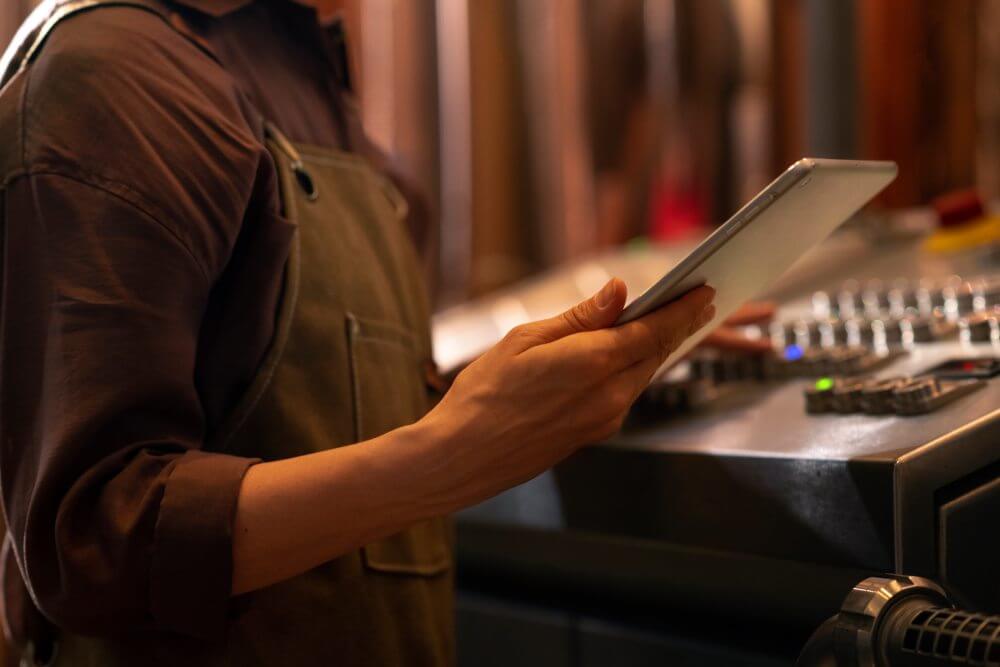
For 100 years, the Machine Logbook has been the memory of the factory.
A technician fixes a jam. They scribble a note in a notebook tied to the machine. The next shift reads it (maybe).
In 2026, this system is broken.
Paper logbooks are Data Silos. You cannot search them.
You cannot analyze them. You cannot graph the frequency of "Jams" because the data is trapped in ink.
Worse, if the logbook gets lost or coffee gets spilled on it, that history is gone forever.
You need a Digital Logbook—an app that captures the "Story" of the machine in real-time, searchable, and accessible from anywhere.
Here are the 5 Best Digital Logbook Apps for manufacturing in 2026.
1. Fabrico: The "Automated" Logbook
Best For: Manufacturers who want the machine to write its own logbook.
Fabrico transforms the logbook from a "Diary" into a "Database." It combines manual entries from operators with automated entries from the machine itself.
Why Operations Leaders Switch to Fabrico:
-
Auto-Logging: Fabrico connects to the machine (PLC). When the machine stops, Fabrico automatically writes an entry in the digital log: "Stop - 10:02 AM - Duration: 5 min." No human memory required.
-
The "Context" Layer: Operators can add photos and notes to these auto-logs. "Machine stopped because of bad raw material." Now you have the Data (Time) and the Context (Reason) in one place.
-
Searchability: "Mike" (Maintenance Manager) can type "Bearing" into the search bar and see every log entry mentioning bearings for the last 5 years.
-
Shift Handover: The digital log automatically rolls up into a Shift Report, ensuring the next crew sees the critical issues immediately.
The Verdict: If you want a logbook that captures the truth—even when operators forget to write it down—Fabrico is the integrated choice.

2. MaintainX
Best For: Communication-heavy teams.
MaintainX is excellent at replacing the "Communication Book." It looks and feels like a chat feed.
-
Pros: Very intuitive. Technicians can post updates like social media comments ("Fixed the sensor, running smooth now"). It allows for photo uploads and threaded conversations.
-
Cons: It can be unstructured. Because it relies on chat, it is harder to pull hard data trends (e.g., "How many minutes of downtime?") compared to a structured OEE logbook.
-
The Difference: MaintainX captures the conversation; Fabrico captures the event data.
3. eLogbook (j5 / Hexagon)
Best For: Process Industry (Oil & Gas, Chemical).
j5 Operations Management (now part of Hexagon) is the standard for heavy industrial logging.
-
Pros: Incredible depth for compliance. It handles "Standing Orders," safety bypasses, and shift instructions with rigorous audit trails. Essential for high-risk environments.
-
Cons: It is heavy enterprise software. It is expensive and complex to set up. It is overkill for a discrete manufacturing plant (packaging, assembly).
-
The Difference: j5 is for the Control Room; Fabrico is for the Production Line.
4. Poka (IFS)
Best For: Knowledge sharing and training logs.
Poka focuses on the "How-To" aspect of the logbook.
-
Pros: Excellent for capturing solutions. If an operator solves a tricky problem, they can record a video log ("Here is how I unjammed it"). This turns the logbook into a training library.
-
Cons: It is less focused on the "Timeline" of events (Stops/Starts) and more on the "Knowledge" of events.
-
The Difference: Poka logs the solution; Fabrico logs the performance impact.
5. SafetyCulture (iAuditor)
Best For: Inspection-based logging.
If your "Logbook" is really just a daily checklist, SafetyCulture is the form-building master.
-
Pros: You can force a structured log entry at the start of every shift (e.g., "Check Pressure," "Check Guarding"). It ensures the log is filled out consistently.
-
Cons: It is not a "Continuous" log. It captures snapshots in time (Inspections), but it doesn't easily show the running narrative of the shift (breakdowns, adjustments) in a timeline view.
-
The Difference: SafetyCulture is a checklist; Fabrico is a timeline.
Comparison Matrix: Diary vs. Database
| Feature |
Fabrico |
MaintainX |
j5 (Hexagon) |
Poka |
| Primary Focus |
Machine History |
Team Chat |
Compliance |
Training |
| Auto-Logging (PLC) |
✅ Native |
❌ No |
✅ Native |
❌ No |
| Searchability |
✅ Deep |
⚠️ Basic |
✅ Deep |
✅ Video |
| User Experience |
Modern |
Excellent |
Complex |
Modern |
| Cost |
Value |
Mid |
Premium |
Premium |
Summary: Upgrade Your Memory
A paper logbook has a memory of about one week (before the page is turned).
A digital logbook has a perfect memory forever.
-
Choose j5 if you run a refinery.
-
Choose MaintainX if you just want a team chat app.
-
Choose Fabrico if you want a Smart Logbook. If you want a system that automatically records machine stops (OEE) and allows operators to add context, giving you a perfect history of your asset's health, Fabrico is the unified solution.
Make history useful.
[Book a Demo with Fabrico] to see how our Digital Logbook turns daily notes into long-term intelligence.


 Login
Login
 Blog
Blog