Implementing OEE on a single production line is straightforward. Implementing OEE across a global enterprise with 50 sites, 10 languages, and 5 different ERP systems is a massive strategic undertaking.
The most common failure mode is the "Apples-to-Oranges" Trap.
-
Plant A defines "Lunch Breaks" as Planned Downtime (excluded from OEE).
-
Plant B defines "Lunch Breaks" as Unplanned Downtime (included in OEE).
-
The Result: The Corporate Dashboard shows Plant A is 10% more efficient, but in reality, they are just counting differently.
To fix this, decision-makers need Enterprise OEE Software that acts as a "Single Source of Truth." Here are the 5 best platforms for multi-site manufacturing in 2026.
The "Tower of Babel" in Global Manufacturing
Without a unified platform, your enterprise suffers from data fragmentation.
-
Data Fragmentation: Different sites use different names for the same downtime reason (e.g., "Jam" vs. "Material Blockage").
-
Latency: Some sites report real-time via IoT; others report weekly via Excel.
-
Action Gap: Knowing OEE is low is useless if you don't have visibility into what is being done about it.
The best Enterprise Platforms solve this by centralizing the Data Model while distributing the Execution Tools.
Top 5 Enterprise OEE Software Platforms (Ranked)
1. Fabrico
Best For: Standardized Execution & Agile Scale.
The "Global Blueprint" Advantage:
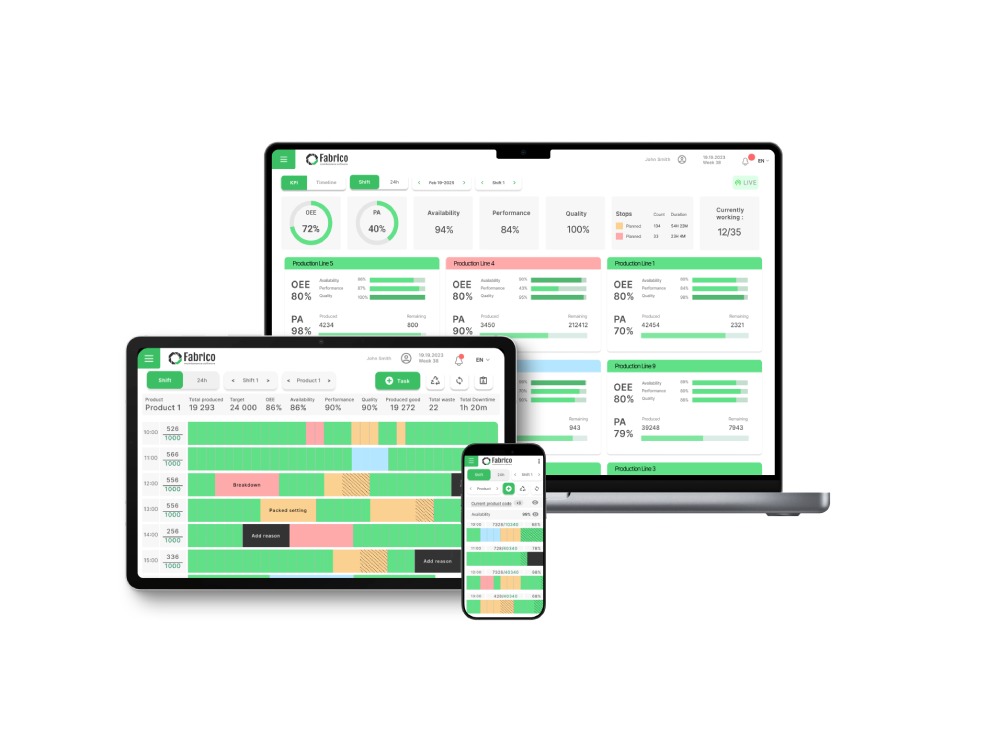
Fabrico is built for the multi-site enterprise that values Speed and Consistency. Unlike heavy legacy systems that require months of onsite server configuration, Fabrico utilizes a cloud-native architecture that allows headquarters to push a "Digital Blueprint" to every site globally.
Why It Wins the Enterprise:
-
Master Data Governance: You can define standard Downtime Codes, Shift Patterns, and KPI calculations at the Group Level. This ensures that every plant reports data in the exact same format, enabling true benchmarking.
-
Visual Validation: When a remote plant reports "Chronic Machine Failure," headquarters usually has to take their word for it. Fabrico integrates Visual Process Analysis (Video), allowing corporate engineers to watch clips of the failure remotely. This validates the data and allows for remote troubleshooting support.
-
Unified Action Layer: OEE is just a number. Fabrico links that number to Maintenance Workflows. If OEE drops below target in any plant, the system can trigger standardized recovery protocols (e.g., CILs or Inspections) ensuring global best practices are followed.
Pros:
-
Rapid Rollout: Can be deployed to a new acquisition in weeks, integrating them into the corporate standard instantly.
-
Low Infrastructure: No need for heavy local servers or complex VPNs at every site.
-
High Adoption: The user interface is designed for the modern workforce, reducing training time across diverse languages and cultures.
2. Vorne XL (Enterprise)
Best For: Hardware Consistency (The "Scoreboard").
Overview:
Vorne XL takes a hardware-first approach. By installing a physical Vorne device on every machine, you ensure that the method of data collection is identical everywhere. It bypasses the complexity of different PLCs by using simple sensor inputs.
Key Enterprise Features:
-
XL Productivity Appliance: A bolt-on device that acts as a standardized data collector.
-
Cloud Reporting: Aggregates data from thousands of devices into a central view.
-
Visual Factory: Famous for its large LED scoreboards that drive floor-level motivation.
Pros:
Cons:
3. Parsec TrakSYS
Best For: Complex Compliance & Genealogy.
Overview:
Parsec TrakSYS is a heavyweight in the Manufacturing Operations Management (MOM) space. It is particularly strong in regulated industries like Pharmaceutical and Food & Beverage where OEE must be tracked alongside Batch Genealogy and Compliance.
Key Enterprise Features:
-
Contextualization: Links OEE data to specific batch numbers, operators, and raw material lots.
-
Workflow Engine: Capable of managing complex electronic batch records (EBR).
-
Scalability: Proven architecture for managing high-speed, high-volume data streams.
Pros:
Cons:
4. Sight Machine
Best For: Data Normalization (The Data Lake).
Overview:
Sight Machine is a data platform first, and an OEE tool second. Its superpower is Ingestion. If your enterprise has a messy mix of 50 different machine types, 3 different ERPs, and 2 different MES systems, Sight Machine can ingest all that data and normalize it.
Key Enterprise Features:
-
Data Transformation: Automatically cleans and maps disparate data tags into a common "Production Model."
-
Cross-Plant Analytics: Allows for sophisticated variance analysis between sites (e.g., "Why is Line 1 in Ohio faster than Line 1 in France?").
-
Digital Twin: Creates a statistical model of the process.
Pros:
Cons:
5. PTC ThingWorx
Best For: Custom IIoT Dashboarding.
Overview:
PTC ThingWorx allows the enterprise to build its own OEE application. It is an Industrial IoT platform that provides the connectivity and visualization tools to create a bespoke solution tailored exactly to the company's unique needs.
Key Enterprise Features:
-
Connectivity: Kepware integration connects to almost any industrial asset.
-
Mashups: Create custom screens that combine OEE with ERP or PLM data.
-
Role-Based Views: Tailor the dashboard for the Operator vs. the Plant Manager vs. the CEO.
Pros:
Cons:
Comparison Matrix: Enterprise Capabilities
| Feature |
Fabrico |
Vorne XL |
Parsec |
Sight Machine |
ThingWorx |
| Strategy |
Standardized Ops |
Hardware Standard |
Deep MOM |
Data Analytics |
Custom Build |
| Rollout Speed |
Fast |
Medium (Install) |
Slow |
Medium |
Slow (Dev) |
| Normalization |
Native Cloud |
Hardware |
Config |
AI-Driven |
Developer |
| Actionability |
High (Workflow) |
Low (Visual) |
High |
Medium |
Medium |
| Best For |
Global Ops |
Legacy Assets |
Pharma/F&B |
Data Science |
Engineering |
The "Lighthouse" Rollout Strategy
Don't try to "Big Bang" OEE across 50 sites. It will fail.
Successful enterprises use the Lighthouse Strategy:
-
Select: Pick one high-performing plant.
-
Perfect: Implement Fabrico to define the standard downtime codes, shift patterns, and maintenance triggers.
-
Validate: Prove the ROI (Efficiency Gain).
-
Replicate: Copy-paste this "Digital Blueprint" to the next 5 plants.
Conclusion
-
If you have Messy, Heterogeneous Data that needs cleaning, choose Sight Machine.
-
If you need Hardware Consistency on old machines, choose Vorne XL.
-
If you need a Unified Enterprise Platform that standardizes OEE definitions, provides visual context, and links performance to maintenance action across your global footprint, Fabrico is the best choice for 2026.
Standardize your success. Schedule an Enterprise OEE Consultation with Fabrico.


 Login
Login
 Blog
Blog