The promise of the Industrial Internet of Things (IIoT) is seductive.
You install wireless sensors on your motors, pumps, and conveyors. You get a dashboard full of graphs showing vibration, temperature, and humidity.
But then what?
A graph showing a temperature spike doesn't fix the motor.
Most manufacturers ("Paula" and "Mike") struggle because they buy an IoT Platform that is separate from their Maintenance System (CMMS).
The IoT dashboard turns red, but the maintenance team doesn't see it.
To get a Return on Investment (ROI) from IIoT, you need a system that turns Sensor Data into Work Orders.
Here are the 5 best IIoT solutions for maintenance in 2026, ranked by their ability to drive action.
1. Fabrico: The "Actionable IIoT" Solution
Best For: Manufacturers who want IoT data to automatically trigger repairs.
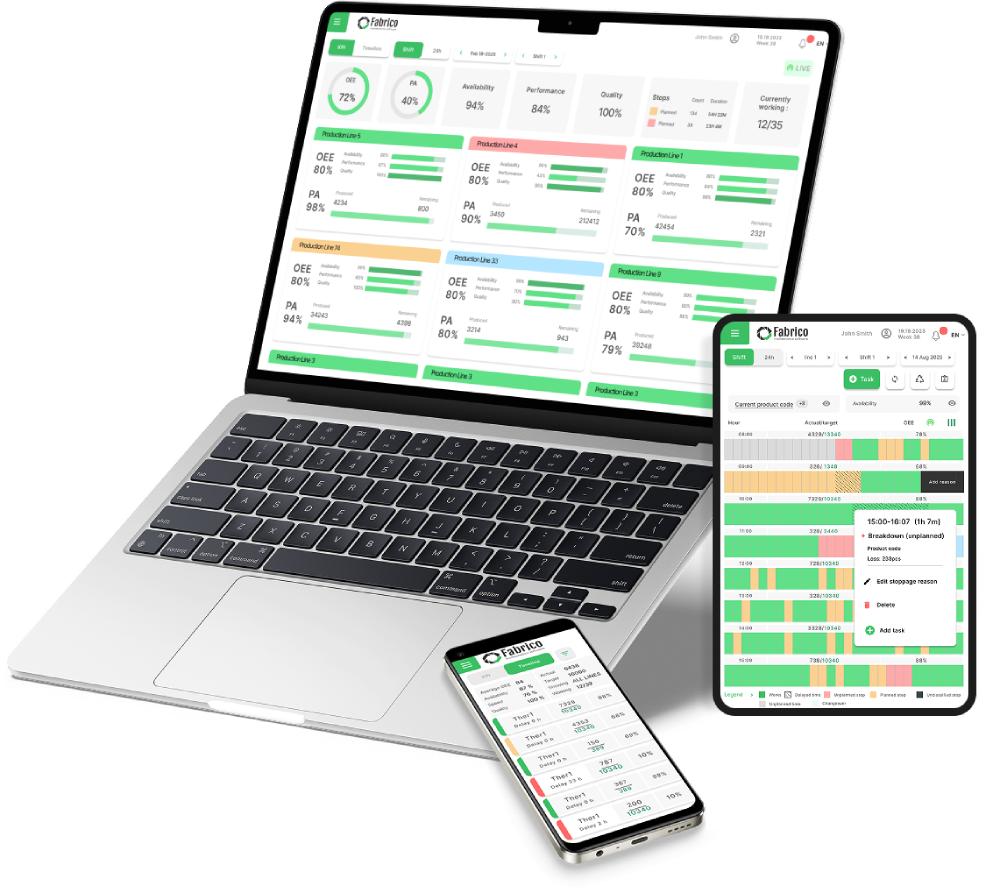
Fabrico solves the "So What?" problem of IIoT. It is a unified platform that combines Machine Connectivity with Maintenance Execution.
Why Manufacturers Switch to Fabrico:
-
Automated Triage: When a sensor detects a fault (e.g., Vibration > 5mm/s), Fabrico doesn't just log it. It automatically generates a Work Order, assigns it to the correct technician, and attaches the relevant troubleshooting guide.
-
Software-First Connectivity: You don't always need expensive new sensors. Fabrico connects to your existing PLCs (via OPC UA/MQTT) to extract the data you already have, saving you hardware costs.
-
The "OEE" Context: Fabrico correlates sensor data with production cycles. It can tell you why the temperature spiked (e.g., "Running at 110% speed"), giving maintenance the context they need to fix the root cause.
-
Computer Vision: Fabrico expands IIoT beyond simple sensors. It uses cameras to detect visual faults (jams, missing parts), adding a "visual sensor" to your reliability toolkit.
The Verdict: If you want your machines to "call for help" and get an immediate response, Fabrico is the integrated choice.
2. Samsara
Best For: Fleet management and remote asset tracking.
Samsara is a giant in the IoT space. While famous for trucking/fleets, they have a strong industrial offering for monitoring remote assets (generators, pumps, tanks).
-
Pros: Incredible hardware. Their "plug-and-play" gateways and sensors are the easiest to install in the industry. Great for tracking energy usage and environmental data.
-
Cons: It is a monitoring platform, not a CMMS. It excels at showing you the data, but its maintenance module is basic compared to a dedicated tool. You often need to integrate it with a separate system to manage the repair work.
-
The Difference: Samsara monitors the asset; Fabrico manages the repair.
3. MachineMetrics
Best For: CNC Machine Monitoring.
If your factory is full of high-precision CNC machines, MachineMetrics is the specialized IIoT choice.
-
Pros: Deep integration with CNC controls (Fanuc, Haas, Siemens). It can detect tool wear and spindle load anomalies with extreme precision.
-
Cons: Like Samsara, it is an analytics tool. It identifies the problem but relies on integrations (APIs) to push that data to a maintenance system for execution.
-
The Difference: MachineMetrics is for Machinists; Fabrico is for Maintenance Teams.
4. Augury
Best For: Advanced Vibration Analysis (AI).
Augury focuses entirely on Machine Health AI. Their sensors listen to your machines and use AI to predict bearing failures months in advance.
-
Pros: The best vibration AI in the market. It doesn't just say "Vibration High"; it says "Inner Race Bearing Fault detected."
-
Cons: It is a premium, niche solution. It is expensive and focuses strictly on rotating equipment. It does not handle general maintenance (PMs, Lubrication, Safety Checks) or OEE tracking.
-
The Difference: Augury predicts the failure; Fabrico manages the entire lifecycle (Prediction + Repair + Spares).
5. Particle
Best For: Custom DIY IoT projects.
Particle is a platform for building your own IoT devices. If you have a strong engineering team that wants to build custom sensors for a unique process, this is the toolkit.
-
Pros: Infinite flexibility. You can build exactly the sensor you need.
-
Cons: High effort. You are building a product, not buying a solution. It requires coding, hardware engineering, and maintenance of the IoT fleet itself.
-
The Difference: Particle is for builders; Fabrico is for operators.
Comparison Matrix: Data vs. Action
| Feature |
Fabrico |
Samsara |
MachineMetrics |
Augury |
| Primary Focus |
Maintenance & OEE |
Asset Tracking |
CNC Analytics |
Vibration AI |
| Auto-Work Order |
✅ Native |
⚠️ Basic |
⚠️ API Needed |
⚠️ API Needed |
| PLC Connectivity |
✅ Native |
⚠️ Gateway |
✅ Native |
❌ No |
| Cost Model |
Mid-Market |
Premium |
Premium |
Premium |
| Hardware Req. |
Flexible |
Proprietary |
Proprietary |
Proprietary |
Summary: Don't Just Collect Data
The goal of IIoT is not to have a nice dashboard on the wall. The goal is to prevent downtime.
-
Choose Samsara if: You need to track vehicles and remote assets outside the factory walls.
-
Choose Augury if: You have critical turbines or compressors that require PhD-level vibration analysis.
-
Choose Fabrico if: You want to Operationalize your data. If you want your PLC data to automatically drive your maintenance schedule, reduce spare parts waste, and improve OEE, Fabrico is the complete platform.
Give your machines a voice.
Book a Demo with Fabrico to see how we turn sensor signals into maintenance solutions.


 Login
Login
 Blog
Blog