In 2026, "Going Digital" is no longer enough. Moving from paper to a tablet is just the first step. The goal of Industry 4.0 is Automation.
Maintenance Automation Software removes the human bottleneck. Instead of a planner manually creating a work order when a machine overheats, the software does it instantly via PLC integration.
Instead of a manager manually adjusting the schedule, an AI Agent optimizes it based on production gaps.
We reviewed the top 5 platforms to see which ones are truly "Automated" and which are just "Digital."
1. Fabrico (Best for Manufacturing Autopilot)
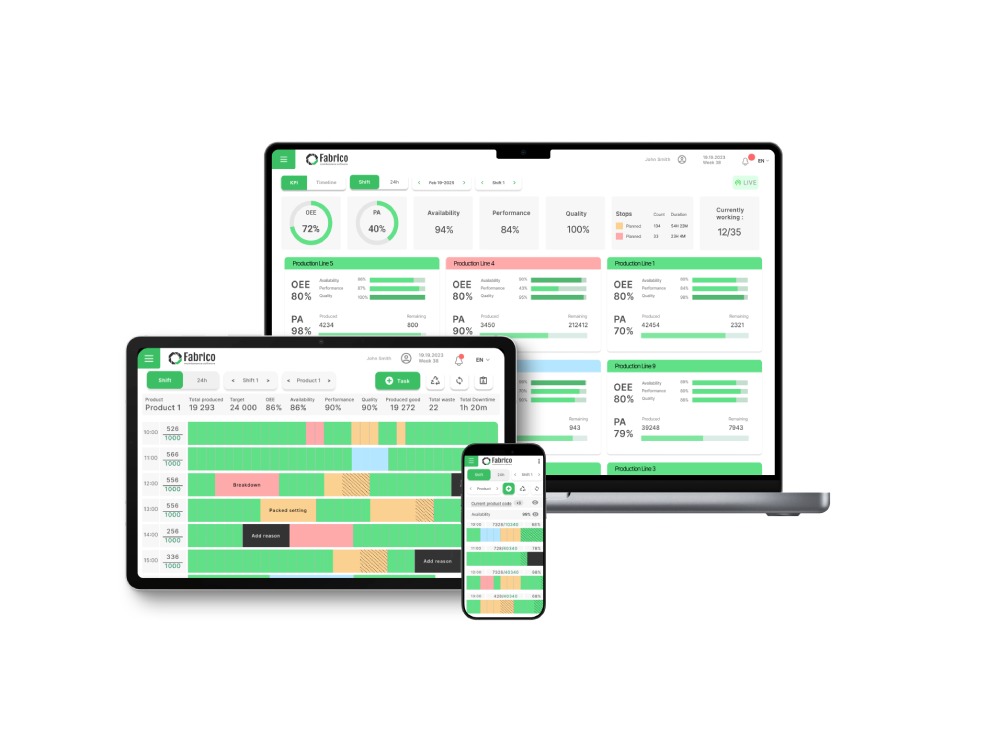
The Verdict: The only platform that combines PLC Triggers (Machine Data), OEE Integration (Production Context), and the Fabrico Agent (AI) to fully automate the maintenance lifecycle.
Fabrico isn't just a CMMS; it's a "System of Action." It excels in manufacturing environments because it connects directly to the machine's "Heartbeat." By integrating with PLCs and reading OEE data, Fabrico can trigger workflows that other tools miss.
Key Automation Features:
-
Condition-Based Logic: Connects to PLCs via API/IoT. If Temperature > 85°C, it automatically generates a high-priority Work Order and alerts the electrical team.
-
The Fabrico Agent (AI): An intelligent agent that analyzes historical data and production schedules to automatically suggest the best maintenance windows, filling gaps in the Interactive Planning Board.
-
Inventory Auto-Replenishment: Automatically triggers reorder notifications when spare parts hit their "Min" levels via QR-code scan-outs.
-
OEE-Triggered RCAs: If machine performance (speed) drops below a threshold, it auto-creates a "Root Cause Analysis" task for the CI team.
Best For: Factories wanting to move from "Preventive" to "Self-Driving" maintenance.
2. Fiix (Best for Rockwell Ecosystems)
The Verdict: A heavyweight contender for automation, particularly strong if you already use Rockwell Automation hardware.
Owned by Rockwell, Fiix has strong "Asset Risk" prediction capabilities. It uses a proprietary AI engine to forecast when assets might fail based on historical data. Its strength lies in its ability to handle complex enterprise hierarchies and automate the purchasing workflow for large organizations.
Pros:
-
Strong "Asset Risk" AI forecasting.
-
Deep integration with Rockwell PLCs and sensors.
-
Automated purchasing workflows (PO generation).
Cons:
-
Implementation Cost: Requires significant setup and consulting.
-
Complexity: Can be overkill for agile manufacturing teams.
-
OEE Gap: Primarily a maintenance tool; lacks the native "Production/OEE" unified view found in Fabrico.
Best For: Large enterprises heavily invested in Rockwell Automation hardware.
3. Limble CMMS (Best for Workflow Rules)
The Verdict: Excellent for automating administrative tasks and PM generation, though less focused on real-time machine data.
Limble is famous for its ease of use. Its automation power lies in its "PM Engine." You can set up complex rules for recurring tasks (e.g., "On the 1st of the month, create X task"). It also automates the "Request Portal," turning user emails or QR scans into neat work orders automatically.
Pros:
-
Very easy to set up automated PM schedules.
-
"Modular" design allows you to build custom workflows.
-
Good vendor automation (auto-emailing external contractors).
Cons:
-
Weak IoT Link: Connecting to live machine PLCs for real-time triggers is harder than with specialized tools.
-
No Native AI Agent: Uses standard logic, not generative AI for scheduling.
Best For: Teams who want to automate administrative paperwork quickly.
4. MaintainX (Best for Communication Automation)
The Verdict: The leader in "Chat-based" automation, great for keeping teams in sync via mobile.
MaintainX focuses on the human side of automation. Its logic is built around "Procedures." If a technician answers "Fail" on an inspection, it automatically opens a chat thread, alerts the manager, and creates a follow-up work order. It feels like WhatsApp met a CMMS.
Pros:
-
Excellent "If/Then" logic within digital checklists.
-
Automated chat alerts keep everyone informed instantly.
-
Best-in-class mobile interface.
Cons:
Best For: Teams who need better communication and mobile workflow automation.
5. MachineMetrics (Best for IoT Data Triggers)
The Verdict: The king of "Machine Data," but requires integration with a CMMS to handle the "Work" part.
MachineMetrics is an IoT platform first. It automates data collection perfectly—reading spindle speeds, load, and cycles directly from CNCs. It can trigger alerts (e.g., text message when a machine crashes). However, it is not a full Maintenance Management system; it usually feeds data into another tool.
Pros:
-
Plug-and-play automation for CNC data collection.
-
High-frequency triggers (millisecond precision).
-
Automated OEE calculation.
Cons:
-
No Work Orders: You cannot plan labor, manage inventory, or schedule technicians inside it.
-
Requires Integration: You likely need to buy another CMMS (like Fiix or Fabrico) to manage the actual repair.
Best For: Machine shops focused purely on data collection automation.
Comparison Matrix: The 2026 Landscape
| Feature |
Fabrico |
Fiix |
Limble |
MaintainX |
MachineMetrics |
| Automation Type |
Full (PLC + AI + Workflow) |
Enterprise / Prediction |
Admin / Rules |
Communication / Mobile |
IoT / Data |
| PLC/IoT Triggers |
✅ Native & Easy |
✅ Native (Rockwell) |
⚠️ Via Integration |
⚠️ Via Integration |
✅ Best in Class |
| AI Scheduler |
✅ Fabrico Agent |
✅ Asset Risk AI |
❌ No |
❌ No |
❌ No |
| OEE-Driven Actions |
✅ Native Integration |
❌ No |
❌ No |
❌ No |
✅ Yes (Data only) |
| Inventory Bots |
✅ Auto-Replenish |
✅ Strong PO Auto |
✅ Yes |
✅ Yes |
❌ No |
Conclusion: Don't Just Digitize, Automate
If you want to move away from paper, buy Limble or MaintainX. If you want to connect to a massive Rockwell infrastructure, buy Fiix.
But if you want to Automate the Factory Floor—linking machine data (PLC/OEE) to maintenance action with the help of AI—Fabrico is the clear choice for modern manufacturers.
Put your maintenance on autopilot.
[Request a Demo] and see the Fabrico Agent in action.


 Login
Login
 Blog
Blog