Why do factories with identical machines have vastly different outputs?
The answer is Systemic Friction.
-
Friction 1: The machine stops, and the operator waits 10 minutes for a technician. (Labor Loss).
-
Friction 2: The technician arrives but lacks the right part. (Process Loss).
-
Friction 3: The machine runs, but at 85% speed due to a micro-jam. (Asset Loss).
Traditional software (siloed MES and CMMS) cannot see this friction because it happens between the systems. Manufacturing Productivity Platforms are designed to see it and eliminate it.
Here are the 5 best platforms to drive productivity in 2026.
Solving the "Productivity Equation"
True productivity is Total Factor Productivity. It combines:
-
Asset Productivity: Maximizing OEE and Utilization.
-
Labor Productivity: Maximizing "Value-Added" time vs. "Admin" time.
-
Process Productivity: Minimizing waste and rework.
The best platforms optimize all three variables simultaneously.
Top 5 Manufacturing Productivity Platforms (Ranked)
1. Fabrico
Best For: Total Factor Productivity (Machine + Human).
The "Unified Output" Advantage:
Fabrico takes a holistic approach to productivity. It recognizes that you cannot optimize the machine without optimizing the maintenance team that supports it.
How It Drives Productivity:
-
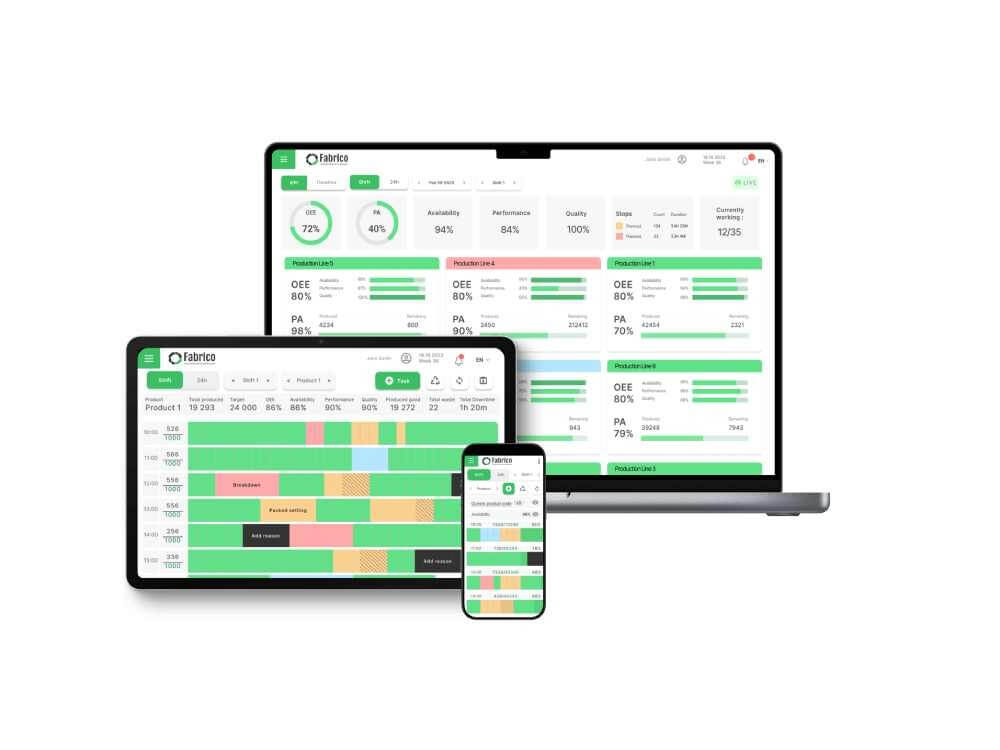
Asset Optimization: Fabrico ingests Real-Time Operational Data to identify performance drifts. It highlights the "Micro-Stops" that silently destroy 10% of your daily capacity, allowing you to reclaim that time.
-
Labor Efficiency: By providing a Mobile-First Execution Layer, Fabrico eliminates the paperwork and travel time that consumes 60% of a technician's day. This effectively increases your workforce capacity without hiring new staff.
-
Visual Problem Solving: Using Visual Process Analysis (video integration), Fabrico reduces the "Mean Time To Diagnose." Teams stop guessing why the rate dropped and start fixing the root cause immediately based on visual evidence.
Pros:
-
Hidden Factory: specifically designed to find and unlock unused capacity.
-
Speed to Insight: Cloud-native architecture delivers real-time dashboards to decision-makers instantly.
-
Adoption: Consumer-grade interface ensures the shop floor actually uses the tool, generating accurate data.

2. Redzone
Best For: Workforce Engagement.
Overview:
Redzone believes that productivity comes from People. Its platform uses gamification, social collaboration, and digital "Huddles" to energize the workforce.
It turns productivity into a team sport. Shifts compete to hit their targets ("Running the Play"). This creates a massive boost in morale and focus.
Key Productivity Features:
-
Compliance Scorecards: Teams track their own performance in real-time.
-
Digital Huddles: Standardized meetings to review yesterday's wins and losses.
-
Kaizen: Allows operators to submit ideas for improvement instantly.
Pros:
Cons:
3. MachineMetrics
Best For: Machine Utilization.
Overview:
MachineMetrics focuses on the Asset. It connects directly to the control units of CNCs and automated equipment to track utilization with extreme precision.
It answers the question: "Is the spindle turning?" By visualizing exactly when machines are idle, it allows managers to optimize scheduling and identify capacity bottlenecks.
Key Productivity Features:
-
Load Monitoring: Detects when a machine is cutting vs. just air-cutting.
-
operator View: Tablets at the machine allow operators to classify downtime instantly.
-
Capacity Planning: Uses actual usage data to inform production scheduling.
Pros:
Cons:
4. L2L (Leading2Lean)
Best For: Flow Efficiency.
Overview:
L2L drives productivity by improving Flow. It uses a "Dispatch" engine to ensure that resources (people and materials) are always moving to where they are needed most.
If a machine goes down, L2L calculates the "Cost of Delay" and routes the nearest available technician. It eliminates the "Wait Time" that kills productivity.
Key Productivity Features:
-
Dynamic Dispatch: Automated routing of tasks based on priority.
-
Pitch Boards: Hour-by-hour production tracking.
-
Systemic Issue Tracking: Identifies chronic issues that disrupt flow.
Pros:
Cons:
5. Tulip
Best For: Assembly Productivity.
Overview:
Tulip focuses on Manual Assembly. In environments where humans build products by hand, productivity is defined by the process steps. Tulip allows engineers to build "Apps" that guide operators through the most efficient sequence.
Key Productivity Features:
-
Cycle Time Tracking: Measures exactly how long each step takes.
-
Digital Guidance: Projector/Screen instructions reduce errors and rework.
-
IoT Integration: Connects pick-to-light systems to speed up material handling.
Pros:
Cons:
Comparison Matrix: Productivity Drivers
| Feature |
Fabrico |
Redzone |
MachineMetrics |
L2L |
Tulip |
| Primary Driver |
Asset + Labor |
Culture / Team |
Machine Usage |
Dispatch Flow |
Manual Tasks |
| Data Source |
Unified (Ops/Maint) |
Human Input |
Machine Data |
Event Data |
Process Step |
| Visual Context |
Video Analysis |
Charts |
Trends |
Dashboards |
Work Instructions |
| Implementation |
Fast (Weeks) |
Fast (Weeks) |
Fast (Days) |
Medium |
Medium (Build) |
| Best For |
Smart Factory |
Workforce |
CNC Shops |
Lean Plants |
Assembly |
The "Hidden Capacity" Strategy
Most factories are running at 60-70% of their true potential. The rest is lost to "Micro-Inefficiencies."
Fabrico helps you find this Hidden Capacity. By digitizing the workflow and connecting it to real-time machine data, you can often unlock 10-20% more output without buying a single new machine. That is pure profit.
Conclusion
-
If you need to Motivate your Team, choose Redzone.
-
If you need to Track CNC Utilization, choose MachineMetrics.
-
If you need a Unified Platform to optimize Asset Reliability, Production Speed, and Labor Efficiency simultaneously, Fabrico is the best Manufacturing Productivity Platform for 2026.
Unlock your hidden factory. Schedule a Productivity Audit with Fabrico.


 Login
Login
 Blog
Blog