"The line ran fine all day, but we missed our target by 15%."
This is the classic symptom of Micro-Stops.
A Micro-Stop (or "Minor Stop") is a stoppage that lasts less than 2 minutes. It’s too short for the operator to log in a book, and often too short for them to even notice. But if your line stops for 30 seconds every 5 minutes, you lose 10% of your capacity every shift.
Legacy OEE tools ignore these. They filter out "short stops" to clean up the data. This is a mistake. You cannot fix what you filter out.
In 2026, the best manufacturing software doesn't ignore micro-stops—it hunts them. It uses Video "Zoom-In" technology to show you exactly what caused the jam, the blockage, or the sensor fault.
Here are the 5 best tools to help you stop dying by a thousand cuts.
The Comparison Matrix (2026)
| Software |
Best For... |
Detection Method |
Visual Evidence |
Root Cause Context |
| 1. Fabrico |
Visual Root Cause Analysis |
PLC + Computer Vision |
Video "Zoom-In" |
Deep (AI Suggested) |
| 2. Vorne XL |
High-Speed Lines |
Hardware Sensors |
None |
Basic (Codes) |
| 3. MachineMetrics |
CNC / Machining |
High-Frequency Data |
Data Charts |
Load/Tooling |
| 4. Evocon |
General OEE |
IIoT Device |
None |
Operator Input |
| 5. LineView |
Beverage/Bottling |
PLC Integration |
Playback (Add-on) |
Causal Loss |
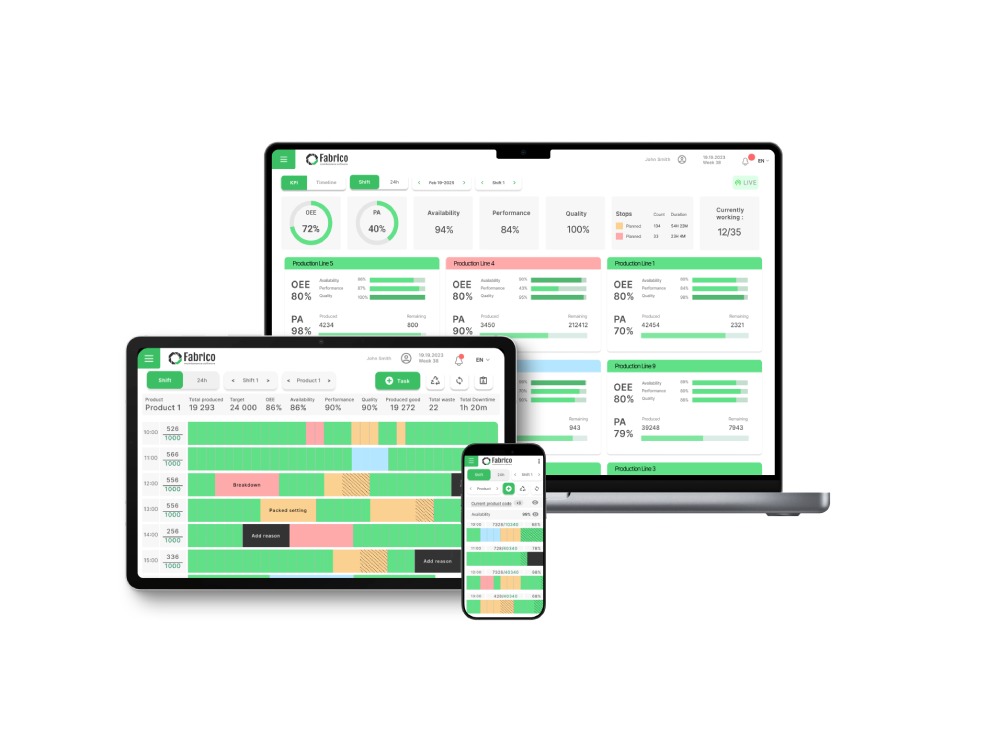
1. Fabrico: The "Instant Replay" for Manufacturing
Verdict: The best choice for factories that want to eliminate the "Unknown" downtime category using video evidence.
Fabrico is built on the philosophy that Visibility eliminates waste. For micro-stops, text data is useless. Knowing "Error 404" occurred 50 times doesn't help. Seeing a video of a bottle falling over 50 times does.
Why It Wins on Micro-Stops:
-
Inefficiencies Zoom-In: Fabrico’s cameras buffer video 24/7. When the machine triggers a stop (even for 10 seconds), the system saves the clip. You can watch a montage of every micro-stop from the last shift in minutes.
-
AI Pattern Recognition: The Fabrico Agent (AI) analyzes these clips and data points. It can tell you, "The wrapper stops for 20 seconds every time the label roll diameter drops below 10%."
-
Automated Action: If a micro-stop becomes chronic (e.g., happens 10 times in an hour), Fabrico automatically triggers a Maintenance Task to inspect the sensor, preventing a major breakdown.
Best For: Fast-moving consumer goods (FMCG), Packaging, and Bottling lines.
2. Vorne XL: The "Down Time" Scoreboard
Verdict: The industry standard for capturing the count of micro-stops on high-speed lines.
Vorne’s XL hardware is legendary for its ability to count every single pulse. It excels at showing operators the sheer volume of stops.
Pros:
-
Granularity: It captures stops as short as 1 second.
-
Top Loss View: It instantly ranks your "Top 5 Loss Events," showing clearly that "Infeed Jam" is killing your shift.
Cons:
-
No Video: It tells you that the Infeed jammed 50 times, but it can't show you why (e.g., was it a bent flap or a double feed?).
-
Operator Dependency: For context, it relies on the operator scanning a barcode, which they won't do for a 30-second stop.
Best For: High-volume lines that need a "Scoreboard" focus.
3. MachineMetrics: The "Load" Analyzer
Verdict: The best for detecting micro-stops in precision machining (CNC) caused by tool stress.
In machining, a micro-stop might be the machine pausing to calculate a path or reacting to a dull tool. MachineMetrics sees this in the high-frequency data.
Pros:
Cons:
Best For: CNC Machine Shops.
4. Evocon: The "Cloud" Counter
Verdict: A simple, cloud-based OEE tool that is easy to deploy for basic stop counting.
Evocon uses a simple IIoT device to count pulses. It is great for getting a baseline of how many micro-stops you actually have.
Pros:
-
Ease of Use: Very simple interface. Green is running, Red is stopped.
-
Unlimited Users: easy to share reports with the whole team.
Cons:
Best For: Small to mid-sized factories needing a quick OEE baseline.
5. LineView: The "Bottling" Specialist
Verdict: A powerful system designed specifically for the high-speed complexity of beverage lines.
LineView (and its "Focus" methodology) is built to analyze "Causal Loss" on lines running 60,000 bottles per hour.
Pros:
Cons:
-
Complexity: It is a heavy, expert-level system. It requires significant training to interpret the data.
-
Cost: Enterprise pricing model.
Best For: Large Breweries and Soft Drink plants.
Conclusion: Catch the Small Stops Before They Become Big Losses
Micro-stops are the "termites" of manufacturing. They are small, numerous, and they eat your foundation.
-
If you are in Beverage, look at LineView.
-
If you are in Machining, look at MachineMetrics.
-
If you need to See the Truth using Video to solve jams and sensor faults on any production line, Fabrico is the unified solution.


 Login
Login
 Blog
Blog