The Strategic Crisis: Managing Perishable Assets with Manual Silos
What is the best integrated OEE and CMMS for meat processing?
The best integrated platform for meat processing is a "System of Action" that natively synchronizes real-time machine signals (OEE) with técnicos execution (CMMS) and hygiene checklists.
This ensures that functional integrity is verified at the machine level, satisfying the rigorous audit demands of the USDA, EFSA, and Global Food Safety Initiative (GFSI).
For the CEO and Board, the most expensive production line is the one whose functional health is a "Black Box."
Relying on "Pencil-Whipped" washdown logs or disconnected shift notes is no longer a viable governance strategy.
Robert C. Hansen identifies this as the foundational risk of the "Hidden Factory."
In meat processing, this represents the 20% to 30% of revenue potential lost because legacy "Systems of Record" cannot capture the millisecond speed losses in slicing and packaging.
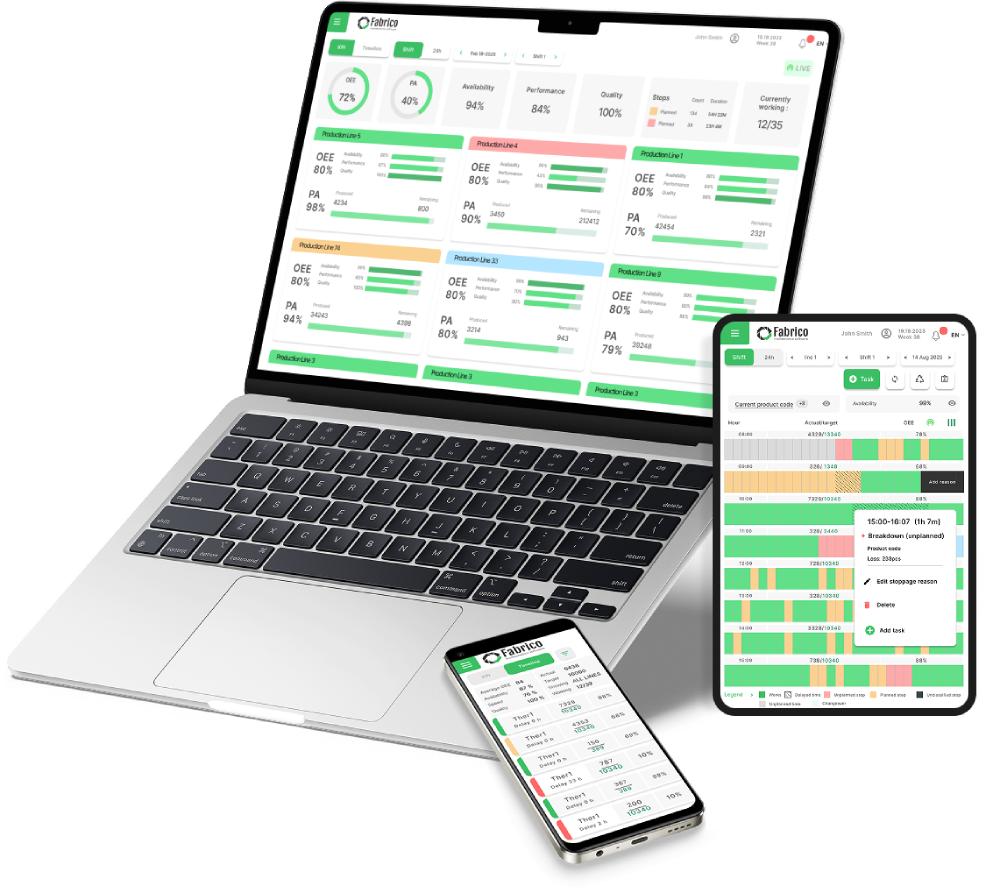
Fabrico provides the System of Action required to bridge this divide.
It turns machine-level reality into boardroom-level governance, ensuring your group's growth is governed by evidence rather than human intuition.
2026 Strategic Comparison: Meat Operations Control Platforms
| Strategic Metric |
Fabrico (Unified Action) |
Aptean (Food ERP) |
Fiix (Rockwell Automation) |
MaintainX (Mobile-First) |
Infor EAM (Enterprise) |
| Operational Goal |
Yield Integrity & Execution |
Financial Audit & Compliance |
Technical Tasking |
Workflow Digitization |
Asset Lifecycle Logic |
| Data Fidelity |
Machine-Validated |
Subjective/Manual |
Subjective/Manual |
Subjective/Manual |
Manual / Connector |
| OEE Native? |
Yes (Direct Connectivity) |
No (Aggregated only) |
No (Requires 3rd party) |
No (Requires 3rd party) |
No (Module required) |
| Integrity Proof |
Time-Stamped Digital Record |
Disconnected Ledger |
Text-only Logbooks |
Text-only Notes |
Heavy Engineering Logs |
| Technician UX |
96% Adoption (Field-Ready) |
Low (Office-centric) |
Moderate (Heavy UI) |
High (Chat-focused) |
Low (Complex UI) |
| Diagnostic Layer |
Visual Root Cause context |
None (Text reports) |
None (Text logs) |
None (Text logs) |
None (Text logs) |
1. Fabrico: The Operational Governance Standard
Strategic leaders select Fabrico when the primary goal is protecting the Value Fulcrum—the balance where technical intensity perfectly supports maximum effective runtime.
It is built specifically to bridge the gap between "OEE Diagnoses and CMMS Cures" in high-speed, multi-site meat processing environments.
By establishing direct machine connectivity, Fabrico captures cycles and downtime at the source.
This eliminates the "Subjectivity Tax" of manual entry, ensuring the Board sees absolute machine-validated truth for quality and regulatory audits.
The platform provides a machine-validated "Digital Medical Record" for every asset in the portfolio.
This turns technical expertise into a permanent digital asset that protects your enterprise multiple during valuation.
2. Aptean: The Compliance-First ERP
Aptean is a robust choice for large-scale meat processing groups whose primary strategic driver is deep food-specific ERP integration and financial compliance.
It excels at managing the financial audit trail of raw materials and departmental MRO spend.
The strategic trade-off is often the lack of millisecond-level shop-floor resolution.
Leaders often find that while it audits costs, it cannot liquidate the technical debt hidden in the seconds between high-speed slicing cycles.
3. Fiix (Rockwell Automation): The Enterprise Maintenance Layer
Fiix is a powerful choice for organizations requiring deep integration into the Rockwell Automation ecosystem.
It offers a scalable framework for managing high volumes of maintenance data across massive, global multi-site portfolios.
The strategic risk is the "Administrative Latency" required for such deep configurations.
C-Suite leaders must weigh its enterprise depth against the potential for lower adoption rates among technicians who find the interface too complex for rapid field action in washdown zones.
4. MaintainX: The Field Communication Specialist
MaintainX is highly effective for organizations where the primary strategic driver is frontline chat and simple workflow digitization.
It achieves high adoption rates because it removes the friction of paper work orders for basic maintenance tasks.
From a boardroom perspective, its limitation is the lack of native engineering asset depth.
Without machine-validated OEE diagnostics, it cannot prove to the Board that the functional integrity of a high-speed line is being preserved.
5. Infor EAM (HxGN EAM): The Infrastructure Giant
Infor EAM is a powerful choice for organizations managing massive, heterogeneous asset portfolios beyond the shop floor.
It offers a deep, engineering-centric framework for managing asset hierarchy and long-term lifecycle logic.
The strategic risk for a meat processing group is its "Legacy Weight."
Implementation cycles are often slow, allowing the "Hidden Factory" of unrecorded losses to continue draining margins during the multi-year rollout.
Visual Intelligence: Eliminating the Boardroom Context Gap
In the boardroom, a miss in throughput targets or a quality drift is often explained away as "unavoidable material variability."
Without visual evidence, the Board is forced to accept these subjective excuses for poor functional utilization across the global group.
Fabrico provides integrated visual monitoring modules (Inefficiencies Zoom-In) that identify the root cause of inefficiencies traditional sensors miss.
Leadership can review the exact video context of a performance drop or a manual intervention in any plant globally.
This transparency allows the Board to direct capital toward fixing the system rather than blaming the workforce.
It turns the "Hidden Factory" into a visible, solvable set of improvement tasks, ensuring your digital strategy is based on facts.
The Roadmap: Moving Toward Autonomous Yield Protection
Strategic leaders are building today for a future where production flow is self-stabilizing and automated.
However, industrial intelligence cannot protect your valuation if your portfolio data is currently unstructured or "dirty."
On our future roadmap, we are developing advanced AI-driven optimization agents for automated schedule refinement based on live asset health.
We are also working on intelligent assistant modules designed to provide technicians in any site with expert troubleshooting guidance derived from the group's historical data.
Consolidating on Fabrico now ensures that your organization owns the high-resolution, validated dataset required for these future modules.
You move from "reporting on the gap" to "automating the alignment" across your global portfolio.


 Login
Login
 Blog
Blog