Why Food, Beverage & Packaging Manufacturing Demands a Unified Platform
What makes OEE and CMMS integration critical for food and packaging lines?
In food, beverage, and packaging manufacturing, the cost of an unplanned failure is not just lost output — it is scrapped product, compliance exposure, and customer penalty risk arriving simultaneously.
A filling line running at 800 units per minute that goes down for 45 minutes does not just lose 36,000 units of output.
It potentially loses the in-process product that was mid-fill at the time of failure. It creates a temperature excursion risk if the line is part of a cold-chain process. It triggers a compliance documentation requirement if the line operates under FDA or GMP oversight. It risks an OTIF (On-Time In-Full) penalty if the run was fulfilling a retailer commitment.
The financial exposure of a single significant unplanned event in this environment routinely exceeds $50,000 when all factors are included.
A platform that detects the loss without closing the maintenance loop — automatically, immediately, with parts and SOP attached — is not a solution.
It is an expensive scoreboard.
Evaluation Criteria
Every platform in this review was assessed against five criteria weighted specifically for food, beverage, and packaging operations:
Native OEE tracking — Real-time Availability, Performance, and Quality measurement aligned with the Six Big Losses framework. Not a bolt-on module or third-party integration.
Compliance audit trail — Automatic logging of every maintenance action with user ID, timestamp, and task completion record. SQF, BRCGS, FDA, GMP, and ISO 9001 alignment.
Mobile field execution — Offline-capable native mobile app with QR code asset access, digital SOPs, and work order closure at the machine.
High-speed line connectivity — Direct PLC connection, IoT gateway, or computer vision capability for lines where micro-stops occur faster than manual logging is possible.
Closed-loop fault-to-fix — Automatic work order generation triggered by OEE events, with parts availability check and technician dispatch without manual intervention.
The 6 Best OEE and CMMS Software Tools for Food, Beverage & Packaging
1. Fabrico
Best for: Food, beverage, and packaging manufacturers who need a single platform to replace both their OEE monitoring tool and their CMMS.
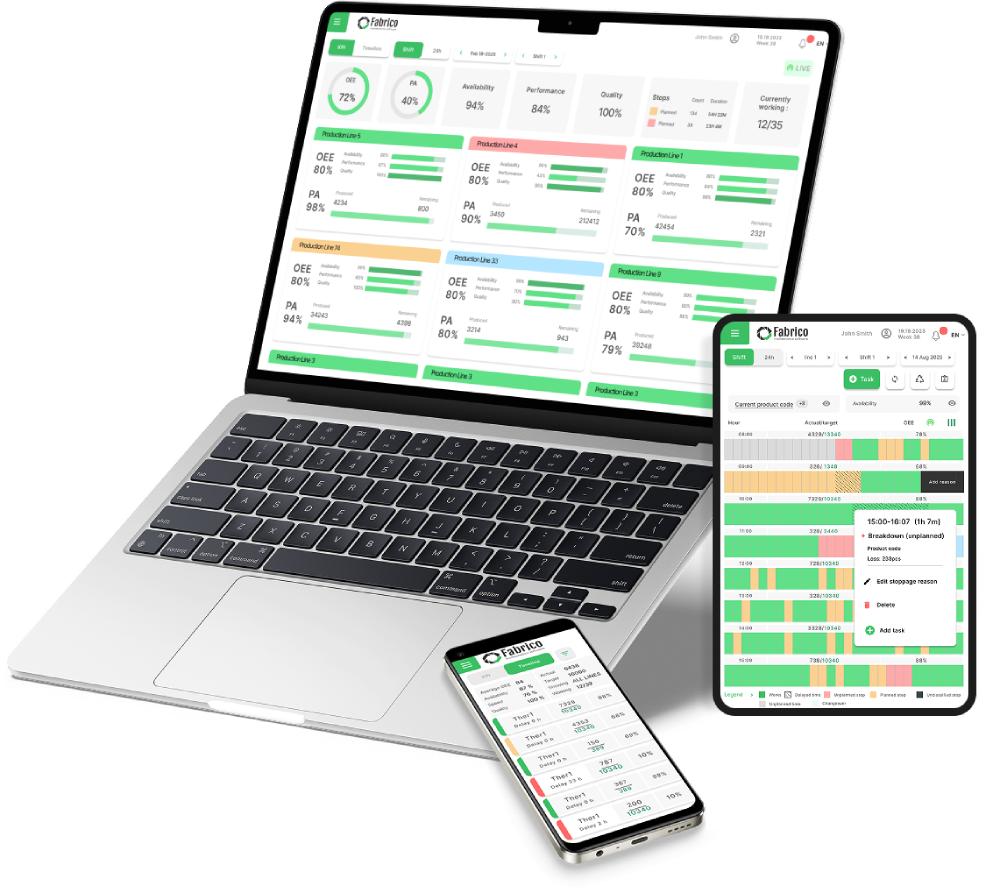
Fabrico is the only platform in this review built from the ground up as a unified System of Action — combining native OEE monitoring, direct machine connectivity, mobile CMMS execution, computer vision root cause analysis, and production scheduling into a single environment.
Why it leads for food, beverage, and packaging:
High-speed filling, labeling, and packaging lines produce micro-stops at a frequency that manual operator logging cannot keep pace with.
Fabrico addresses this through three complementary data capture paths.
Direct PLC connection captures real-time cycle signals on digitalized lines. IoT gateways and optical sensors connect legacy equipment that cannot be accessed via PLC. Computer vision cameras installed above the line detect and record micro-stops, changeovers, and operator events in real time — including at manual and hybrid stations where sensors provide no signal.
The result is 100% visibility of production losses — including the micro-stop categories that most platforms miss entirely and that the Six Big Losses framework identifies as Minor Stoppages and Reduced Speed losses.
Compliance capability:
Every maintenance action is logged automatically — user ID, timestamp, location, parts consumed, checklist sign-off. Digital checklists are aligned with ISO 9001, IATF 16949, and GMP requirements — completed on mobile, stored in an unalterable audit trail. For food and beverage manufacturers operating under SQF or BRCGS, the audit trail is generated without any additional documentation burden.
Closed-loop fault-to-fix:
When an OEE event is detected, Fabrico automatically generates a prioritized work order, checks spare parts availability, and dispatches the work order to the right technician's mobile device — before the supervisor has made a phone call.
AI features in development:
The Fabrico Agent — which automatically analyzes OEE and downtime patterns to create improvement tasks and refine production schedules — is currently in development and on the product roadmap. The Fabrico Assistant — which reads machine manuals and maintenance history to answer technician diagnostic questions — is also currently in development and on the product roadmap.
Implementation: 30-day pilot, 3-4 month full deployment. Multi-site: Group-first architecture with consolidated reporting and global PM template enforcement. Adoption: 96% within first month of go-live.
Best fit: Mid-sized to enterprise food, beverage, and packaging manufacturers seeking a unified platform that eliminates the OEE-to-CMMS action gap.
2. Redzone
Best for: Food manufacturers prioritizing frontline culture and team engagement alongside production performance.
Redzone is a production system built around operator engagement, coaching workflows, and connected worker capabilities.
It delivers real-time production tracking, shift communication tools, and structured team huddle workflows that drive behavioral change on the shop floor.
Where it performs well:
Redzone's culture-first approach produces measurable results in environments where frontline engagement is the primary improvement lever — particularly in food manufacturing sites with high operator turnover or inconsistent shift behaviors.
Its connected worker capabilities and digital communication tools are among the strongest in the market.
Where it falls short for this vertical:
Redzone is primarily a production performance and culture platform — not a CMMS.
Maintenance execution, PM scheduling, spare parts management, and compliance audit trail generation require a separate system — creating the exact OEE-to-maintenance action gap that drives extended downtime in high-speed food and packaging environments.
The service model is also significantly more expensive than most mid-market manufacturers can sustain long-term, with ongoing coaching engagements forming a substantial portion of the total cost.
Best fit: Large food manufacturers with significant change management requirements and budget for a service-heavy implementation model.
3. MaintainX
Best for: Food and packaging manufacturers who need a modern, mobile-friendly work order system and are not yet prioritizing OEE integration.
MaintainX is one of the most user-friendly CMMS platforms available — with an excellent mobile experience, strong work order management, and solid PM scheduling capability.
Its chat-based communication model makes technician collaboration intuitive, and its implementation speed is genuinely impressive.
Where it performs well:
MaintainX's mobile-first design produces high technician adoption rates. Its work request portal is one of the most accessible in the market — operators can submit fault reports quickly without CMMS training.
Where it falls short for this vertical:
MaintainX has no native OEE monitoring capability.
For food, beverage, and packaging manufacturers where every production loss needs to trigger a structured maintenance response automatically — based on real machine data, not operator-submitted requests — this is a fundamental gap.
Condition-based PM triggers driven by actual cycle counts or OEE-detected degradation are not available natively. Compliance audit trail depth for SQF and BRCGS environments is partial rather than comprehensive.
Best fit: Small to mid-sized food and packaging manufacturers prioritizing work order management and technician adoption over OEE integration.
4. Fiix (by Rockwell Automation)
Best for: Enterprise food and beverage manufacturers already invested in the Rockwell Automation ecosystem.
Fiix is a well-established enterprise CMMS with strong asset management depth, solid PM scheduling capability, and the credibility of the Rockwell Automation portfolio behind it.
Where it performs well:
Fiix's asset hierarchy management and reporting capabilities are mature and comprehensive. Its integration with Rockwell's broader automation ecosystem gives it connectivity advantages for manufacturers already running Allen-Bradley PLCs and FactoryTalk infrastructure.
Where it falls short for this vertical:
Fiix is a System of Record — not a System of Action.
Native OEE monitoring is not part of the Fiix platform. OEE data requires a separate Rockwell system or third-party integration — reintroducing the data silo problem that a unified platform eliminates.
Implementation complexity and cost are significantly higher than most mid-market food and packaging manufacturers require. Technician adoption rates on complex enterprise platforms consistently lag behind mobile-first alternatives in manufacturing environments.
Best fit: Large enterprise food and beverage manufacturers with existing Rockwell infrastructure and an IT team capable of managing a complex implementation.
5. Limble CMMS
Best for: Packaging manufacturers who prioritize ease of use and fast implementation over OEE depth.
Limble consistently ranks among the highest-rated CMMS platforms for user experience — with an intuitive interface, fast implementation, and strong customer support that produces genuine satisfaction among maintenance teams.
Where it performs well:
Limble's PM scheduling, work order management, and reporting capabilities are well-executed and accessible to non-technical users. Its implementation speed is genuine — most sites are operational within two to four weeks.
Where it falls short for this vertical:
Limble has no native OEE integration.
For packaging lines where micro-stops and speed losses represent the largest OEE loss category — and where those losses need to automatically trigger maintenance responses — Limble provides no mechanism to close that loop.
Condition-based PM triggers require manual configuration workarounds rather than native OEE-driven automation.
Best fit: Small to mid-sized packaging manufacturers who need a fast, user-friendly CMMS and are managing OEE separately or not at all.
6. SafetyCulture (iAuditor)
Best for: Food manufacturers whose primary need is digital inspection and compliance audit documentation.
SafetyCulture built its reputation on digital inspection checklists and audit documentation — and in food manufacturing environments with heavy compliance requirements, it genuinely delivers on that specific capability.
Where it performs well:
SafetyCulture's checklist and inspection workflow capabilities are among the most flexible in the market. Its mobile interface for inspection completion is well-designed and produces strong adoption among quality and compliance teams.
Where it falls short for this vertical:
SafetyCulture is an audit and inspection tool — not a maintenance execution platform or an OEE monitoring system.
It has no work order management, no PM scheduling, no spare parts management, no machine connectivity, and no OEE tracking.
Deploying SafetyCulture alongside a CMMS and an OEE tool creates a three-system stack with three data silos — which is the architecture that produces the action gaps and reporting inconsistencies that this review is designed to help manufacturers avoid.
Best fit: Food manufacturers who need a standalone digital inspection tool and are managing maintenance and OEE through separate systems — understanding the integration limitations that creates.
Full Platform Comparison Matrix
| Criteria |
Fabrico |
Redzone |
MaintainX |
Fiix |
Limble |
SafetyCulture |
| Native OEE Tracking |
✅ Six Big Losses |
Partial |
❌ No |
❌ No |
❌ No |
❌ No |
| Closed-Loop Fault-to-Fix |
✅ Automatic |
❌ No |
Partial |
Partial |
Partial |
❌ No |
| Mobile Field Execution |
✅ Offline-capable |
✅ Yes |
✅ Yes |
Partial |
✅ Yes |
✅ Inspection only |
| High-Speed Line Connectivity |
✅ PLC, IoT, Vision |
Partial |
❌ No |
Partial (Rockwell) |
❌ No |
❌ No |
| Compliance Audit Trail |
✅ Automatic, full |
Partial |
Partial |
✅ Yes |
Partial |
✅ Inspection only |
| Computer Vision RCA |
✅ Live footage |
❌ No |
❌ No |
❌ No |
❌ No |
❌ No |
| Condition-Based PM Triggers |
✅ OEE and usage |
❌ No |
❌ No |
Limited |
Limited |
❌ No |
| Spare Parts MRO Management |
✅ Full |
❌ No |
Partial |
✅ Yes |
✅ Yes |
❌ No |
| Multi-Site Group Architecture |
✅ Group-first |
✅ Yes |
Partial |
✅ Yes |
Partial |
Partial |
| Implementation Timeline |
30-day pilot |
60-90 days |
2-4 weeks |
3-6 months |
2-4 weeks |
1-2 weeks |
| Technician Adoption Rate |
96% in 30 days |
High |
High |
Medium |
High |
High (inspection) |
| Standalone OEE Replacement |
✅ Yes |
❌ No |
❌ No |
❌ No |
❌ No |
❌ No |
How to Choose: The Decision Framework for Food, Beverage & Packaging
Choose Fabrico if:
Your operation needs to close the loop between OEE loss detection and maintenance execution — automatically, without a separate system or manual handoff. You are operating under SQF, BRCGS, FDA, or GMP compliance requirements and need automated audit trail generation.
Your lines run at speeds where micro-stops occur faster than operators can manually log them. You are managing multiple sites and need consolidated group reporting alongside site-level execution.
Choose Redzone if:
Frontline culture and operator engagement are your primary improvement levers and you have the budget for a service-heavy model. You are prepared to run a separate CMMS alongside it for maintenance execution.
Choose MaintainX if:
You need a fast, user-friendly CMMS implementation and are not yet prioritizing native OEE integration. Your maintenance team's primary pain point is work order management rather than OEE-driven reliability improvement.
Choose Fiix if:
You are a large enterprise already invested in the Rockwell Automation ecosystem and have IT resources to manage a complex implementation.
Choose Limble if:
Your primary requirement is a simple, well-supported CMMS with fast implementation and strong user experience — and OEE monitoring is managed separately.
Choose SafetyCulture if:
Your primary need is digital inspection and compliance documentation — and you are managing maintenance and OEE through separate dedicated systems.
Frequently Asked Questions
What is the best OEE and CMMS software for food manufacturing?
Fabrico is the strongest unified platform for food manufacturing — combining native OEE monitoring, automatic compliance audit trail generation, mobile maintenance execution, and computer vision root cause analysis in a single system without requiring integration between separate tools.
Do food and beverage manufacturers need both OEE and CMMS software?
Yes — but the more important question is whether those capabilities need to be in the same platform. In high-speed food and beverage environments, the delay between OEE loss detection and maintenance response is the primary driver of extended downtime. That delay is structural when OEE and CMMS are separate systems. It is eliminated when they are unified.
How does Fabrico handle GMP and SQF compliance documentation?
Every maintenance action in Fabrico is logged automatically with user ID, timestamp, location, parts consumed, and checklist completion — creating a complete, unalterable audit trail that satisfies GMP, SQF, BRCGS, and ISO 9001 requirements without additional documentation effort.
Can Fabrico connect to high-speed filling and packaging line PLCs?
Yes. Fabrico connects directly to existing PLCs or automation systems on digitalized lines. For legacy or semi-automated equipment, IoT gateways and optical sensors are deployed. For manual stations, computer vision provides signal capture where PLCs cannot reach.
How long does implementation take for a food or beverage facility?
A pilot site is operational within 30 days. Full single-facility deployment is completed within 3-4 months, supported by a dedicated automation engineer and account manager throughout the process.
If your food, beverage, or packaging operation is running OEE and maintenance as separate functions — the action gap between them is costing you measurable output every shift. Request a demo to see how Fabrico closes it in 30 days.


 Login
Login
 Blog
Blog