What is automated escalation in OEE software?
Automated escalation in OEE software is a digital manufacturing feature that monitors real-time equipment performance and automatically notifies a predefined hierarchy of technical and management personnel if a production stop or speed loss remains unresolved beyond a set duration.
For Mike (the Tactical Manager), this is the end of "Walking the Floor" to check for bottlenecks.
Instead of waiting for a radio call, he uses Fabrico to ensure that if a high-speed filler is down for more than 15 minutes, he is alerted instantly on his mobile device with the technical root cause attached.
1. Fabrico: The Integrated System of Action
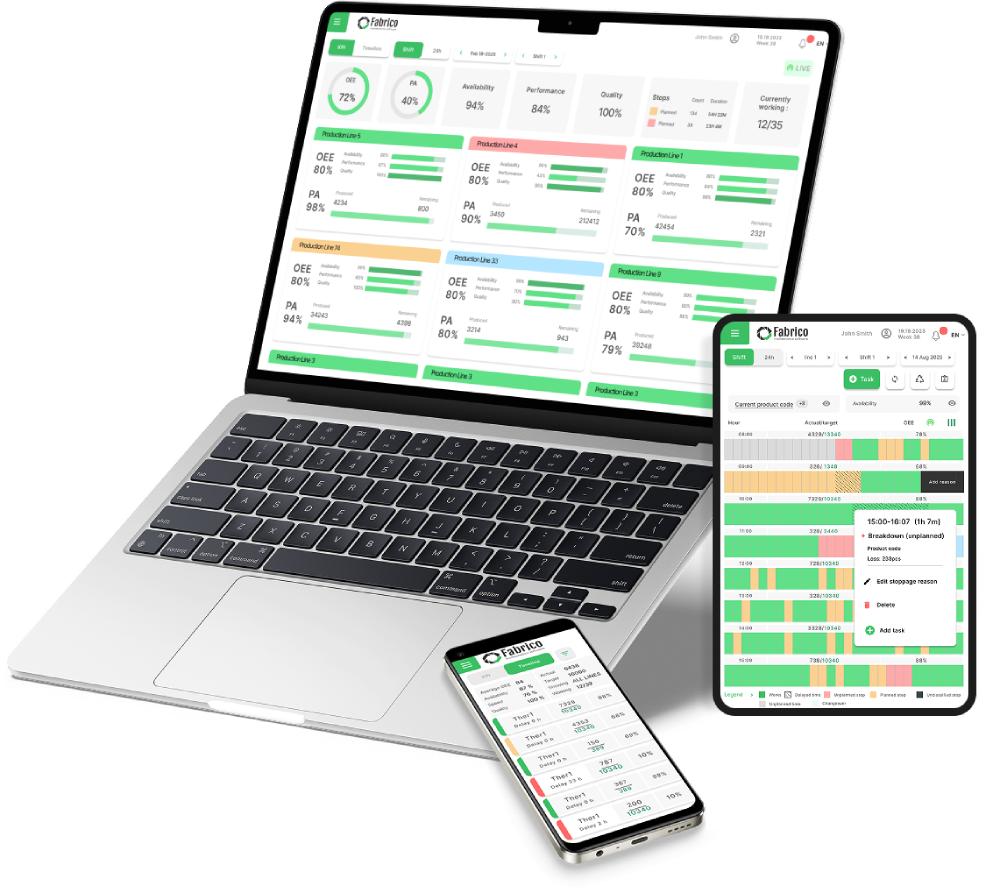
Fabrico is the only platform built to natively unify Native OEE pulses with a multi-tier escalation engine and a Field-Ready CMMS.
Why it wins for response speed:
Fabrico treats a downtime event as a live crisis. It utilizes "Smart Notifications" that are color-coded (urgent vs. informative) and role-specific. When a performance threshold is breached, the system natively triggers a prioritized Work Order.
Because it is a System of Action, if the assigned technician does not acknowledge the task or the machine's OEE remains at zero, the "Swift Escalation" logic notifies the next level of leadership. By utilizing the Inefficiencies Zoom-In (Computer Vision) module, the escalated alert includes a video clip of the failure, ensuring management sees the truth in seconds.
2. Matics
Matics is an agile, cloud-native production monitoring platform that focuses on real-time OEE visibility and floor-level alert management.
The Trade-off:
Matics has a very responsive notification engine that sends alerts based on downtime events. However, it lacks the deep engineering asset data and Master PM Templates required for a full Reliability-Centered Maintenance (RCM) strategy. It identifies the stop and notifies the team, but it doesn't natively manage the technical "How-To" of the mechanical repair.
3. Redzone Production System
Redzone is recognized for its "Social OEE" approach, using gamification and community feeds to drive operator-led alerts.
The Trade-off:
Redzone excels at operator communication and frontline "Social" escalation. However, it functions primarily as a "System of Culture." It lacks the native MRO inventory and complex asset hierarchy management found in a unified platform like Fabrico. It helps people talk about a stop, but it doesn't always help the machines talk to the technicians.
4. Plex (by Rockwell Automation)
Plex is a heavyweight ERP and MES platform that offers a comprehensive view of the entire manufacturing enterprise, including administrative escalation workflows.
The Trade-off:
Plex is a "Finance-First" system designed for high-level auditing. While it has escalation logic, the implementation is notoriously long and expensive. The user interface is often too complex for technicians on the shop floor, resulting in higher Decision Latency as users navigate through multiple ERP menus to log a response.
5. Tulip Interfaces
Tulip provides a "no-code" platform that allows manufacturers to build their own custom apps for data collection and escalation triggers.
The Trade-off:
Tulip offers extreme flexibility for building bespoke notification apps. The challenge is the "DIY Tax." You must build and maintain the logic between the production signal and the maintenance response yourself. For Paula (the Strategic Leader), this creates a data silo that can lead to high IT overhead compared to an out-of-the-box System of Action.
Comparison Matrix: OEE Escalation & Notification Capabilities
| Feature |
Fabrico (System of Action) |
Matics |
Redzone |
Plex (MES) |
Tulip |
| Escalation Type |
Automated / Multi-Tier |
Logic-Based |
Social Feed |
Workflow-Based |
Custom Build |
| Notification Sync |
Native CMMS Loop |
Dashboard Only |
Manual Chat |
ERP-Integrated |
App-Based |
| Urgency Tagging |
Color-Coded / Smart |
Basic Alert |
Social Tag |
Text Alert |
Custom |
| Visual Proof (RCA) |
Advanced (Zoom-In) |
Photo-Only |
Photo-Only |
None |
Photo-Only |
| Decision Latency |
Zero (Automated) |
Moderate |
Moderate |
High |
Moderate |
| Implementation |
3-4 Months |
2-3 Months |
4-6 Months |
12+ Months |
Ongoing |
The Strategic ROI: Reclaiming the "Decision Latency" Revenue
For Paula (the Strategic Leader), the business case for automated escalation is built on Capacity Reclamation.
In high-speed bottling or packaging, every ten minutes of "Decision Latency" can cost $5,000 in lost output. By automating the hand-off from production signals to a management hierarchy, you ensure that technical labor is always focused on the Value Fulcrum—the machines that drive the highest throughput.
Consolidating OEE and maintenance into one platform reduces the global Maintenance Cost per Unit and ensures your capital assets reach their full residual value.
Stop hoping your team sees the red light. Start engineering a response with a System of Action.


 Login
Login
 Blog
Blog
![What is Overall Equipment Effectiveness (OEE)? [2026 Guide]](https://s3.fabrico.io/uploads/what-is-overall-equipment-effectiveness-oee-guide.jpg)