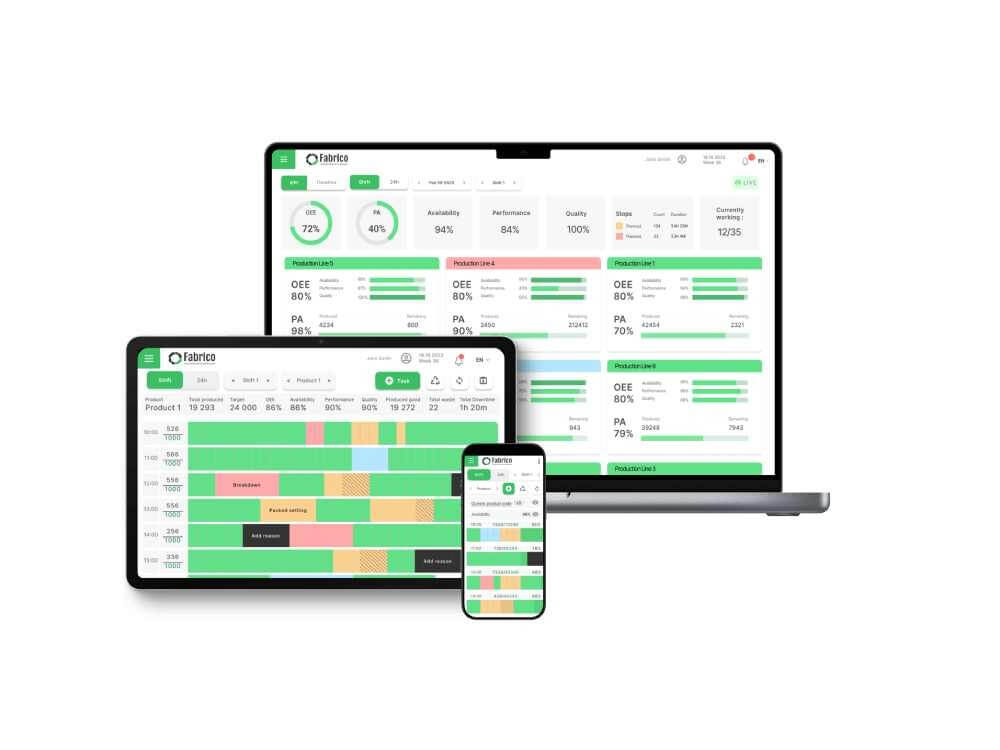
What is automatic work order generation from OEE?
OEE software with automatic work order generation is a manufacturing platform that monitors real-time machine signals and natively triggers a maintenance task in a CMMS the moment Availability, Performance, or Quality drifts below a predefined threshold.
For Mike (the Tactical Manager), this feature is a "Force Multiplier."
Instead of spending his shift acting as a dispatcher, Fabrico handles the prioritization, ensuring that Tom (the Technician) receives a smart notification on his mobile device the millisecond a line enters a "Six Big Losses" event.
1. Fabrico: The Integrated System of Action
Fabrico is the only platform built from the ground up to natively merge Native OEE diagnostics with an automated Field-Ready CMMS execution loop.
Why it wins for high-speed lines:
Fabrico utilizes the "Visibility Trifecta", pulling data from PLCs, operators, and AI-powered Computer Vision.
When a performance drop is detected, the Inefficiencies Zoom-In module flags a video clip and attaches it to an automatically generated, prioritized Work Order.
This ensures Tom sees the mechanical root cause on his mobile app before he even arrives at the machine, slashing MTTR (Mean Time to Repair) and protecting your Value Fulcrum.

2. MachineMetrics
MachineMetrics is widely recognized for its deep machine connectivity and IoT data analytics, specifically within the CNC and discrete manufacturing sectors.
The Trade-off:
While it provides excellent real-time alerts, it often functions as a "System of Record" for analytics rather than an execution engine.
For Paula (the Strategic Leader), the lack of a native, field-ready CMMS means the "Automatic" work order often still requires a third-party bridge, creating a data silo that can lead to synchronization errors and increased IT overhead.
3. Fiix (by Rockwell Automation)
Fiix is a robust, enterprise-grade CMMS that has increasingly integrated with Rockwell’s automation ecosystem to provide OEE-triggered maintenance.
The Trade-off:
Fiix is a heavyweight "System of Record" designed for large-scale asset management.
The implementation is often long and expensive, and the user interface can be difficult for Tom to navigate on a mobile device in a high-pressure shift. Its automated triggers often focus on "Time-Based" schedules rather than the "Usage-Based" agility required for high-speed Food & Beverage or Plastics lines.
4. MaintainX
MaintainX is a popular mobile-first maintenance tool that excels at team communication and manual checklists.
The Trade-off:
It is a "Maintenance-First" platform that lacks native, high-frequency PLC integration.
While it can receive "alerts," it doesn't automatically analyze the Six Big Losses or use Computer Vision to provide the context for the work order. This leaves the technician "blind" to the root cause until they arrive at the machine and perform manual diagnostics.
5. Redzone Production System
Redzone focuses on "Social OEE," using gamification and shop-floor coaching to improve operator engagement.
The Trade-off:
Redzone is a "System of Culture," not a technical execution engine.
While it excels at operator communication, it lacks the deep engineering asset data and native CMMS functionality required to manage spare parts and complex asset hierarchies. Its work order generation is often a manual "social" trigger rather than a data-driven mechanical one.
Comparison Matrix: OEE-to-Work Order Automation
| Capability |
Fabrico (System of Action) |
MachineMetrics |
Fiix (Rockwell) |
MaintainX |
Redzone |
| Response Trigger |
Native / Instant |
Email / Alert |
Scheduled |
Manual Chat |
Social Feed |
| OEE Data Source |
PLC + Vision + Human |
PLC / IoT |
Integrated |
Manual / Basic |
Operator Input |
| Visual RCA |
Advanced (Zoom-In) |
Data-Only |
None |
Photo-Only |
Photo-Only |
| Mobile UX |
Native Offline App |
Browser-Based |
Complex |
High (Chat) |
High (Social) |
| Maintenance Link |
Native CMMS |
Siled / API |
Integrated / Heavy |
Manual / Basic |
None |
| ROI Strategy |
Capacity Reclamation |
OT Visibility |
Compliance |
Communication |
Culture |
The Strategic ROI: Slashing Decision Latency
For Paula, the business case for automatic work order generation is built on "Capacity Reclamation."
Reclaiming just 5% of your Availability through reduced Decision Latency is often more profitable than purchasing a new production line.
By identifying "Bad Actor" assets through real-time performance data, you move your team to Condition-Directed Tasks that directly protect your revenue.
Consolidating into a unified platform ensures your 12-month data foundation is ready for the Fabrico Agent (AI Roadmap) to automate even more complex scheduling.
Stop managing your losses on a scoreboard. Start engineering uptime with a System of Action.


 Login
Login
 Blog
Blog