What is "Bad Actor" identification in OEE software?
OEE software with Bad Actor identification is an advanced analytical framework that uses real-time machine performance data (Availability, Performance, Quality) and maintenance history to automatically rank assets based on their contribution to total plant downtime.
For Paula (the Strategic Leader), this feature is a "Value Fulcrum." Instead of guessing where to allocate Capex, she uses the Unified Data Intelligence to see exactly which filler or labeler is destroying the week's Takt time.
Fabrico bridges this gap by ensuring these identified bottlenecks natively trigger an investigation in the Field-Ready CMMS.
1. Fabrico: The Integrated System of Action
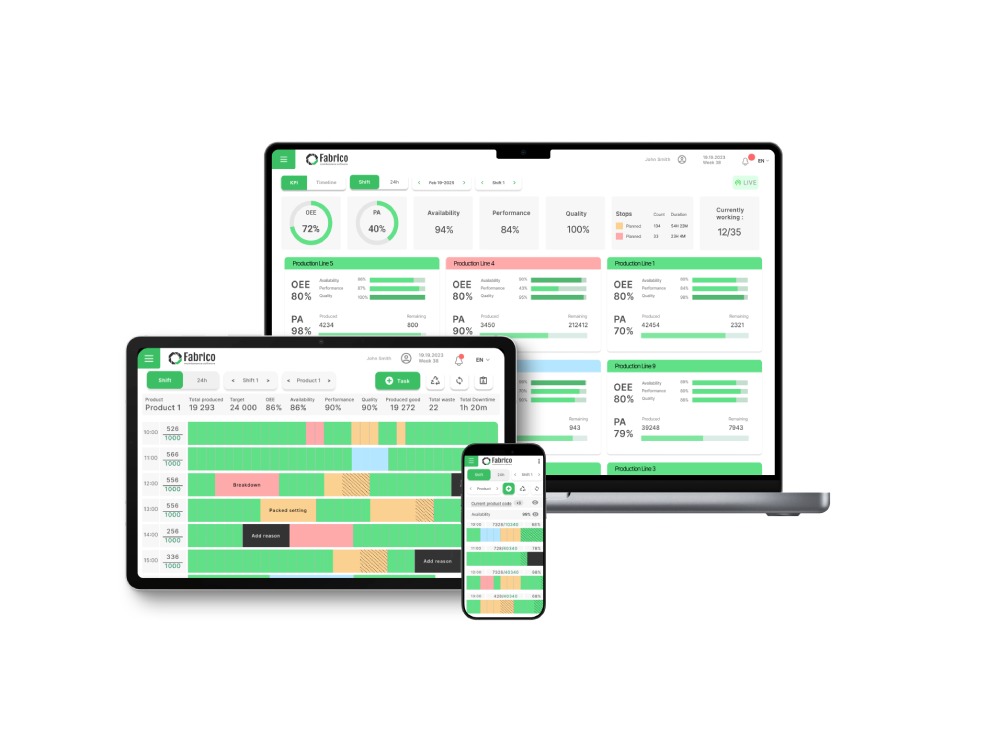
Fabrico is the only platform built to natively merge Native OEE pulses with AI-driven visual evidence to isolate and fix Bad Actors.
Why it wins for high-speed lines:
Fabrico utilizes the "Visibility Trifecta" to identify not just that a machine is a Bad Actor, but why. When an asset's MTBF (Mean Time Between Failures) drops, the Inefficiencies Zoom-In (Computer Vision) module flags video clips of the failure patterns.
Because it is a System of Action, the system doesn't just provide a report; it triggers a Condition-Directed Task. Tom (the Technician) receives a prioritized Work Order on his mobile device, ensuring that the machines limiting your Effective Runtime receive the most attention.
2. MachineMetrics
MachineMetrics is a robust platform focused on deep IoT machine connectivity and technical data analysis, particularly for the CNC and discrete manufacturing sectors.
The Trade-off:
They offer world-class data science for identifying tool wear and machine health anomalies. However, their identification of Bad Actors often remains in an "Analytics Silo." For Mike (the Tactical Manager), the lack of a native, field-ready maintenance execution layer means he must manually transfer these insights into a separate CMMS to drive a fix.
3. Fiix (by Rockwell Automation)
Fiix is an enterprise-grade CMMS that has increasingly integrated with Rockwell’s automation ecosystem to provide reliability engineering insights.
The Trade-off:
Fiix excels at the "Maintenance-First" side of the equation, offering deep asset hierarchy management. However, its OEE pulse is often lagged. For high-speed FMCG or Plastics, the "Complexity Tax" of the Fiix interface can slow down the identification of micro-stops—the primary symptoms of a Bad Actor asset in high-volume production.
4. Sight Machine
Sight Machine focuses on creating a "Digital Twin" of the entire manufacturing process by consolidating data from across the enterprise.
The Trade-off:
It is a powerful tool for data scientists to find long-term correlations in "Bad Actor" behavior. However, it is often too "heavy" for the shop floor. The implementation takes 6-12 months, and it lacks the mobile-first simplicity technicians need to manage the immediate "Fault-to-Fix" cycle that reclaims capacity.
5. Vorne XL (Visual Scoreboards)
Vorne XL is the industry standard for hardware-centric scoreboards that provide immediate visual feedback on the factory floor.
The Trade-off:
It is a "Digital Clock" that identifies that a machine is underperforming now. However, it lacks the historical technical database and Advanced Visual RCA needed to identify chronic "Bad Actor" patterns over time. For the Strategic Leader, it tracks the decline but doesn't provide the digital workflows to manage the enterprise-wide recovery.
Comparison Matrix: Bad Actor Identification Capabilities
| Feature |
Fabrico (System of Action) |
MachineMetrics |
Fiix (Rockwell) |
Sight Machine |
Vorne XL |
| Identification Logic |
80/20 Automated |
Data Science |
Reliability Engine |
Digital Twin |
Visual Only |
| Response Trigger |
Auto-Work Order |
Email / Alert |
Scheduled |
Dashboard |
Visual Alert |
| Visual Proof |
Advanced (Zoom-In) |
Data-Only |
None |
Data-Only |
None |
| Maintenance Link |
Native CMMS |
Siled / API |
Integrated / Heavy |
None |
None |
| Mobile UX |
Native Offline App |
Browser-Based |
Complex |
Low |
N/A |
| Implementation |
3-4 Months |
4-6 Months |
6-12 Months |
12+ Months |
Days |
The Strategic ROI: Reclaiming the "Hidden Factory" Revenue
For Paula, the business case for a Bad Actor-focused system is built on "Capacity Reclamation."
Reclaiming just 5% of Availability from your worst-performing 20% of assets is often more profitable than adding a new production line. By identifying these "Bad Actors" through real-time 3D data (Machine + Human + Vision), you move your team from reactive "firefighting" to Reliability-Centered Maintenance (RCM).
This shift directly reduces the Maintenance Cost per Unit and ensures your multi-million dollar assets reach their full residual value.
Stop maintaining every machine. Start engineering uptime with a System of Action.


 Login
Login
 Blog
Blog