What is real-time bottleneck detection in OEE software?
Real-time bottleneck detection is an advanced digital manufacturing capability that uses machine pulses and flow analysis to identify the specific asset currently limiting total production throughput.
For Mike (the Tactical Manager), this feature is a "Focus Engine."
Instead of his technicians spreading their effort across five machines, Fabrico tells them exactly which "Bad Actor" is starving the line.
Fabrico eliminates "Investigation Waste" by ensuring the Value Fulcrum is always centered on the constraint, natively linking the diagnostic to the cure.
1. Fabrico: The Integrated System of Action
Fabrico is the only platform built to natively unify Native OEE bottleneck analysis with an AI-driven optimization engine.
Why it wins for high-speed lines:
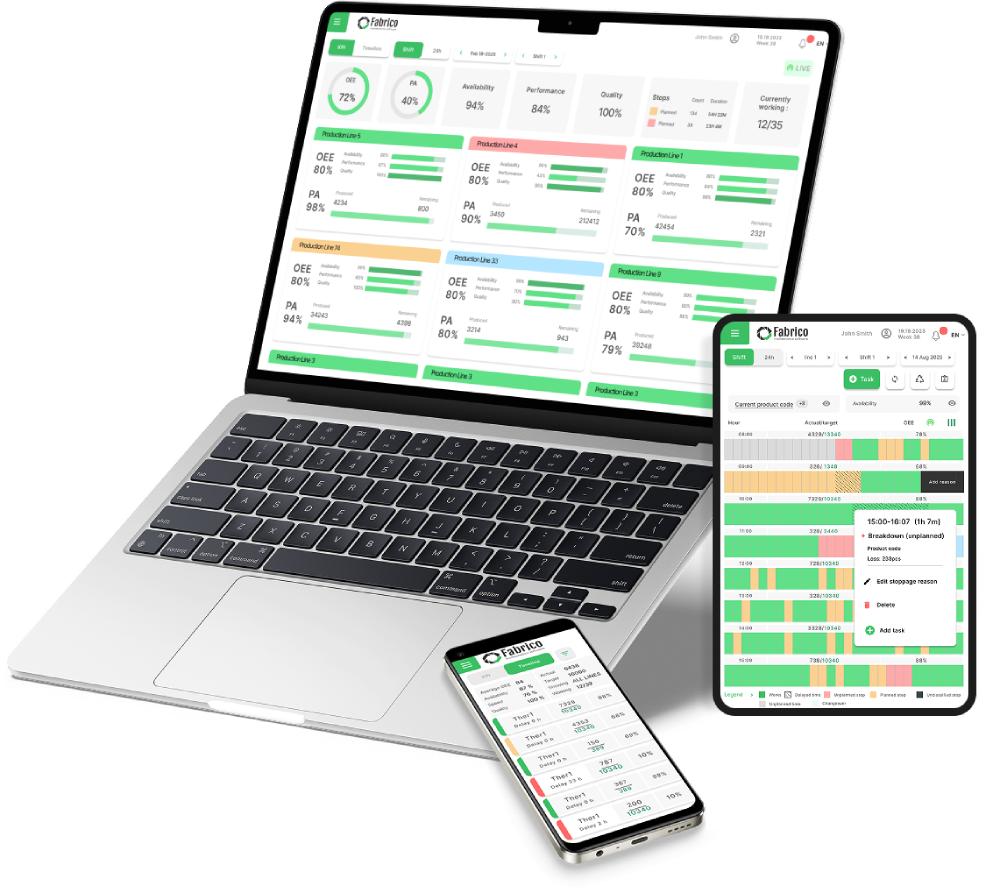
Fabrico utilizes the Fabrico Agent (AI Roadmap) to analyze your "Master Data of Inefficiencies" and identify production constraints in real-time.
Because it is a System of Action, identifying a bottleneck instantly triggers a prioritized task in the Field-Ready CMMS.
By combining PLC signals with the Inefficiencies Zoom-In (Computer Vision) module, Fabrico captures the visual truth of why a bottleneck is failing.
This ensures Tom (the Technician) arrives with the correct tools to reclaim the Hidden Factory capacity that is currently choking your output.
2. MachineMetrics
MachineMetrics excels at deep IoT machine connectivity and technical data analysis, particularly for the CNC and discrete manufacturing sectors.
The Trade-off:
They offer world-class technical analytics for identifying tool wear and machine health anomalies.
However, their bottleneck identification often remains in an "Analytics Silo."
For Paula (the Strategic Leader), the lack of a native, mobile-first maintenance execution layer means there is still a significant "Action Gap" between seeing a bottleneck and fixing it.
3. Seeq
Seeq provides advanced time-series analytics for process manufacturing, allowing engineers to identify complex bottlenecks in continuous flow lines.
The Trade-off:
Seeq is a powerful tool for data scientists and process engineers to find long-term correlations.
However, it is often too "heavy" for the shop floor.
It lacks the field-ready simplicity and native QR Code asset tagging technicians need to manage repairs at the machine in real-time.
4. Vorne XL (OEE Scoreboards)
Vorne XL is the industry standard for hardware-centric scoreboards that provide immediate visual feedback of OEE metrics.
The Trade-off:
It is a "Digital Clock" that identifies that a machine is down now.
However, it lacks the technical database and flow analysis needed to identify which machine is the primary bottleneck over a multi-day shift.
It tracks the stop but doesn't provide the digital workflows to manage the maintenance recovery.
5. Evocon
Evocon is an entry-level OEE tool recognized for its visual simplicity and ease of setup for shop floor operators.
The Trade-off:
Evocon relies heavily on manual downtime tagging by operators.
In high-speed lines, this leads to the "Pencil Whip" trap, where micro-stops are mislabeled, providing zero actionable evidence for Mike to fix the underlying mechanical drift at the bottleneck.
Comparison Matrix: Real-Time Bottleneck Detection
| Feature |
Fabrico (System of Action) |
MachineMetrics |
Seeq |
Vorne XL |
Evocon |
| Constraint Logic |
AI Agent (Native) |
Data-Driven |
Time-Series AI |
Visual Only |
Manual Tagging |
| Maintenance Link |
Native CMMS |
Siled / API |
None |
None |
None |
| Response Trigger |
Auto-Work Order |
Email / Alert |
Dashboard |
Visual Alert |
Dashboard |
| Visual Proof |
Advanced (Zoom-In) |
Data-Only |
None |
None |
None |
| Mobile Experience |
Native Offline App |
Browser-Based |
Desktop-First |
N/A |
Browser-Based |
| Implementation |
3-4 Months |
4-6 Months |
6-12 Months |
Days |
1 Month |
The Strategic ROI: Protecting the Throughput Engine
For Paula (the Strategic Leader), the business case for bottleneck-integrated OEE is built on "Capacity Reclamation."
Reclaiming just 5% of uptime on a bottleneck asset is worth more than 20% on a non-critical machine.
By identifying "Bad Actors" through real-time data, you move your team to Condition-Directed Tasks that protect your most valuable production time.
As you build 12 months of clean bottleneck data, you are preparing the facility for the future of autonomous optimizations.
Stop fixing the loudest machines. Start engineering the bottlenecks with a System of Action.


 Login
Login
 Blog
Blog