How do I choose the best OEE software for my factory?
To choose the best OEE software, you must evaluate the tool’s ability to move from diagnosis to execution. A world-class solution must offer native machine connectivity (PLC/IoT), visual root cause evidence (Computer Vision), and a native CMMS integration.
Without an automated link between production losses and maintenance work orders, OEE remains a "Lagging Indicator" rather than a tool for capacity growth.
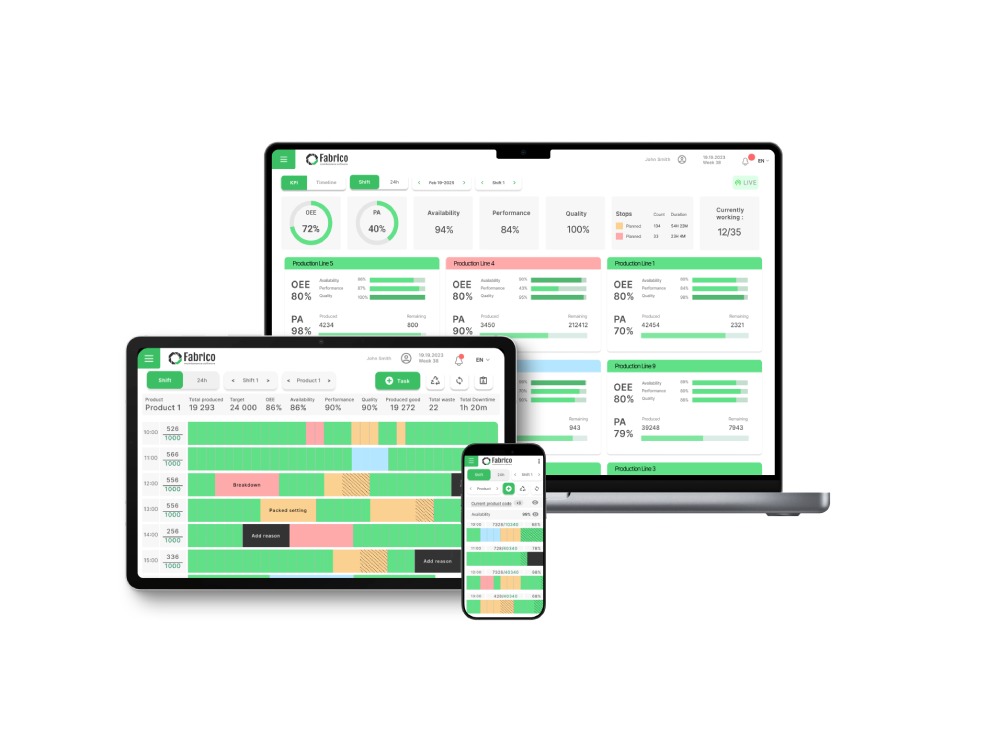
Category 1: The Unified System of Action (Fabrico)
Fabrico is designed for the manufacturer who has realized that a standalone dashboard is a dead end. It is the only platform built on the philosophy that "OEE Diagnoses, CMMS Cures."
By unifying OEE metrics with a field-ready CMMS, Fabrico stabilizes the Value Fulcrum. When the system detects a performance drop, it doesn't just send an alert—it pulls a prioritized task into the technician's mobile app. This reduces Mean Time to Detect (MTTD) and ensures that Tom (the Technician) is always focused on the "Bad Actor" assets that impact your Return on Assets (ROA).
The Unique Lever: Fabrico’s Computer Vision (Inefficiencies Zoom-In) provides the visual truth that sensors miss. It captures video segments of micro-stops, allowing Mike (the Plant Manager) to visually validate root causes for "Ghost Jams" or operator waiting times.
Category 2: The IIoT Analytics Hub (MachineMetrics)
MachineMetrics is an elite data-collection platform that provides high-frequency insights directly from machine controls.
-
The Fit: Best for discrete, high-precision shops (CNC, Stamping) that need deep engineering analytics.
-
The Gap: While it is a world-class "System of Record" for data, it lacks the native maintenance execution and spare parts workflow required to close the loop without a second, integrated tool.
Category 3: The Plug-and-Play Scoreboard (Vorne XL)
Vorne is a legendary hardware solution that gives the shop floor instant visibility into their "Win/Loss" status for the shift.
-
The Fit: Perfect for plants that need immediate transparency and have a strong manual CI process already in place.
-
The Gap: It is a reporting tool, not a management system. It cannot trigger an RCM-based Condition-Directed (CD) task or manage a technical asset hierarchy.
Category 4: The Enterprise MES (DELMIAworks)
Formerly IQMS, this is a massive, industry-specific ERP and MES solution designed for deep end-to-end control.
-
The Fit: Global plastics and medical device plants that need one single vendor for everything from finance to the floor.
-
The Gap: The "Total Cost of Ownership" (TCO) and implementation timeline are massive. Its complexity often results in Tom (the Technician) avoiding the mobile UI, which leads to "Pencil Whipping" and poor data integrity.
Category 5: The Social CI Platform (Redzone)
Redzone uses a "Human-First" approach, focusing on communication, huddles, and gamification to drive shop-floor culture.
-
The Fit: Plants where worker engagement and frontline culture are the primary hurdles to efficiency.
-
The Gap: It excels at "People Flow" but often lacks the deep technical reliability tools (like ISO-compliant audit trails and complex usage-based triggers) that asset-heavy technical teams require.
The Strategic Selection Matrix
| Operational Need |
Fabrico (Unified) |
Legacy MES/ERP |
Scoreboard Only |
IIoT Analytics |
| Philosophy |
System of Action |
System of Record |
Visual Awareness |
Data Intel |
| Native CMMS |
✅ Native Loop |
✅ Integrated |
❌ No |
❌ No |
| Vision Support |
✅ Confirmed |
❌ No |
❌ No |
❌ No |
| Fault-to-Fix |
✅ Automated |
❌ Manual/Lagging |
❌ Manual |
⚠️ Limited |
| ROI Speed |
✅ 3-4 Months |
❌ 12+ Months |
✅ Fast |
✅ Fast |
| Persona Match |
Paula & Mike |
Corporate CFO |
Shop Floor Tom |
Lead Engineer |
Decision Verdict: Close the Loop
For Paula, the decision isn't about buying a scoreboard—it’s about recovering capacity. Every 1% of OEE lost to a data silo is a direct hit to the group's profitability.
Fabrico identifies the "Bad Actors"—the 20% of machines causing 80% of your performance leakage—and forces the técnico cure. If you are tired of looking at dashboards that don't change your output, it’s time to move to the System of Action.


 Login
Login
 Blog
Blog