What is OEE software with Visual Root Cause Analysis?
Visual Root Cause Analysis (RCA) in OEE software is an advanced diagnostic capability that synchronizes real-time production data with AI-powered video footage to provide undeniable proof of why an asset failed or slowed down.
By using high-definition cameras above the line, these systems capture micro-stops, jams, and operator delays that are too fast for the human eye.
This visual evidence eliminates the "Blame Game" between production and maintenance shifts, allowing for permanent mechanical fixes rather than temporary adjustments.
1. Fabrico: The Integrated System of Action
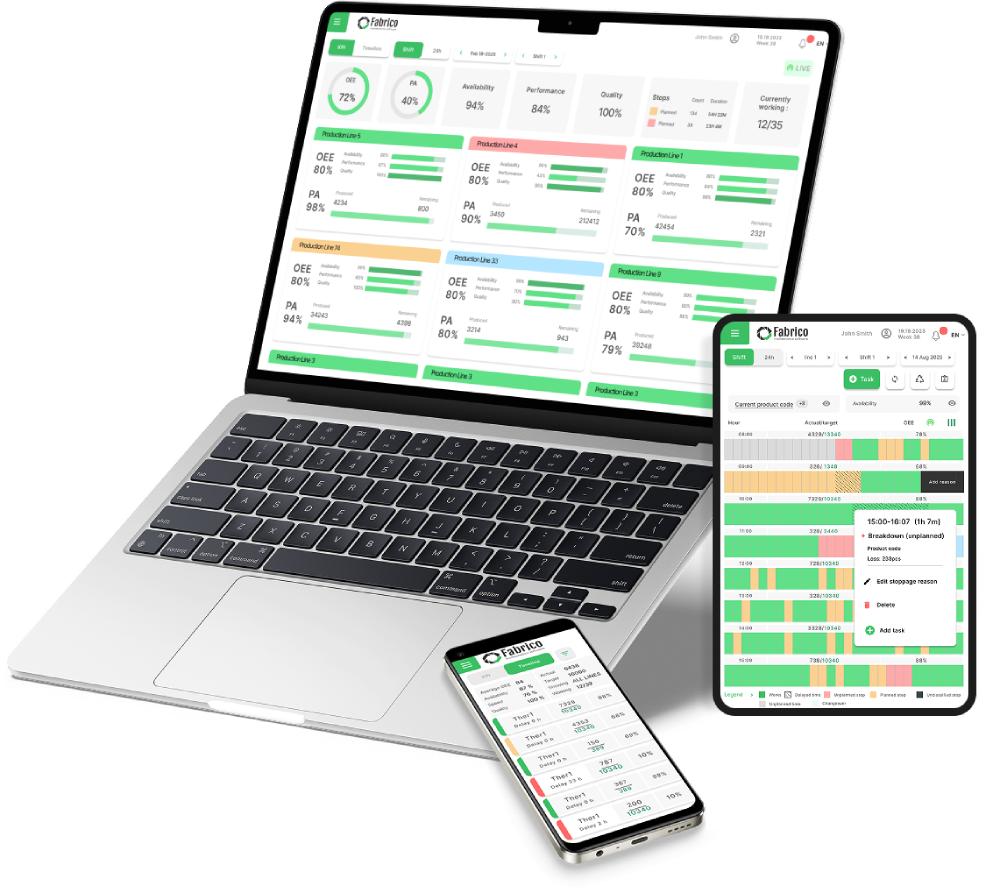
Fabrico is the only platform that natively unifies Native OEE, AI-powered Computer Vision, and a Field-Ready CMMS into a single source of truth.
Why it wins for high-speed lines:
Fabrico utilizes the "Inefficiencies Zoom-In" module. When a performance drop or micro-stop is detected via PLC, the system automatically flags a video clip of the exact moment.
Because it is a System of Action, it doesn't just log the fault; it triggers a prioritized Work Order for Tom (the Technician). Tom scans the QR Code at the machine, views the "Replay" on his mobile device, and executes the fix based on facts, not guesswork.
2. MachineMetrics
MachineMetrics is a robust platform that excels at deep IoT machine connectivity and technical data analysis, primarily for the CNC and discrete manufacturing sectors.
The Trade-off:
While they offer world-class technical analytics, their visual RCA capabilities are often treated as a secondary "add-on." For Paula (the Strategic Leader), the lack of a native, mobile-first maintenance execution layer means there is still a significant "Action Gap" between seeing a fault and fixing it.
3. Sight Machine
Sight Machine focuses on creating a "Digital Twin" of the entire manufacturing process by consolidating data from across the enterprise.
The Trade-off:
Their platform is highly sophisticated but functions primarily as a "System of Record" for data scientists and analysts. In a high-pressure shift, the implementation is heavy, and the interface lacks the technician-friendly simplicity required to manage real-time repairs at the point of work.
4. Oden Technologies
Oden Technologies provides "Big Data" and AI-driven insights to optimize production processes in high-volume environments like plastics extrusion and chemical manufacturing.
The Trade-off:
Oden is a powerful diagnostic tool for process engineers to find long-term correlations. However, it lacks a native Field-Ready CMMS to execute the repairs it identifies. Without the "Action" half of the loop, the planning board remains an "Insights" dashboard rather than a driver of shop floor activity.
5. Matics
Matics is an agile production monitoring platform that focuses on real-time OEE visibility and simple task management for shop floor teams.
The Trade-off:
Matics excels at floor-level communication, but it lacks the deep technical asset data and Advanced Visual RCA needed for a full Reliability-Centered Maintenance (RCM) strategy. While it tracks downtime, it doesn't provide the high-definition "Zoom-In" capabilities required to see the "Why" behind micro-stops.
Comparison Matrix: OEE with Visual RCA Capabilities
| Feature |
Fabrico |
MachineMetrics |
Sight Machine |
Oden |
Matics |
| Visual Proof |
Advanced (Zoom-In) |
Basic / API |
Data-Only |
Data-Only |
Photo-Only |
| Response Trigger |
Auto-Work Order |
Email / Alert |
Dashboard Only |
Manual |
Manual Chat |
| Maintenance Link |
Native CMMS |
Siled / API |
None |
None |
Basic Task Mgmt |
| Mobile UX |
Native Offline App |
Browser-Based |
Desktop-First |
Desktop-First |
Browser-Based |
| Implementation |
3-4 Months |
4-6 Months |
12+ Months |
6-9 Months |
2-3 Months |
| Primary Goal |
Capacity Reclamation |
OT Visibility |
Data Science |
Process Optimization |
Communication |
The Strategic ROI: Reclaiming the 15% Capacity Gap
For Paula (the Strategic Leader), the business case for a visual RCA system is built on Capacity Reclamation.
By identifying the "Ghost Losses" that traditional sensors miss, she can increase total plant throughput without purchasing a single new machine. Consolidating these visual insights with maintenance execution in Fabrico ensures that her team focuses on the Value Fulcrum—the high-impact tasks that protect effective runtime.
As you build 12 months of clean visual and signal data, you are preparing the facility for the future of automated diagnostic cycles.
Stop guessing why your machines are stopping. Start seeing the truth with a System of Action.


 Login
Login
 Blog
Blog