What is OEE-linked condition-based maintenance?
OEE-linked condition-based maintenance (CBM) is a reliability strategy where real-time machine performance data—specifically cycle counts, speed deviations, and quality drifts—is used to automatically trigger maintenance tasks in a CMMS when the asset’s health falls below an optimized threshold.
For Mike (the Tactical Manager), CBM triggers are the end of the "Sunday Night Call-In."
Instead of waiting for a motor to seize, Fabrico identifies that the line is running 5% slow or drawing more amperage and dispatches Tom (the Technician) during a planned changeover.
1. Fabrico: The Integrated System of Action
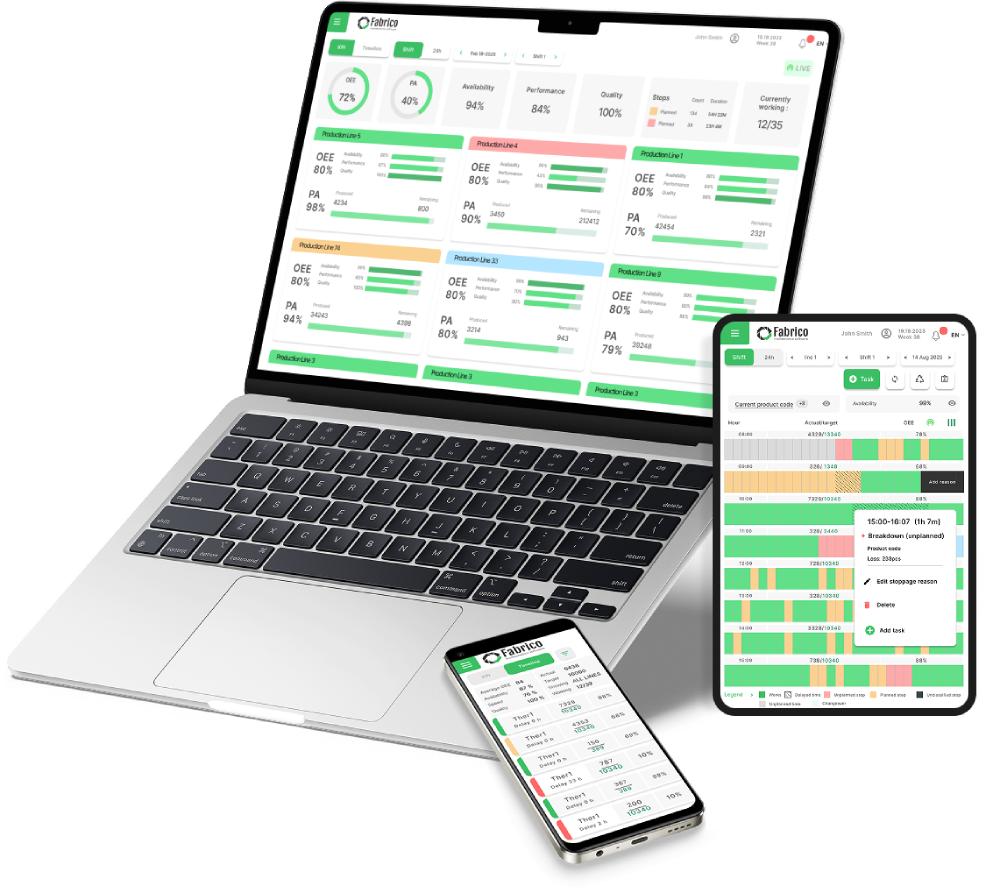
Fabrico is the only platform built to natively unify Native OEE pulses with a Field-Ready CMMS through usage-based triggers.
Why it wins for high-speed lines:
Fabrico treats OEE cycles as the primary driver of maintenance priority. By pulling real-time PLC signals, it counts every stroke or rotation and cross-references it with the Inefficiencies Zoom-In (Computer Vision) module.
If a machine’s performance drifts, the system doesn't just send an alert; it triggers a prioritized Work Order on Tom’s mobile device. This ensures maintenance effort is always focused on the Value Fulcrum, reclaiming the Hidden Factory revenue lost to unpredicted wear.
2. MachineMetrics
MachineMetrics is a robust IoT platform that excels at pulling deep technical data from machine controls, primarily for CNC and discrete manufacturing.
The Trade-off:
It provides excellent data science for condition monitoring, but it often lacks a native, mobile-first maintenance execution engine. For Paula (the Strategic Leader), the lack of a native loop means Mike still faces Decision Latency as data from MachineMetrics must be manually pushed into a separate CMMS to assign a task.
3. eMaint (by Fluke Reliability)
eMaint is a highly customizable EAM/CMMS that integrates natively with Fluke’s hardware sensors for vibration and heat monitoring.
The Trade-off:
eMaint is a "System of Record" that excels at tracking technical anomalies. However, it often lacks the native, high-frequency PLC integration required to correlate those anomalies with OEE cycle speeds in real-time. This creates a data silo between "how the machine feels" and "how the machine produces."
4. Fiix (by Rockwell Automation)
Fiix is a robust, enterprise-grade CMMS that has increasingly leveraged Rockwell’s automation ecosystem to provide asset health monitoring.
The Trade-off:
Fiix is a heavyweight tool designed for large-scale procurement and financial auditing. The implementation is often slow (6-12 months), and the user interface can be too complex for Tom on the floor. Its CBM triggers are often "Manual-in-the-Loop," slowing down the response to high-speed failures.
5. UpKeep
UpKeep is a mobile-first CMMS known for its user-friendly interface and simple work order management.
The Trade-off:
UpKeep is designed for facility care and general asset maintenance rather than high-volume production optimization. It lacks the native OEE monitoring and Visual Root Cause Analysis required to capture the micro-stops that drive performance-based triggers in a heavy manufacturing plant.
Comparison Matrix: OEE-Linked CBM Capabilities
| Capability |
Fabrico (System of Action) |
MachineMetrics |
eMaint |
Fiix |
UpKeep |
| Trigger Source |
Real-Time PLC + CV |
IoT Signal Only |
Hardware Sensor |
Integrated / Slow |
Manual Entry |
| Maintenance Link |
Native CMMS |
Siled / API |
Native EAM |
Integrated / Heavy |
Manual / Basic |
| Usage Logic |
Actual OEE Cycles |
Runtime Hours |
Threshold Alerts |
Schedule-Based |
Calendar-Based |
| Visual RCA |
Advanced (Zoom-In) |
Data-Only |
None |
None |
Photo-Only |
| Mobile UX |
Native Offline App |
Browser-Based |
Complex |
Low (Desktop) |
High (Task) |
| Implementation |
3-4 Months |
4-6 Months |
6-12 Months |
12+ Months |
1-2 Months |
The Strategic ROI: Lowering Maintenance Cost per Unit
For Paula, the business case for OEE-driven CBM is built on "MRO Optimization."
By eliminating 20% of unnecessary "calendar PMs," you reclaim the technical labor required to fix the "Bad Actors" that are actually hurting your OEE score. This shift directly lowers the Maintenance Cost per Unit and ensures your global fleet reaches its full residual value.
As you build 12 months of clean usage data, you are preparing the facility for the Fabrico Agent (AI Roadmap) to automate these reliability cycles.
Stop maintaining the calendar. Start engineering uptime with a System of Action.


 Login
Login
 Blog
Blog