What is Condition-Directed (CD) Reliability?
Condition-Directed Reliability is a maintenance strategy where technical interventions are triggered by real-time equipment data, such as cycle counts, speed deviations, or quality drifts, rather than fixed time intervals.
For Mike (the Tactical Manager), this is the end of the "Sunday Night Call-In." Instead of waiting for a motor to seize on the night shift, the integrated OEE and CMMS identifies that the machine has hit a specific wear threshold and dispatches Tom (the Technician) during a planned changeover.
1. Fabrico: The Integrated System of Action
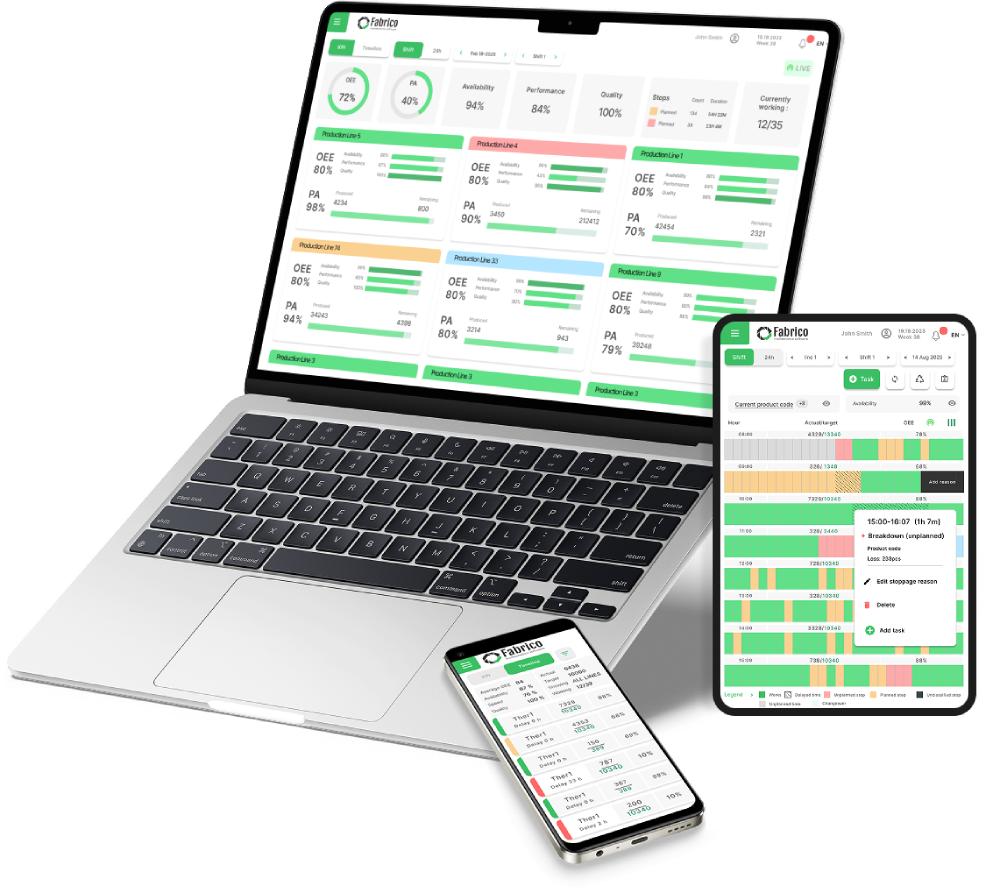
Fabrico is the only platform built to natively unify Native OEE pulses with automated Condition-Directed Tasks in a Field-Ready CMMS.
Why it wins for high-speed lines:
Fabrico treats production cycles as the primary driver of reliability. By pulling real-time signals via PLC or IoT, it counts every stroke, rotation, or bottle filled with absolute precision.
Because it is a System of Action, the system doesn't just "notify" a manager when a performance threshold is hit; it natively triggers a prioritized Work Order on Tom’s mobile device. This ensures your team is always focused on the Value Fulcrum—the machines that actually drive your revenue.
2. MachineMetrics
MachineMetrics excels at deep IoT machine connectivity and technical data analysis, particularly for the CNC and discrete manufacturing sectors.
The Trade-off:
They offer world-class data science for identifying tool wear. However, their reliability triggers often remain in an "Analytics Silo." For Paula (the Strategic Leader), the lack of a native, mobile-first maintenance execution layer means she still faces an "Action Gap" where insights must be manually pushed into a separate CMMS to drive a fix.
3. Augury (Machine Health)
Augury is a leader in machine health, using high-end vibration and acoustic sensors to identify failures before they occur.
The Trade-off:
Augury provides exceptional "Early Warning" signals, but it is primarily a "System of Intelligence." It lacks the native Field-Ready CMMS and Interactive Planning Board required to manage daily maintenance execution, spare parts inventory, and production scheduling in one place.
4. Fiix (by Rockwell Automation)
Fiix is a robust, enterprise-grade CMMS that has increasingly leveraged Rockwell’s automation ecosystem to provide asset health monitoring.
The Trade-off:
Fiix is a heavyweight "System of Record" designed for large-scale procurement. While it supports meter-based triggers, the implementation is often slow (6-12 months). In high-speed FMCG or Plastics, the complexity of the interface can lead to lower shop-floor adoption compared to more agile, field-ready systems.
5. Tractian
Tractian is an emerging player in the reliability space, offering plug-and-play sensors that provide real-time vibration and temperature data.
The Trade-off:
While Tractian is excellent for standalone equipment monitoring, it often lacks the deep OEE performance context found in a unified system. For Mike, this means he can see that a motor is hot, but he can't automatically see how that heat is impacting his quality rejects or shift Takt time.
Comparison Matrix: Condition-Directed Reliability Capabilities
| Feature |
Fabrico |
MachineMetrics |
Augury |
Fiix (Rockwell) |
Tractian |
| Primary Goal |
System of Action |
Data Analytics |
Machine Health |
Asset Record |
Monitoring |
| OEE Native Link |
Native / Built-in |
High / Native |
None |
Integrated / API |
None |
| Trigger Logic |
Performance + Usage |
Tool Wear |
Acoustic / Vib |
Meter-Based |
Threshold Alerts |
| Visual RCA |
Advanced (Video) |
Data-Only |
None |
None |
None |
| Technician UX |
Native Offline App |
Browser-Based |
Tablet-First |
Complex |
High (Mobile) |
| Implementation |
3-4 Months |
4-6 Months |
6+ Months |
6-12 Months |
1-2 Months |
The Strategic ROI: Lowering Maintenance Cost per Unit
For Paula (the Strategic Leader), the business case for condition-directed reliability is built on the stabilization of her Value Fulcrum.
By moving to Condition-Directed Tasks, you eliminate the 20% of technical labor typically wasted on healthy machines. This reclaimed "Wrench Time" allows your team to fix the "Bad Actor" assets that drive 80% of your downtime.
This shift directly reduces the Maintenance Cost per Unit and ensures your multi-million dollar capital assets reach their full residual value without being "run to failure."
Stop maintaining the calendar. Start engineering uptime with a System of Action.


 Login
Login
 Blog
Blog