What is cross-site spare parts sharing in OEE software?
Cross-site spare parts sharing is an enterprise manufacturing feature that provides real-time visibility into MRO (Maintenance, Repair, and Operations) inventory across all global facilities, allowing maintenance teams to place internal orders from other sites to resolve "Availability" losses faster than traditional OEM lead times.
For Paula (the Strategic Leader), this feature is a "Risk Mitigation" tool.
Instead of paying $5,000 in emergency air-freight, she uses Fabrico to facilitate an internal transfer, ensuring that a "Bad Actor" asset in one plant is fixed using "Dead Capital" from another.
Fabrico eliminates this friction by natively merging Native OEE usage data with a Group-First CMMS inventory engine.
1. Fabrico: The Integrated System of Action
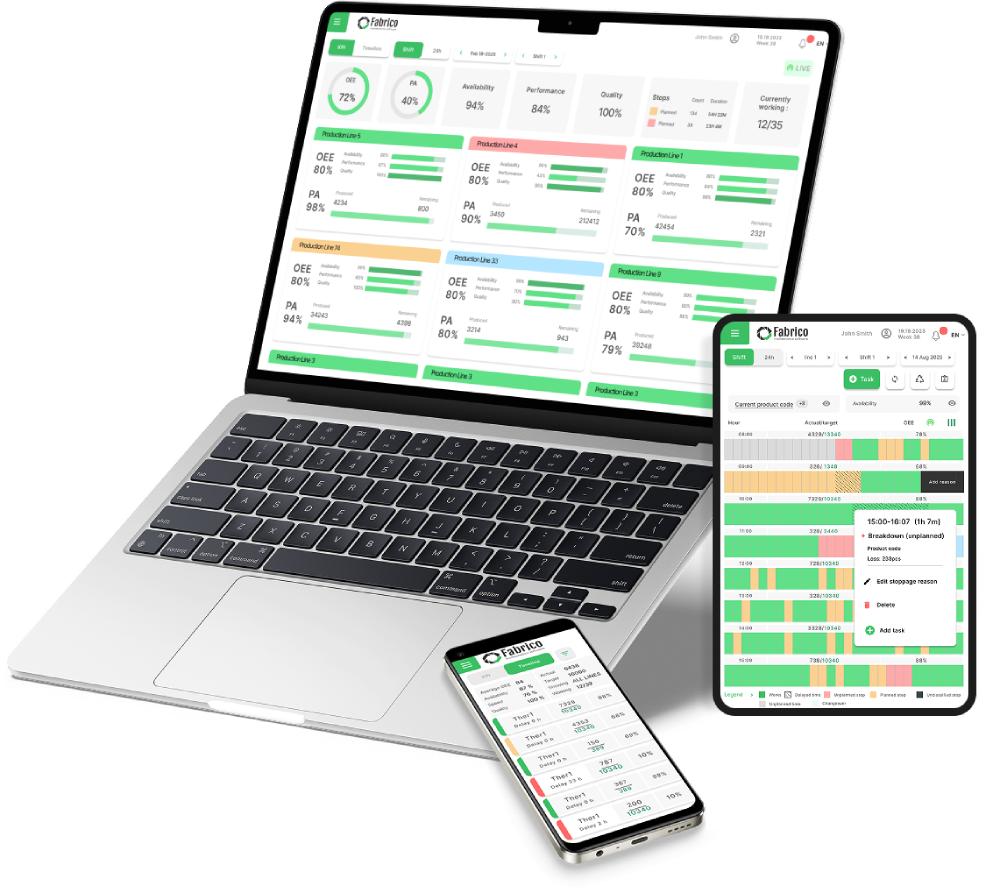
Fabrico is the only platform built from the ground up to natively unify real-time Native OEE with a Group-First Architecture for spare parts sharing.
Why it wins for multi-site groups:
Fabrico treats your global inventory as a "Virtual Warehouse." When Tom (the Technician) scans a machine’s QR Code and identifies a failure, the system doesn't just check the local bin; it checks the entire enterprise.
Because it is a System of Action, technicians can place internal orders directly from their mobile devices. This ensures that maintenance effort is always applied to the Value Fulcrum, reclaiming the Hidden Factory revenue that typically disappears while waiting for external vendors.
2. Fiix (by Rockwell Automation)
Fiix is a robust, cloud-based CMMS that offers sophisticated multi-site inventory management and standardized asset hierarchies.
The Trade-off:
While Fiix excels at "Maintenance-First" organization, its OEE pulse is often provided via third-party APIs. For high-speed FMCG or Plastics, this creates "Information Latency." The inventory team sees what is in stock, but they don't natively see how the real-time cycle speed of a machine in another country should be impacting the reorder trigger.
3. IBM Maximo
IBM Maximo is the infrastructure giant of the asset management world, designed for massive enterprises with complex procurement and financial auditing requirements.
The Trade-off:
Maximo is a classic "System of Record." It is excellent for tracking capital depreciation and large-scale MRO budgets, but it is notoriously "OEE-blind." The implementation is notoriously slow (12-24 months), and the interface is often too complex for Tom to use for a quick "Point-of-Work" parts transfer.
4. eMaint (by Fluke Reliability)
eMaint is a highly customizable EAM/CMMS that excels at tracking large volumes of parts across complex industrial environments.
The Trade-off:
Customization often leads to a high "Complexity Tax." Many enterprise users find that eMaint requires significant IT resources to maintain and lacks the "Field-Ready" simplicity of a native offline mobile app. It functions well as a financial database but often falls short as a real-time diagnostic engine for OEE-driven uptime.
5. MaintainX
MaintainX is widely praised for its intuitive mobile interface and chat-heavy workflow that simplifies team communication on the floor.
The Trade-off:
MaintainX is a "Communication-First" tool. While it makes asking for a part from another site simple through chat, it lacks the deep Unified Data Intelligence and high-frequency PLC integration required to predict when those parts will be needed based on actual machine cycles and Inefficiencies Zoom-In evidence.
Comparison Matrix: Cross-Site Spare Parts & OEE Integration
| Capability |
Fabrico (System of Action) |
Fiix (Rockwell) |
IBM Maximo |
eMaint |
MaintainX |
| Global Inventory Visibility |
Native / Virtual Warehouse |
Multi-Site |
Procurement Only |
Moderate |
Basic / Chat |
| Internal Order Trigger |
Mobile / Automated |
Manual |
Administrative |
Manual |
Chat-Based |
| OEE Native Link |
High / Real-Time |
Siled / API |
None |
None |
Basic / API |
| Decision Latency |
Zero (Instant Sync) |
Moderate |
High |
Moderate |
Moderate |
| Implementation Speed |
3-4 Months |
6-12 Months |
12-24 Months |
6-12 Months |
1-2 Months |
| Strategic Category |
Capacity Reclamation |
Task Management |
Financial Record |
Asset History |
Team Comms |
The Strategic ROI: Turning Dead Capital into Uptime
For Paula, the business case for a cross-site System of Action is built on the stabilization of the Maintenance Cost per Unit.
By moving to a "Virtual Warehouse" model, she can reduce her group-wide MRO safety stock by up to 20% while simultaneously increasing OEE Availability. This reclaimed cash is then reinvested into high-impact optimizations like Computer Vision (Inefficiencies Zoom-In).
As you build 12 months of clean enterprise data, you are preparing your facility for the Fabrico Agent (AI Roadmap) to automate global supply chain optimizations.
Stop managing parts in a silo. Start engineering global uptime with a System of Action.


 Login
Login
 Blog
Blog