What is automated cycle time tracking in OEE software?
Automated cycle time tracking is the digital process of monitoring a production line’s actual operating speed against its engineered "Ideal Cycle Time" using direct PLC signals and Computer Vision to identify Performance Losses in real-time.
For Mike (the Tactical Manager), this is the end of the "Post-Shift Surprise."
Instead of wondering why the target was missed despite zero breakdowns, he uses Fabrico to see the exact millisecond where the process drifted.
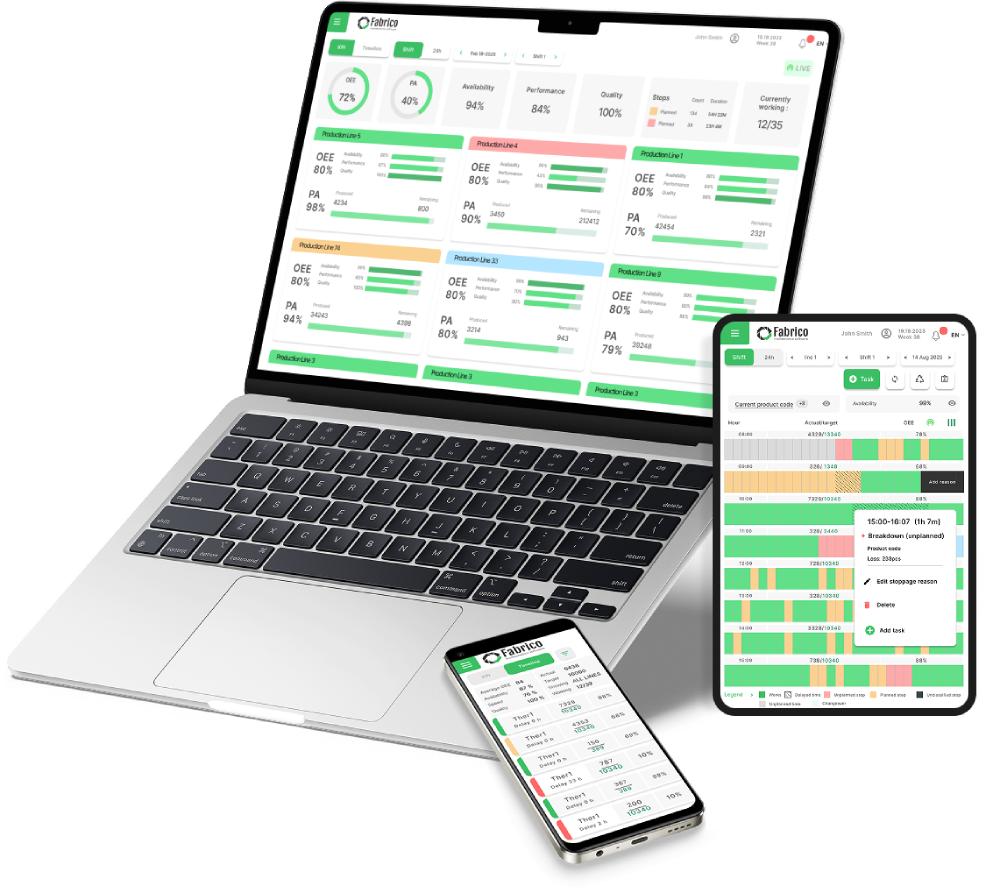
Fabrico act as a System of Action, ensuring that when a cycle slows down, the "Cure" is instantly assigned to a technician's mobile device.
1. Fabrico: The Integrated System of Action
Fabrico is the only platform built to natively unify high-frequency cycle tracking with AI-powered visual proof and maintenance execution.
Why it wins for high-speed lines:
Fabrico utilizes the "Visibility Trifecta" to capture 100% of cycle truth. It pulls direct signals from the PLC and uses the Inefficiencies Zoom-In (Computer Vision) module to "see" why the line stuttered.
Because it is a System of Action, identifying a cycle slowdown natively triggers a prioritized task in the Field-Ready CMMS. This ensures Tom (the Technician) fixes the root cause—such as a slipping belt or misaligned guide rail—reclaiming the Hidden Factory revenue before the shift ends.
2. MachineMetrics
MachineMetrics excels at deep IoT machine connectivity and high-frequency data analysis, particularly for the CNC and discrete sectors.
The Trade-off:
They are leaders in "Machine Intelligence," pulling deep data from control systems to identify anomalies. However, their cycle time logic often remains in an "Analytics Silo" for process engineers.
For Paula (the Strategic Leader), the lack of a native, mobile-first maintenance loop means her team sees the speed loss in a report but still faces an "Action Gap" in fixing it.
3. Worximity
Worximity focuses on "Smart Factory" connectivity and provides real-time cycle visibility through an intuitive "Tile" interface.
The Trade-off:
Worximity uses sensors to track performance in real-time, but it functions primarily as a scoreboard. It lacks the deep engineering asset history and native MRO Inventory Management needed for a full reliability strategy.
It identifies that your machine is running slow, but it doesn't manage the technical "How" of the mechanical repair.
4. Matics
Matics is an agile, cloud-native production monitoring platform that focuses on real-time OEE visibility and floor-level task management.
The Trade-off:
Matics excels at floor-level communication and has a responsive alerting engine. However, it lacks the advanced Computer Vision layer required to capture the visual root cause of cycle drift automatically.
It relies heavily on manual operator context, which often leads to the "Pencil Whip" trap where micro-stops are mislabeled as "General Performance."
5. Plex (by Rockwell Automation)
Plex is a heavyweight ERP and MES platform that offers a comprehensive view of the entire manufacturing enterprise, including cycle time history.
The Trade-off:
Plex is a "Finance-First" system designed for high-level auditing. The implementation is notoriously long (12–24 months), and the interface is often too complex for technicians on the shop floor.
In high-speed agile environments, the "Complexity Tax" results in high Decision Latency compared to native, field-ready systems.
Comparison Matrix: Cycle Time Tracking Capabilities
| Feature |
Fabrico (System of Action) |
MachineMetrics |
Worximity |
Matics |
Plex (MES) |
| Speed Detection |
Absolute (PLC + Vision) |
High (PLC) |
Sensor-Based |
PLC-Only |
Batch-Processed |
| Response Trigger |
Auto-Work Order |
Alert Only |
Dashboard |
Manual Chat |
Manual Entry |
| Visual Proof (RCA) |
Advanced (Zoom-In) |
Data-Only |
Photo-Only |
Photo-Only |
None |
| Maintenance Link |
Native CMMS |
Siled / API |
Siled / API |
Basic Tasks |
Integrated / ERP |
| Decision Latency |
Zero (Automated) |
Moderate |
Moderate |
Moderate |
High |
| Implementation |
3-4 Months |
4-6 Months |
2-3 Months |
2-3 Months |
12+ Months |
The Strategic ROI: Engineering Peak Throughput
For Paula (the Strategic Leader), the business case for automated cycle tracking is built on "Capacity Reclamation."
Reclaiming just 3% of cycle speed across a global fleet is often more profitable than adding a new production line. By identifying "Bad Actor" assets through real-time data, you move your team to Condition-Directed Tasks that protect your most valuable production time.
As you build 12 months of clean cycle data, you are preparing the facility for the future of autonomous optimizations via the Fabrico Agent (AI Roadmap).
Stop watching your machines run slow. Start engineering peak speed with a System of Action.


 Login
Login
 Blog
Blog