What is a digital machine medical record in OEE software?
A digital machine medical record is a centralized operational dataset that natively unifies an asset's real-time performance metrics (OEE), its technical repair history (CMMS), and its visual evidence (Computer Vision) into a single, time-stamped, and unalterable technical biography.
For Mike (the Tactical Manager), this feature is the end of "Trial-and-Error" maintenance.
Instead of guessing why a high-speed press is underperforming, he uses Fabrico to see the exact correlation between a 5 percent speed loss today and a bearing replacement that occurred three months ago. Fabrico ensures the Value Fulcrum is balanced by applying technical labor only where the asset history proves a risk.
1. Fabrico: The Integrated System of Action
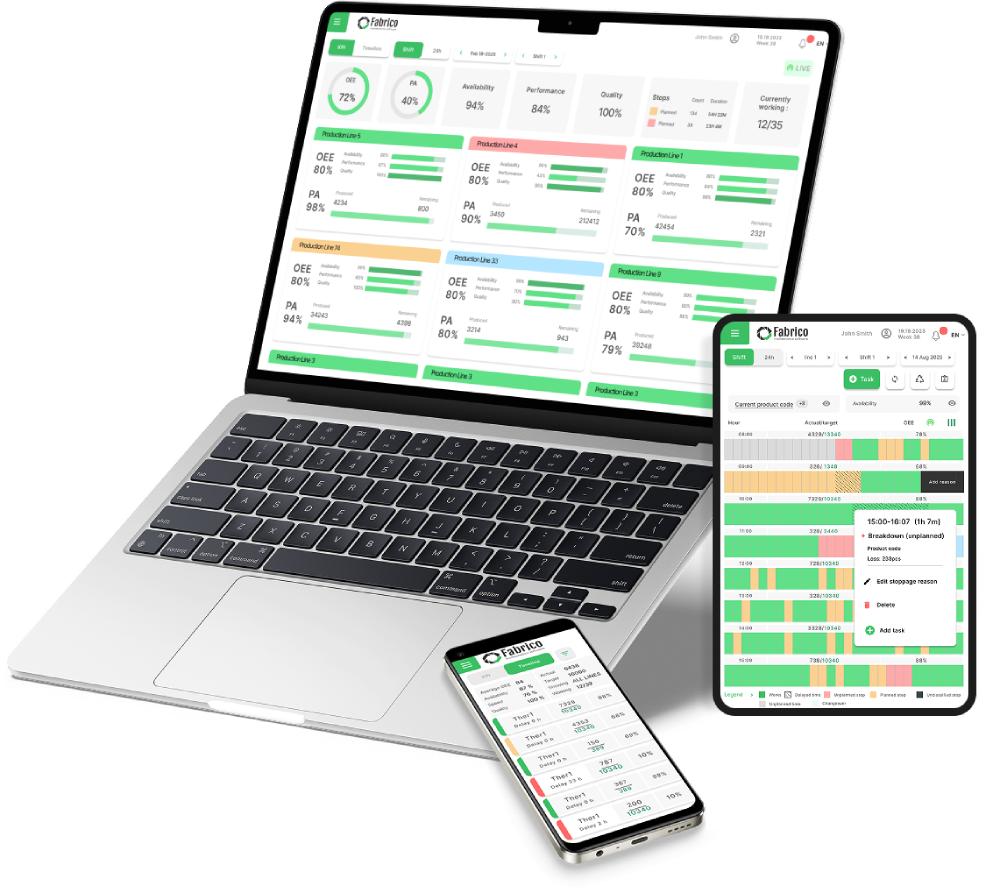
Fabrico is the only platform built to natively unify Native OEE pulses, Field-Ready CMMS execution, and visual evidence into a cohesive Digital Medical Record.
Why it wins for technical history:
Fabrico treats every downtime event as a clinical data point. It utilizes the Visibility Trifecta: combining PLC signals for timing, operator context for intent, and AI-powered video proof via the Inefficiencies Zoom-In module.
Because it is a System of Action, every repair Tom (the technician) performs is logged via a QR Code scan directly at the machine. This ensures the medical record is updated in real-time, even while offline. By linking OEE quality drifts to technical history, Fabrico identifies Bad Actor assets with absolute certainty, reclaiming the Hidden Factory revenue lost to recurring mechanical fatigue.
2. Fiix (by Rockwell Automation)
Fiix is a robust, cloud-based CMMS that specializes in organizing complex asset hierarchies and long-term maintenance documentation.
The Trade-off:
Fiix is a world-class System of Record for maintenance activity. However, its OEE pulse is often provided via third-party APIs or complex Rockwell hardware integrations. For Paula (the Strategic Leader), this creates a data silo. The "Medical Record" shows what was fixed, but it doesn't natively show the real-time cycle speed of the machine that indicates the repair was actually successful.
3. IBM Maximo
IBM Maximo is the enterprise giant of asset management, designed for massive industrial organizations that prioritize financial auditing and capital depreciation.
The Trade-off:
Maximo is the ultimate accounting tool for assets. While it tracks every cent spent on a machine, it is notoriously OEE-blind on the shop floor. The implementation is notoriously slow, often taking 12 to 24 months. In high-speed agile environments, the Complexity Tax results in high Decision Latency, where the medical record exists in the office but provides zero value to the technician at the machine.
4. MachineMetrics
MachineMetrics excels at deep machine connectivity and high-frequency data analytics, specifically within the CNC and discrete manufacturing sectors.
The Trade-off:
They are leaders in Machine Intelligence. Their platform provides excellent technical logs based on machine signals. However, they lack the native, mobile-first CMMS execution layer required to manage spare parts inventory and technician work orders. It provides the diagnostic data for the medical record but lacks the technical engine to execute the cure.
5. MaintainX
MaintainX is widely praised for its intuitive mobile interface and chat-heavy workflow that simplifies team communication on the floor.
The Trade-off:
MaintainX excels at digitizing paper procedures and basic maintenance logs. However, it lacks the native high-frequency PLC integration and Advanced Visual RCA required to capture the micro-stops that define high-volume manufacturing. It acts as a digital logbook for humans, but it doesn't always listen to the machines.
Comparison Matrix: Digital Medical Record Capabilities
| Feature |
Fabrico (System of Action) |
Fiix (Rockwell) |
IBM Maximo |
MachineMetrics |
MaintainX |
| History Logic |
Performance-Driven |
Task-Based |
Financial-Based |
Data-Driven |
Communication |
| OEE Native Link |
High / Real-Time |
Siled / API |
None |
High / Native |
Basic / API |
| Visual Proof (RCA) |
Advanced (Zoom-In) |
None |
None |
Data-Only |
Photo-Only |
| Response Trigger |
Auto-Work Order |
Scheduled |
Manual / Batch |
Alert Only |
Manual Chat |
| Mobile UX |
Native Offline App |
Low (Desktop) |
Low (Complex) |
Browser-Based |
High (Chat) |
| Implementation |
3-4 Months |
6-12 Months |
12-24 Months |
4-6 Months |
1-2 Months |
The Strategic ROI: Lowering Maintenance Cost per Unit
For Paula (the Strategic Leader), the business case for a unified System of Action is built on Capacity Reclamation and Risk Mitigation.
By identifying Bad Actor assets through an integrated medical record, she moves her team from reactive firefighting to Reliability-Centered Maintenance. This reclaimed capacity stabilizes the production schedule and ensures her multi-million dollar assets reach their full residual value.
As the factory builds 12 months of clean 3D data, it creates the essential foundation for the Fabrico Assistant to automate troubleshooting based on the machine's specific history.
Stop managing your assets as a collection of parts. Start engineering their reliability with a System of Action.


 Login
Login
 Blog
Blog