Electronics manufacturing is the Formula 1 of the industrial world.
An SMT line is a blur of robotic arms moving at speeds the human eye can barely track.
But this speed comes with a cost: Fragility.
A single mis-picked resistor, a clogged vacuum nozzle, or a feeder reel that jams can stop the entire multi-million dollar line instantly.
In this environment, standard OEE tools fail. They see the "Stop," but they don't understand the "Why." They don't track the health of the 200+ feeders attached to the machine.
To master Electronics OEE, you need software that understands the connection between Machine Performance and Component Feeder Health.
Here are the 5 best OEE software tools for the high-tech world of PCB Assembly.
1. Fabrico (Best for Feeder Maintenance & Nozzle Health)
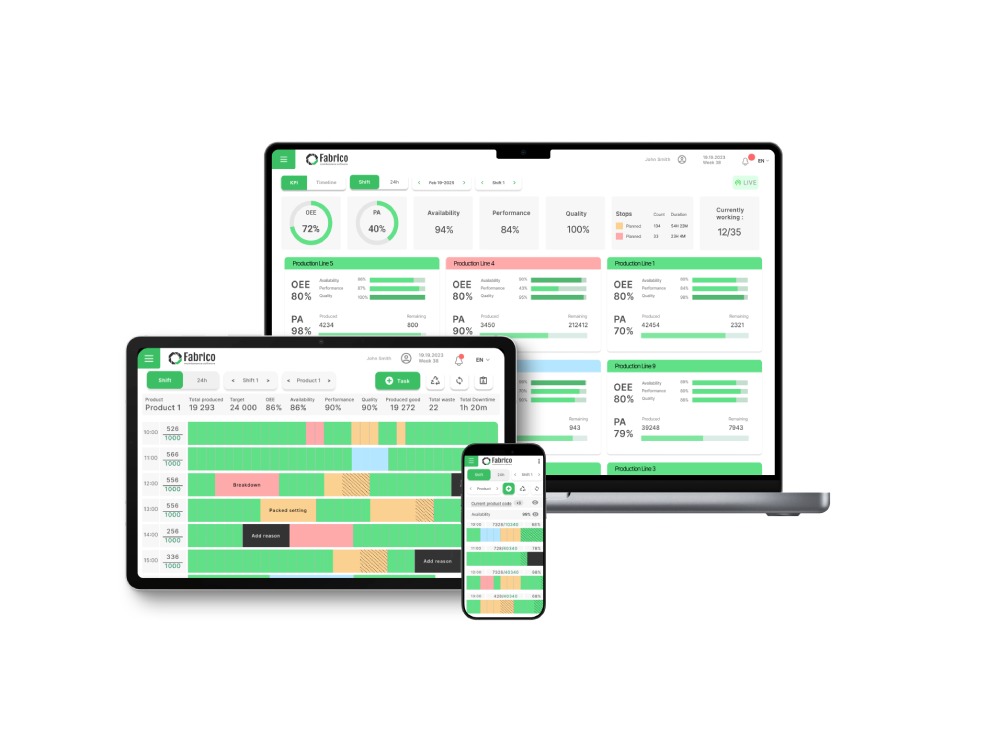
Fabrico brings a fresh perspective to the SMT floor: Preventive Maintenance for the Peripherals.
Most OEE tools blame the "Pick & Place Machine." Fabrico recognizes that the machine is usually fine—it’s the feeder or the nozzle that failed.
Fabrico integrates OEE tracking with a robust Maintenance Management system.
Key Features for Electronics:
-
Feeder Maintenance Tracking: Tracks the cycle count of individual feeders. It triggers maintenance (cleaning/calibration) before the feeder jams and stops the line.
-
Reflow Oven Profiling: Schedules and logs strict thermal profile checks (profiling) required for quality compliance.
-
Micro-Stop Analysis: Uses Computer Vision to identify if a specific head is consistently dropping parts (high scrap rate).
-
ESD Compliance: Digital checklists for ESD (Electrostatic Discharge) audits on the floor, linked to the daily operator rounds.
Best For: SMT Managers who want to stop "Feeder Jams" from killing their line utilization.
2. Siemens (Valor IoT) (Best for Deep SMT Integration)
Valor (now part of Siemens) is the industry standard for SMT data.
It speaks the native language of almost every SMT machine (Panasonic, Fuji, ASM, Juki).
Its ability to "normalize" data is unmatched. It can take the complex error codes from a Fuji machine and a Panasonic machine and present them in a single, unified dashboard.
It also excels at Material Verification—ensuring the right reel is loaded into the right slot to prevent devastating setup errors.
However, it is extremely expensive and complex. It is designed for massive Tier 1 EMS (Electronic Manufacturing Services) providers.
Best For: Large-scale EMS providers with mixed-vendor SMT lines.
3. Cogiscan (Best for Connectivity & Traceability)
Cogiscan is the "Universal Translator" of the electronics industry.
Their TTC (Track, Trace, Control) middleware is legendary.
If your primary OEE loss comes from Setup Time (searching for materials, validating reels), Cogiscan is the solution. They focus heavily on the material flow around the machine to ensure the machine never waits for parts.
Their OEE module is accurate because it relies on deep connectivity, but their focus is more on "Material Control" than "Mechanical Maintenance."
Best For: Factories where Material Management is the biggest bottleneck to OEE.
4. Critical Manufacturing (Best for High-Complexity MES)
Critical Manufacturing is a modern MES built specifically for high-tech industries (Semiconductor, Electronics, Medical).
It handles complex, non-linear routings incredibly well (e.g., a board that needs to go through SMT, then Manual Insert, then Wave Solder, then Conformal Coating).
Their OEE is integrated into a complete "Factory Digital Twin." It is visually stunning and highly futuristic, supporting Augmented Reality (AR) views of the shop floor.
Best For: High-Mix / Low-Volume environments with complex process flows.
5. ITAC (Best for Backend Assembly & Box Build)
ITAC (owned by Dürr) is another heavy hitter in the MES space.
While they handle SMT well, they are particularly strong in the "Backend" processes—Depaneling, Testing (ICT/FCT), and Final Box Build.
OEE in the backend is harder to measure because it involves more manual labor and semi-automated testing stations. ITAC captures this data well.
It is a rigid, enterprise-grade system often found in automotive electronics plants.
Best For: Automotive Electronics manufacturers (IATF compliance).
Comparison: The High-Speed Line
Which tool keeps the pick-and-place running?
| Feature |
Fabrico |
Siemens (Valor) |
Cogiscan |
Critical Mfg |
| Primary Strength |
Feeder/Asset Health (Maintenance) |
Machine Data (Standardization) |
Material Flow (Traceability) |
Complex Flow (MES) |
| Feeder Maintenance |
Native (Cycle Counts) |
Limited |
Limited |
Module |
| Setup Verification |
Digital SOPs |
Native (Lockout) |
Native (Lockout) |
Module |
| Micro-Stop Capture |
Video Replay |
Machine Codes |
Machine Codes |
Data Only |
| Cost |
Subscription (SaaS) |
Very High |
High |
High |
Conclusion: Protect the Nozzle
In electronics, OEE is a game of millimeters.
If you need to control the material (make sure the reel is correct), Cogiscan or Valor are excellent choices.
But if you need to control the asset (make sure the feeder doesn't jam and the nozzle is clean), Fabrico offers the missing link.
By connecting your OEE scores directly to a maintenance workflow, Fabrico ensures that your high-speed machines stay tuned, calibrated, and running at full IPC class speeds.
Ready to reduce feeder jams?
See how Fabrico uses cycle counts to optimize SMT maintenance.
Book a Demo with Fabrico Today


 Login
Login
 Blog
Blog