What is "Fault-to-Fix" automation in OEE software?
Fault-to-Fix automation is a digital manufacturing framework where real-time machine performance data (OEE) natively triggers prioritized maintenance workflows (CMMS) without manual intervention, ensuring that production losses are addressed by technicians in seconds rather than hours.
For Mike (the Tactical Manager), this feature is a "MTTR Multiplier."
Instead of waiting for a radio call, his team receives a smart notification the second a high-speed line drifts from its Takt time. Fabrico eliminates "Investigation Waste" by ensuring the Value Fulcrum is always centered on the machines driving the most revenue.
1. Fabrico: The Integrated System of Action
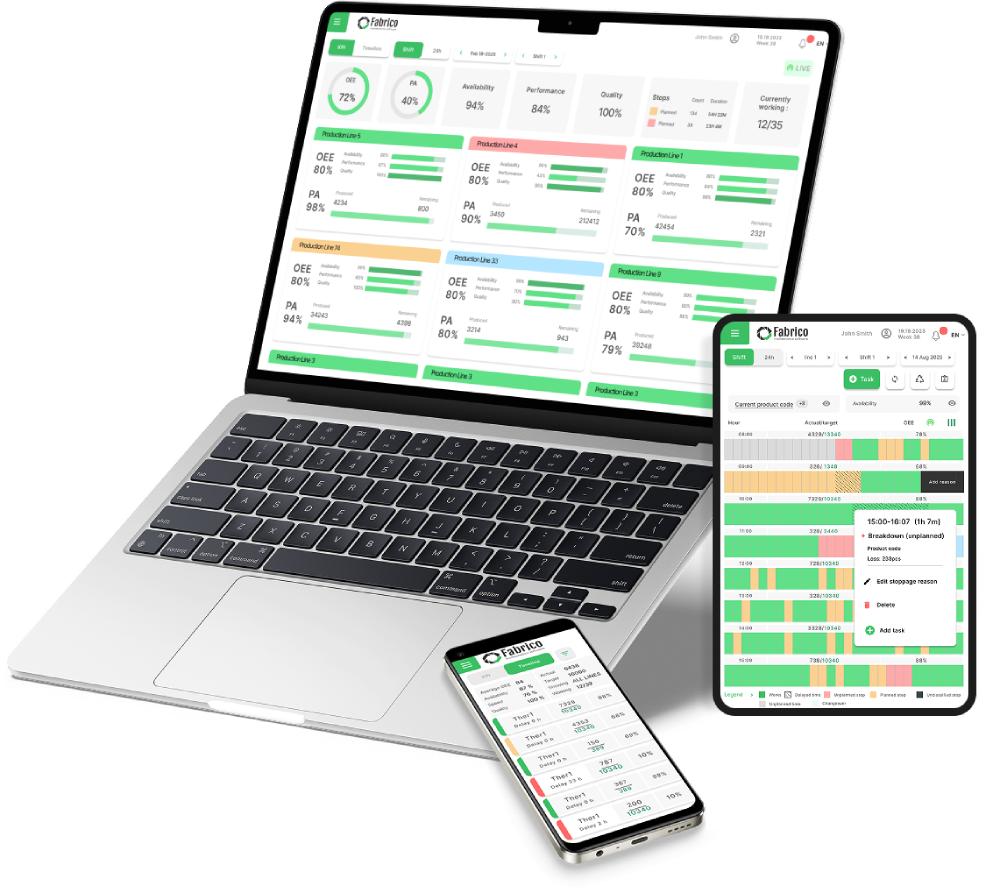
Fabrico is the only platform built from the ground up to natively unify Native OEE pulses, Field-Ready CMMS execution, and AI-powered visual proof.
Why it wins for automation:
Fabrico treats every "Six Big Loss" event as a maintenance trigger. It utilizes the Visibility Trifecta—combining PLC signals, operator context, and the Inefficiencies Zoom-In (Computer Vision) module. When a line slows down, the system flags a video clip of the failure and attaches it to a prioritized Work Order.
Because it is a System of Action, Tom (the Technician) receives the "Cure" on his mobile device instantly. He scans the machine's QR Code, views the visual replay, and accesses digital SOPs even while offline. This ensures your Maintenance Cost per Unit is optimized by fixing the root cause before the shift ends.
2. MachineMetrics
MachineMetrics is a robust industrial IoT platform known for its deep machine connectivity and advanced data science, particularly in CNC and discrete manufacturing.
The Trade-off:
They are leaders in "Machine Intelligence," pulling high-frequency signal data to predict failures. However, they function primarily as a "System of Intelligence" for analysts. For Paula (the Strategic Leader), the lack of a native, mobile-first maintenance execution loop means her team still faces an "Action Gap" between the data alert and the physical repair.
3. Fiix (by Rockwell Automation)
Fiix is a robust, enterprise-grade CMMS that has increasingly leveraged the Rockwell automation ecosystem to provide asset performance insights.
The Trade-off:
Fiix is a heavyweight "System of Record" designed for large-scale procurement and auditing. While it has integrated production signals, the implementation is often slow (6–12 months) and the interface is complex for technicians. In high-speed agile environments, the "Complexity Tax" results in high Decision Latency compared to field-ready tools.
4. MaintainX
MaintainX is widely recognized for its intuitive, chat-heavy mobile interface that makes team communication and simple checklists accessible for frontline teams.
The Trade-off:
It is a "Communication-First" tool. While it excels at digitizing paper work orders, it lacks the native high-frequency PLC integration and Advanced Visual RCA (Computer Vision) required for high-volume manufacturing. It helps people talk, but it doesn't help the machines talk to the people.
5. Worximity
Worximity focuses on "Smart Factory" connectivity and provides real-time OEE visibility through an intuitive dashboard.
The Trade-off:
Worximity excels at real-time visibility and has an easy-to-use interface for managers. However, it lacks the deep engineering asset data and MRO Inventory Management modules required to complete the "Fault-to-Fix" loop. It identifies the revenue leak but doesn't manage the technical labor or parts required to plug it.
Comparison Matrix: OEE "Fault-to-Fix" Capabilities
| Feature |
Fabrico (System of Action) |
MachineMetrics |
Fiix (Rockwell) |
MaintainX |
Worximity |
| Response Trigger |
Native / Automated |
Alert Only |
Scheduled |
Manual |
Alert Only |
| Maintenance Link |
Native CMMS |
Siled / API |
Integrated / Heavy |
Native CMMS |
Siled / API |
| Visual Proof (RCA) |
Advanced (Zoom-In) |
Data-Only |
None |
Photo-Only |
None |
| Offline Capability |
High (Local Cache) |
Low |
Low |
High |
Low |
| Decision Latency |
Zero (Automated) |
Moderate |
High |
Moderate |
Moderate |
| Implementation |
3-4 Months |
4-6 Months |
6-12 Months |
1-2 Months |
2-3 Months |
The Strategic ROI: Engineering Uptime as a Profit Center
For Paula (the Strategic Leader), the business case for "Fault-to-Fix" automation is built on Capacity Reclamation.
Reclaiming just 5% of your availability by reducing MTTR (Mean Time to Repair) through integrated action is often more profitable than purchasing a new production line. By identifying "Bad Actor" assets and automating the technical response, you move your team from reactive "firefighting" to Reliability-Centered Maintenance (RCM).
This shift ensures your multi-million dollar assets reach their full residual value and your factory operates at the Value Fulcrum—where maintenance effort equals maximum revenue.
Stop managing your data in silos. Start engineering uptime with a System of Action.


 Login
Login
 Blog
Blog