Managing a Job Shop (High-Mix / Low-Volume) is the hardest game in manufacturing.
In a car plant, the line runs the same speed all day. In a Job Shop, every day is different.
You might be cutting Inconel for aerospace in the morning and welding aluminum for a boat in the afternoon.
OEE (Overall Equipment Effectiveness) in a Job Shop is often misunderstood.
It isn't about running the spindle 100% of the time (which would just build inventory you haven't sold).
It is about Schedule Adherence and Quote Accuracy.
Standard OEE tools fail here because they lack the "Job Context." They tell you the machine stopped, but they don't know it stopped because the operator was legally reading the blueprint for a complex new part.
Here are the 6 best OEE and Shop Floor Control tools specifically suited for the agile world of Job Shops.
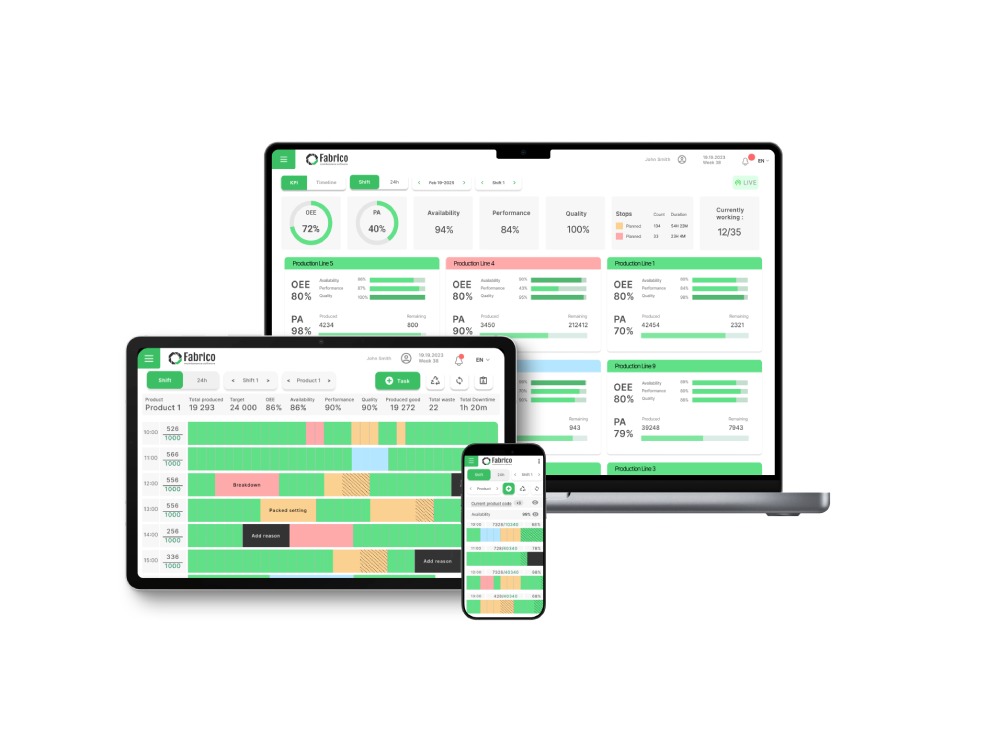
1. Fabrico (Best for Asset Reliability & Changeover Agility)
Fabrico understands that in a Job Shop, Agility is your only competitive advantage.
You win business because you can pivot fast. But pivoting requires reliable machines and fast setups.
Fabrico helps you attack the two biggest killers of Job Shop margins:
Unplanned Downtime (breaking a promise to a customer) and Slow Changeovers (eating into profit).
Key Features for Job Shops:
-
Digital Setup Sheets: Operators access digital photos and videos of the setup (clamping, tooling) on tablets. This reduces the "figure it out" time for repeat jobs.
-
Machine Reliability: Links OEE to Maintenance. If your primary 5-axis mill goes down, you can't just move the job to another machine. Fabrico ensures critical assets are maintained to prevent missed deliveries.
-
Job-Context OEE: Operators tag downtime reasons specific to the job (e.g., "Waiting for First Article Inspection"), differentiating between "Waste" and "Necessary Process."
-
Mobile-First: Rugged, simple app that doesn't slow down the operator who is running three machines at once.
Best For: Shops that need to maximize the availability and agility of their critical assets.
2. ProShop (Best for The "All-In-One" Shop Ecosystem)
ProShop calls itself a "Digital Manufacturing Ecosystem" (DME), rejecting the label of ERP.
It was built by machine shop owners, and it shows.
It combines ERP, MES, and QMS (Quality) into one deep system.
Its OEE tracking is tied intimately to the Part Number. It tracks tool lists, fixture photos, and G-Code programs. It calculates efficiency based on "Earned Hours" vs. "Actual Hours."
It is feature-rich but can be overwhelming (too many clicks) for very simple operations.
Best For: Precision machine shops (Aerospace/Medical) needing deep documentation.
3. Fulcrum (Best for Modern Workflow & Scheduling)
Fulcrum is the "New School" ERP for job shops.
Unlike clunky legacy systems, Fulcrum is cloud-native and beautiful.
Its "Live Schedule" is its superpower. It uses real-time shop floor data to update the schedule constantly.
If Job A takes longer than expected, Fulcrum automatically pushes Job B and alerts the customer. Its OEE metric is Throughput Velocity. It helps you visualize the flow of jobs through the shop.
Best For: Modern fabrication and machine shops wanting a "Tesla-like" software experience.
4. MachineMetrics (Best for CNC Data Automation)
MachineMetrics connects directly to the CNC control (Fanuc, Haas, Heidenhain).
For a Job Shop, this automates the data collection. No one has to type in "Cycle Count."
It excels at Cycle Time Estimating. It records the actual cycle time of every part. You can feed this data back into your quoting system to bid more accurately next time.
It helps you find the "Hidden Capacity" in your existing machines.
Best For: CNC-heavy job shops focused on cycle time optimization.
5. Amper (Best for Retrofitting Mixed Fleets)
Amper is the easiest way to get OEE data from a "Mixed Fleet."
Job Shops often have a brand new laser sitting next to a 1980s press brake and a manual welding station.
Amper uses clip-on electrical sensors to monitor the current. It works on anything that uses electricity.
It gives you a unified view of "Utilization" across the whole shop in hours, not months. It doesn't give deep error codes, but it gives you the truth about run-time.
Best For: Shops with a mix of old and new equipment (Legacy + Modern).
6. JobBOSS² (Best for Financial Job Costing)
JobBOSS² (formerly JobBOSS / E2) is the "Old Reliable" of the industry.
It is primarily a financial tool.
It tracks OEE in terms of Job Costing. Did we make money on the Smith order?
It relies heavily on manual clock-ins/clock-outs at terminals. It is less about real-time machine optimization and more about ensuring that every hour is billed to a customer.
Best For: Traditional shops where accounting/job costing is the primary driver.
Comparison: The High-Mix Matrix
Which tool fits your mix?
| Feature |
Fabrico |
ProShop |
Fulcrum |
MachineMetrics |
Amper |
JobBOSS² |
| Primary Strength |
Agility & Reliability |
Deep Process (DME) |
Scheduling (Flow) |
CNC Data (Auto) |
Retrofit (Simple) |
Costing (Financial) |
| OEE Focus |
Uptime & Setup |
Earned Hours |
Throughput |
Cycle Time |
Utilization |
Billable Hours |
| Maintenance Link |
Native (CMMS) |
Limited |
Limited |
Limited |
Limited |
None |
| Setup Tools |
Digital SOPs |
Deep Documentation |
Tablet View |
Tablet View |
Downtime Tag |
Paper/Terminal |
| Target Shop |
High-Mix Ops |
Precision Machining |
Modern Fab |
CNC Production |
Mixed Legacy |
Traditional |
Conclusion: Agility is Profit
In a Job Shop, you don't make money by running one part fast. You make money by switching to the next part fast.
If your bottleneck is Quoting Accuracy, tools like MachineMetrics or JobBOSS² give you the data to bid right.
If your bottleneck is Process Documentation, ProShop is the standard.
But if your bottleneck is the Operational Chaos—machines breaking down, setups taking too long, and technicians fighting fires—Fabrico gives you the reliability and agility tools to tame the high-mix environment.
Ready to master the mix?
See how Fabrico digitizes setup sheets and maintenance for job shops.
Book a Demo with Fabrico Today


 Login
Login
 Blog
Blog