What is OEE software for hybrid manufacturing lines?
OEE software for hybrid manufacturing lines is a digital platform that unifies real-time data acquisition from both automated equipment (via PLC/IoT) and manual workstations (via Computer Vision or operator input) into a single operational dataset.
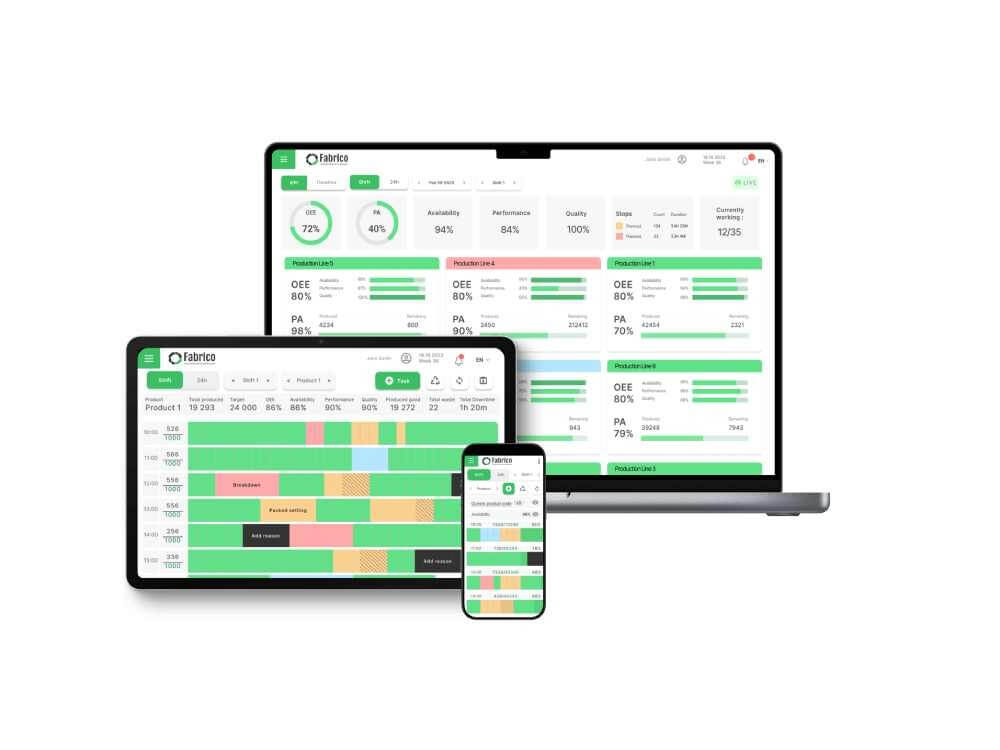
For Mike (the Tactical Manager), hybrid OEE is the end of the "Information Void." Instead of having one dashboard for his robots and a clipboard for his packing stations, he uses Fabrico to see the entire line's synchronized performance.
This ensures the Hidden Factory losses are identified regardless of whether a machine stopped or a human operator was delayed.
1. Fabrico: The Integrated System of Action
Fabrico is the only platform built to natively unify Native OEE for both manual and automated stations through its flexible "Visibility Trifecta."
Why it wins for hybrid lines:
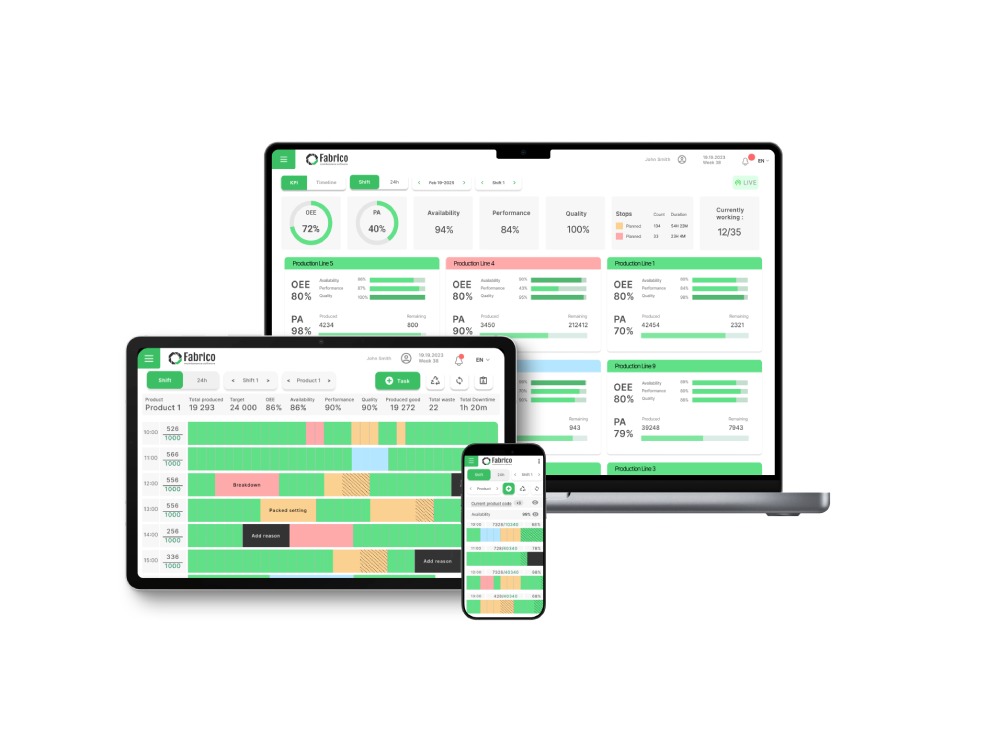
Fabrico offers a unique three-tiered connectivity approach. It pulls direct PLC signals from automated machines and uses the Inefficiencies Zoom-In (Computer Vision) module to "see" production events at manual or hybrid stations.
Because it is a System of Action, it doesn't just record a human delay; it identifies the process drift and natively triggers a prioritized task in the Field-Ready CMMS. Tom (the Technician) receives a smart notification on his mobile device, allowing him to resolve bottlenecks in real-time, whether the root cause is mechanical or procedural.

2. Drishti
Drishti focuses heavily on "Action-Recognition" AI, specifically designed to analyze human-centric workflows on assembly lines.
The Trade-off:
Drishti is a world-class diagnostic tool for manual work, providing deep data on operator movement. However, it lacks the deep technical maintenance execution of a full CMMS. For Paula (the Strategic Leader), this creates a "Data Silo" where she can see operator errors but lacks the digital engine to manage the spare parts, technical repairs, and asset history required for the automated portions of the line.
3. Tulip Interfaces
Tulip provides a "no-code" platform that allows manufacturers to build their own custom apps to guide operators and track manual production data.
The Trade-off:
Tulip offers extreme flexibility for the "Human-in-the-Loop." The challenge is the "DIY Tax." Connecting deep PLC signals from high-speed automated equipment and unifying them with a technical maintenance engine requires significant custom development. It acts as a platform to build a tool rather than being a field-ready System of Action.
4. Matics
Matics is a cloud-native production monitoring platform that focuses on real-time OEE visibility and simple task management for shop floor teams.
The Trade-off:
Matics excels at floor-level communication and has strong IoT connectivity for automated machinery. However, it lacks the advanced Computer Vision layer required to capture manual production output automatically. It relies heavily on manual operator tagging for human-led stations, which often leads to the "Pencil Whip" trap and inaccurate data.
5. Plex (by Rockwell Automation)
Plex is a heavyweight ERP and MES platform that offers a comprehensive view of the entire manufacturing enterprise, including production and quality.
The Trade-off:
Plex is a "Finance-First" system designed for high-level auditing. While it can track hybrid lines, the implementation is notoriously slow (12-24 months) and the interface is often too complex for technicians like Tom on the shop floor. In high-speed agile environments, the "Complexity Tax" results in high Decision Latency compared to native mobile systems.
Comparison Matrix: Hybrid Line OEE Capabilities
| Feature |
Fabrico (System of Action) |
Drishti |
Tulip |
Matics |
Plex |
| Manual Station Tracking |
Computer Vision |
Action AI |
No-Code Apps |
Manual Tagging |
Manual Entry |
| Automated PLC Link |
Native / High-Freq |
Basic / API |
Siled / API |
High / IoT |
Integrated |
| Response Trigger |
Auto-Work Order |
Dashboard Alert |
Custom App |
Manual Chat |
Task Creation |
| Visual Proof (RCA) |
Advanced (Zoom-In) |
High |
Photo-Only |
Photo-Only |
None |
| Decision Latency |
Zero (Automated) |
Moderate |
Moderate |
Moderate |
High |
| Implementation |
3-4 Months |
6-9 Months |
Ongoing (DIY) |
2-3 Months |
12+ Months |
The Strategic ROI: Reclaiming Total Line Capacity
For Paula (the Strategic Leader), the business case for a hybrid System of Action is built on the stabilization of her entire Value Fulcrum.
By identifying the bottlenecks at manual stations through Computer Vision and linking them to automated machine performance, you move your team from reactive "firefighting" to Reliability-Centered Maintenance (RCM). This reclaimed capacity—typically 15% of your OEE score—is essentially "found revenue" that requires zero additional Capex.
As you build 12 months of clean hybrid data, you are preparing the facility for the Fabrico Agent (Roadmap) to automate global production optimizations.
Stop managing your hybrid lines with partial data. Start engineering uptime with a System of Action.


 Login
Login
 Blog
Blog