"The welding cell is running at 60% efficiency. Is the robot slow, or is the loader slow?"
Robotic Cells are black boxes of productivity. They move fast, but they rely entirely on the flow of parts in and out.
Legacy OEE tools (simple counters) fail in robotic cells. They see the robot stop and log a "Down" event. They don't know that the robot was actually ready, but the conveyor downstream was full.
In 2026, Robotic OEE Software is logic-driven. It monitors the Handshake Signals. It tracks the Wait Times. It visualizes the Motion Path.
Here are the 5 best tools to optimize your automation.
The Comparison Matrix (2026)
| Software |
Best For... |
Starve/Block Analysis |
Cycle Time Precision |
Visual Context |
| 1. Fabrico |
Unified (State + Video) |
Native (State Logic) |
High |
Best (Zoom-In) |
| 2. Fanuc ZDT |
Fanuc Health |
Low (Health focus) |
High |
Low |
| 3. MachineMetrics |
Utilization |
Medium |
Best (High Freq) |
Low |
| 4. Sepasoft |
SCADA Integration |
Best (Custom Logic) |
Medium |
Low |
| 5. Drishti |
Cobots / Manual |
Medium |
Medium |
High (Video) |
1. Fabrico: The "Visual-State" Efficiency Platform
Verdict: The best choice for factories with Mixed Robotic Fleets that need to distinguish between Robot Faults and Process Bottlenecks using video.
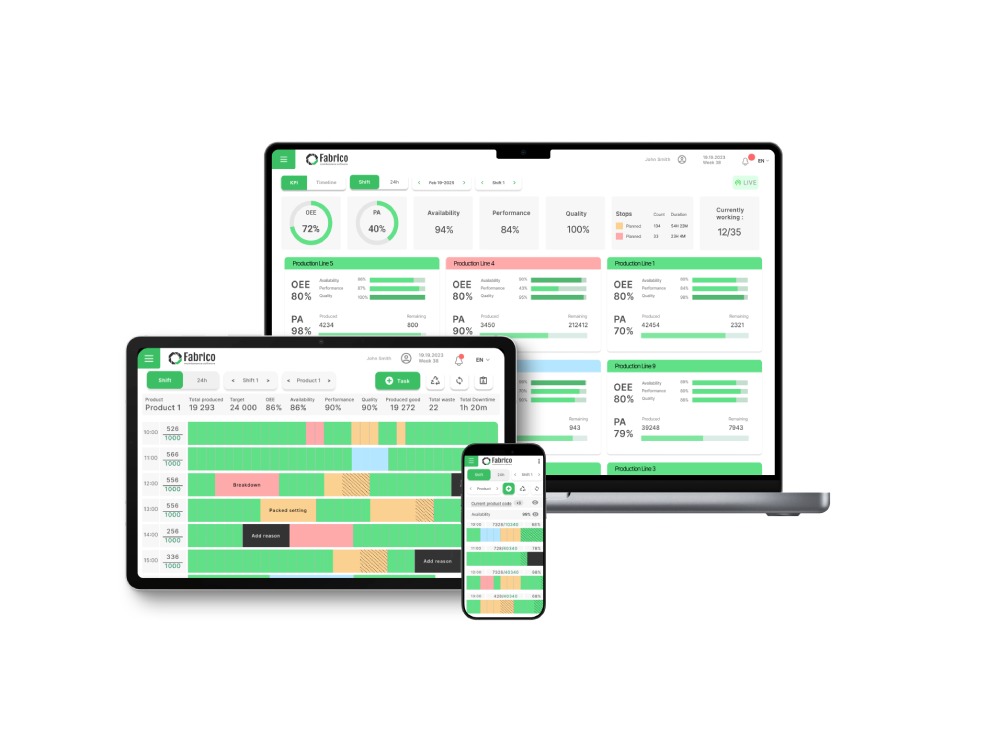
Fabrico connects to the cell controller (PLC) to map the machine states: Running, Faulted, Starved (No Part), and Blocked (Discharge Full).
Why It Wins on Robotic OEE:
-
Visualizing "The Wait": When the robot stops waiting for a part, Fabrico’s Inefficiencies Zoom-In (Video) records the upstream conveyor. You can see why the parts aren't arriving (e.g., a jam 10 feet away), solving the true root cause.
-
State Logic Automation: Fabrico doesn't rely on operators to log "Waiting." It reads the PLC tag. If "Robot Ready" = True AND "Part Present" = False, it automatically categorizes the loss as "Starvation." This cleans up your OEE data instantly.
-
Micro-Stop Analysis: Robots often fail to pick a part and retry (Recovery). This takes 5 seconds. Fabrico detects this "Cycle Time Extension" and flags the gripper for maintenance.
Best For: Packaging, Automotive Welding, and Assembly Cells.
2. Fanuc ZDT (Zero Down Time): The "Health" Monitor
Verdict: The absolute standard for monitoring the Mechanical Health of Fanuc robots.
ZDT is focused on keeping the robot capable of running.
Pros:
Cons:
Best For: Reducing unplanned mechanical downtime on Fanuc units.
3. MachineMetrics: The "Cycle" Scientist
Verdict: Excellent for detecting Cycle Time Variation in precision machining or robotic tending.
MachineMetrics captures high-frequency data to show process stability.
Pros:
-
Cycle Overlays: Overlays the current robot cycle against the "Ideal" cycle. If the robot moves 10% slower (program override), it flags it immediately.
-
Utilization: Simple, clear charts showing exactly how many hours the robot spent cutting vs. loading.
Cons:
Best For: Machine Tending and CNC integration.
4. Sepasoft (Ignition): The "Logic" Builder
Verdict: The best choice if you have a complex line and want to build Custom OEE Logic in Ignition SCADA.
Sepasoft allows you to write scripts that define OEE exactly how you want it.
Pros:
Cons:
Best For: Complex, integrated lines with heavy SCADA infrastructure.
5. Drishti: The "Interaction" Eye
Verdict: Strong for Collaborative Robot (Cobot) cells where humans and robots work together.
Drishti uses AI video to analyze the hand-off between human and machine.
Pros:
-
Bottleneck Identification: Identifies if the robot is waiting on the human, or the human is waiting on the robot.
-
Process Improvement: Helps optimize the physical layout of the cell to reduce motion waste.
Cons:
Best For: Assembly cells with heavy human interaction.
Conclusion: Don't Blame the Robot
The robot is usually waiting on something else.
-
If you have Fanuc, use ZDT for health.
-
If you need Custom SCADA, use Sepasoft.
-
If you need a Unified Platform that visualizes Wait States, tracks Cycle Consistency, and uses Video to find bottlenecks, Fabrico is the 2026 solution.


 Login
Login
 Blog
Blog